
Finding the perfect short curly haircut after 50 isn’t about hiding your natural texture—it’s about celebrating it with cuts that work with your curls, not against them.
Your hair’s natural pattern becomes your greatest asset when you choose styles specifically designed to enhance volume, define ringlets, and minimize styling time.
This comprehensive guide explores 30 texture-loving short curly haircuts for women over 50 that define curls, offering you expert insights into cuts that flatter mature faces, complement changing hair textures, and give you the confidence to embrace your curls fully.
Whether you’re dealing with tighter coils, loose waves, or anything in between, you’ll discover how the right cut can transform your daily routine from frustrating to effortless.
From pixie cuts that maximize curl definition to layered bobs that create beautiful movement, each style has been selected to help you look contemporary, feel beautiful, and spend less time fighting your natural texture.
Get ready to find your signature look among these curl-celebrating cuts that prove age is just a number when you’ve got the right hairstyle.
1. Why Short Curly Haircuts Work Beautifully for Women Over 50

Short curly haircuts offer a transformative solution for mature women because they address the natural changes hair undergoes after 50 while celebrating texture rather than fighting it.
As hair becomes finer or experiences changes in curl pattern due to hormonal shifts, shorter lengths prevent the weight that can drag curls down and create limp, undefined results.
Key Benefits:
- Shorter lengths reduce the weight on your scalp, allowing curls to spring up with more volume and definition at the crown where thinning often occurs first
- Less hair means dramatically reduced styling time, often cutting your morning routine from 45 minutes to just 10-15 minutes
- The strategic removal of length brings focus to your facial features, creating a naturally lifting effect that can take years off your appearance
- Modern short curly cuts work with your hair’s natural texture instead of requiring heat styling that can damage aging hair
- Face-framing layers can be customized to highlight your best features while minimizing areas you’re less confident about
Health Advantages:
- Trimming to shorter lengths removes older, more damaged portions of the hair shaft, revealing healthier curl patterns
- Less manipulation means less breakage, particularly important as hair becomes more fragile with age
- Shorter styles require fewer heavy products, reducing buildup that can weigh down fine curls
- Regular trims every 6-8 weeks maintain shape while promoting healthier growth patterns
Lifestyle Compatibility:
- Active lifestyles become easier with wash-and-go styles that look intentionally textured rather than messy
- Travel becomes simpler with haircuts that require minimal tools and products
- Swimming, exercising, and outdoor activities are no longer styling enemies when your cut is designed to look great naturally textured
Psychological Impact:
- Embracing your natural texture can feel liberating after years of straightening or fighting your curls
- A fresh, modern cut often brings renewed confidence and a sense of starting a new chapter
- Short curly styles communicate vitality, confidence, and an embrace of authenticity that resonates at any age
2. Understanding Your Curl Type and Pattern

Identifying your specific curl type is the foundation for choosing a short haircut that will truly define and enhance your natural texture.
The widely recognized curl typing system, developed by hairstylist Andre Walker, categorizes curls from type 2 (wavy) to type 4 (coily), with subcategories A, B, and C indicating loose to tight patterns within each type.
Type 2: Wavy Hair
- Type 2A features loose S-shaped waves that are easily straightened and may appear almost straight when short
- Type 2B shows more defined S-waves with some frizz, creating moderate volume and body
- Type 2C produces well-defined S-shaped waves that start at the roots and can be resistant to styling
Type 3: Curly Hair
- Type 3A creates loose, shiny ringlets about the diameter of sidewalk chalk with definite S-pattern
- Type 3B forms springy ringlets roughly the circumference of a Sharpie marker with considerable volume
- Type 3C features tight corkscrew curls about the diameter of a pencil or straw with dense texture
Type 4: Coily Hair
- Type 4A shows tightly coiled S-pattern curls that are springy and retain moisture better than looser patterns
- Type 4B has a Z-pattern rather than a defined curl, with sharp angles and less definition
- Type 4C features the tightest curl pattern with extremely fragile strands that shrink up to 75% of actual length
How Curl Type Affects Short Cuts:
- Looser curl types (2A-3A) benefit from layers that prevent flatness and add movement without creating excessive volume
- Medium curls (3B-3C) work beautifully with graduated cuts that maintain volume on top while removing bulk at the bottom
- Tighter patterns (4A-4C) require strategic shaping that accounts for shrinkage and creates intentional silhouettes
- Mixed curl patterns on the same head need customized approaches that address each section’s unique behavior
Changes After 50:
- Hormonal changes during and after menopause can alter your curl pattern, often making curls looser or less defined
- Gray hair typically has a different texture—often coarser and sometimes curlier than your original pattern
- Recognizing these changes helps you choose cuts that work with your current texture, not what you remember from your 20s
Porosity Matters Too:
- Low porosity hair (cuticles lay flat) resists moisture absorption and may need longer to dry after styling
- High porosity hair (raised cuticles) absorbs moisture quickly but loses it just as fast, requiring different product approaches
- Understanding porosity helps you manage your short curly cut’s moisture needs for optimal definition
3. Face Shape Considerations for Short Curly Cuts
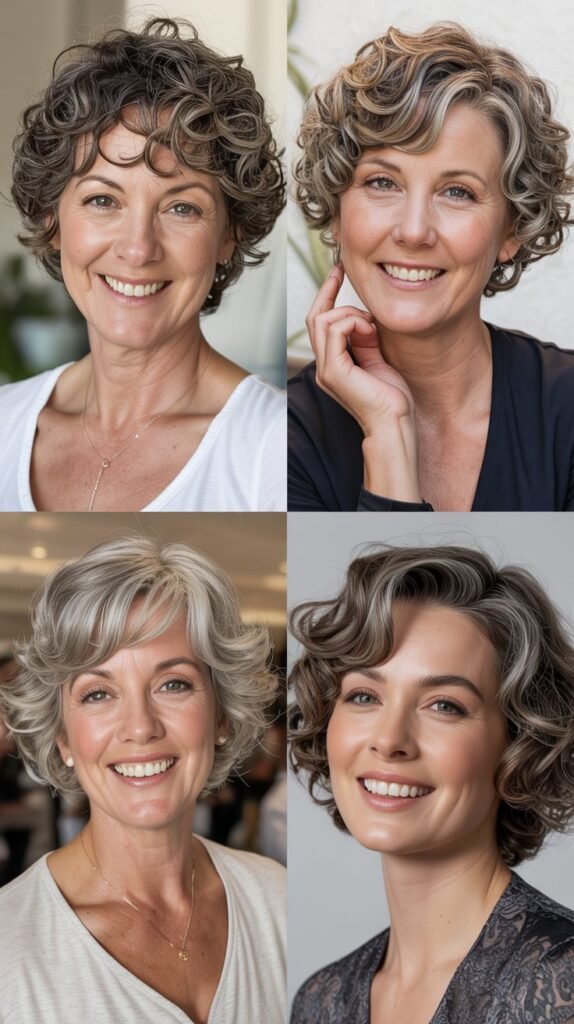
Your face shape plays a crucial role in determining which short curly haircuts will be most flattering, as the right style can balance proportions and highlight your best features.
While curly hair adds its own dimension and can soften angular features naturally, strategic placement of volume and length creates the most harmonious results.
Oval Face Shape:
- Considered the most versatile face shape that can carry virtually any short curly style successfully
- The balanced proportions between forehead, cheekbones, and jawline work with both voluminous and sleek curly cuts
- Can experiment with very short pixies, chin-length bobs, or anything in between without worrying about proportion issues
- The main consideration is choosing cuts that express your personality rather than correcting facial proportions
Round Face Shape:
- Benefits from height at the crown and length that extends past the fullest part of the face (typically at cheekbone level)
- Side-swept bangs or asymmetrical elements create diagonal lines that elongate the appearance of the face
- Avoid blunt cuts that end at the cheekbones or styles with too much width at the sides, which emphasize roundness
- Curly pixies with volume on top and tapered sides work exceptionally well to create vertical interest
Square Face Shape:
- Softening curls naturally complement angular jawlines, making this an ideal texture for square faces
- Styles with volume at the crown and around the temples balance the strong jaw
- Face-framing layers that curve inward toward the jawline soften the squareness
- Avoid severe geometric cuts or blunt lines that emphasize the angular quality
Heart Face Shape:
- Characterized by a wider forehead and narrower chin, benefiting from volume at the jawline and chin level
- Chin-length curly bobs with fullness at the ends perfectly balance the proportions
- Side-swept or wispy bangs help minimize forehead width without requiring straight-across bangs
- Avoid excessive volume at the crown or temples, which makes the upper face appear even wider
Diamond Face Shape:
- Features wide cheekbones with a narrower forehead and chin, requiring styles that add width at the forehead and jaw
- Curly cuts with volume at the crown and near the chin create balance without emphasizing the cheekbones
- Side parts and face-framing layers that start below the cheekbones work beautifully
- Styles that tuck behind the ears or have tapered sides can emphasize the diamond shape, so approach these carefully
Oblong/Rectangle Face Shape:
- Longer face shapes benefit from width rather than height to create better proportions
- Curly bobs with fullness at the sides rather than excessive crown volume work well
- Bangs of any style—whether curly, side-swept, or textured—help shorten the appearance of length
- Avoid very short crops that add height or long, straight lines that emphasize length
4. The DevaCut: Revolutionary Technique for Curly Hair
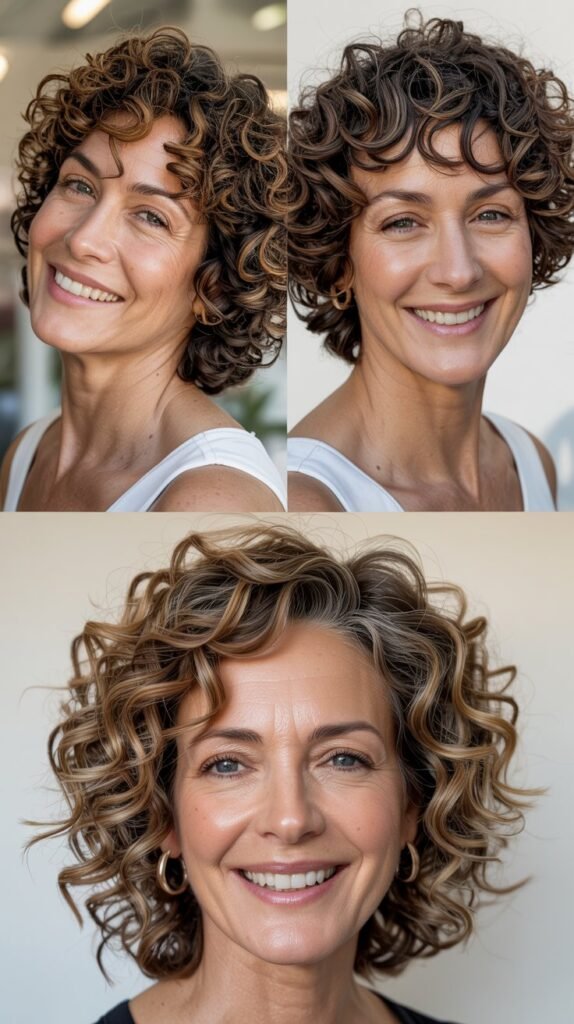
The DevaCut represents a specialized cutting method specifically designed for curly hair, performed on dry hair curl-by-curl to respect each ringlet’s natural pattern and fall.
Developed by Lorraine Massey at the Devachan Salon in New York, this technique has revolutionized how curly-haired women approach haircuts by addressing the unique needs of textured hair.
Core Principles:
- Cutting dry hair allows the stylist to see exactly how each curl behaves in its natural state rather than guessing how wet hair will dry
- Each curl is cut individually based on its specific pattern, density, and how it relates to surrounding curls
- The technique removes weight strategically without creating the harsh lines that traditional wet cutting can produce
- Curls are never point-cut or razored, which can cause fraying and frizz in textured hair
The DevaCut Process:
- Your hair is washed with sulfate-free products and styled with your usual techniques so the stylist sees your typical curl pattern
- The stylist analyzes your curl pattern, density, face shape, and lifestyle needs before making the first cut
- Working section by section, individual curls are isolated, stretched slightly, and cut at angles that encourage the curl to spring back beautifully
- The cut is customized to your specific curl type—tighter curls need different approaches than looser waves
- After the cut, your hair is typically styled with Deva products and techniques to demonstrate the results
Benefits for Women Over 50:
- Addresses the specific challenges of mature curly hair, including changes in texture, density, and curl pattern
- Creates cuts that require minimal styling, perfect for simplified morning routines
- Eliminates the pyramid or triangle shape that often results from traditional layering on curly hair
- The precision approach means your cut grows out beautifully, extending time between appointments
Considerations:
- DevaCuts typically cost more than traditional haircuts, ranging from $75 to $200+ depending on location and stylist experience
- Not all stylists who claim to do DevaCuts are certified—look for graduates of the Devachan Academy
- The technique works best when you’re committed to wearing your hair curly rather than switching between straight and curly styles
- Results depend heavily on the stylist’s skill and understanding of your specific curl pattern
Finding a Qualified DevaCut Stylist:
- Visit naturallycurly.com’s salon finder to locate certified Deva stylists in your area
- Read reviews specifically mentioning DevaCuts and look at before-and-after photos
- Schedule a consultation before committing to the service to ensure the stylist understands your goals
- Ask how long they’ve been performing DevaCuts and whether they have experience with your curl type
5. Dry Cutting vs. Wet Cutting for Curly Hair
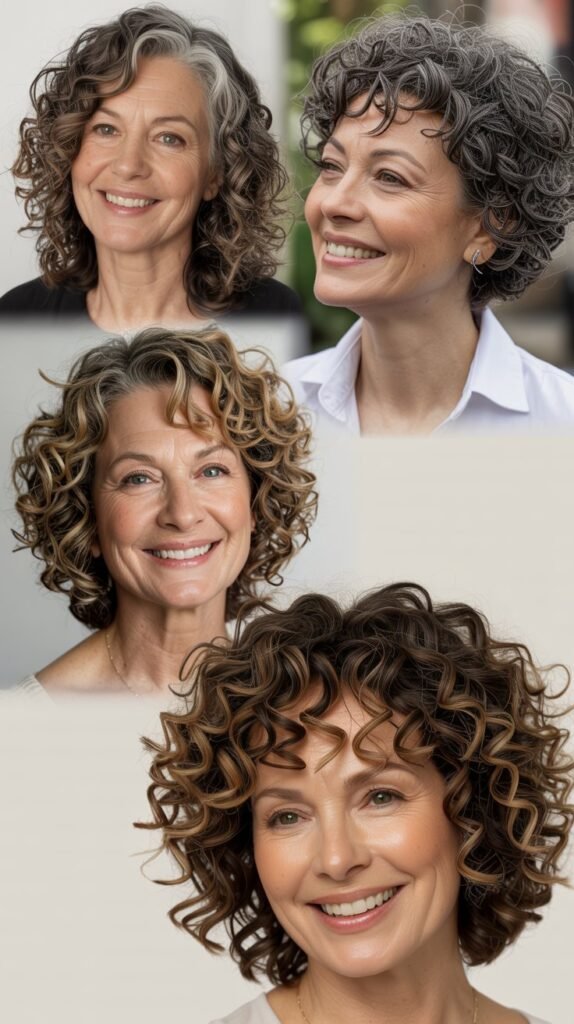
The debate between dry cutting and wet cutting for curly hair centers on which method produces the most flattering, wearable results that honor your natural texture.
While traditional cosmetology training focuses almost exclusively on wet cutting, many curl specialists argue that cutting curly hair dry provides superior outcomes for textured hair types.
Dry Cutting Advantages:
- The stylist sees exactly how your curls fall, spring, and interact in their natural state
- Individual curl patterns can be addressed without guessing how wet hair will behave when dry
- Prevents the common problem of curls “shrinking” after cutting, leaving unexpected shorter pieces
- Allows real-time adjustments as the stylist works, ensuring symmetry and balance as curls naturally fall
- Better for identifying and addressing problem areas like awkward flips or pieces that stick out
Wet Cutting Advantages:
- Provides more precision for creating clean lines and specific geometric shapes
- Hair is easier to control and section when wet, making the cutting process faster
- Better for removing significant length or creating dramatic shape changes
- Most stylists have extensive training in wet cutting techniques
- Can be effective for looser curl patterns (2A-3A) that behave more predictably when wet
Hybrid Approaches:
- Many skilled curl specialists use combination techniques—rough cutting wet to remove length and create basic shape, then refining dry
- Some stylists dampen hair rather than soaking it, providing control while still seeing curl pattern
- The Rezo Cut technique starts with wet cutting in a specific pattern, then dry refines the cut
- Ouidad stylists use the “Carving and Slicing” technique on wet hair but work with the anticipated curl pattern
What Works Best for Different Curl Types:
- Loose waves (2A-2C) can often be successfully cut wet since the pattern is more predictable
- True curls (3A-3C) benefit most from dry cutting techniques that respect individual ringlets
- Coily hair (4A-4C) should almost always be cut dry due to significant shrinkage factors
- Very thick, dense curly hair may need wet rough-cutting for efficiency, then dry refinement
Communicating with Your Stylist:
- If your stylist only cuts curly hair wet, ask about their specific training and experience with curly textures
- Request that they cut conservatively when wet, anticipating that curls will spring up significantly
- If possible, bring photos of your hair styled at home so they understand your natural curl pattern
- Don’t be afraid to seek a curl specialist who cuts dry if you’ve had poor experiences with wet cutting
6. Layering Techniques That Enhance Rather Than Bulk
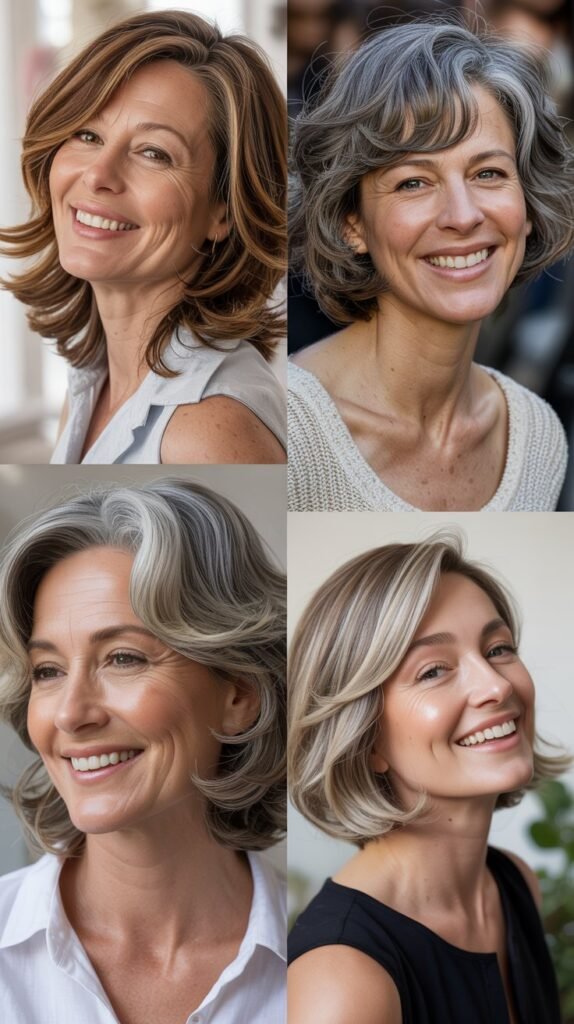
Strategic layering is the secret to beautiful short curly haircuts that have dimension, movement, and shape without the dreaded pyramid or triangle silhouette.
Unlike straight hair where layers create obvious linear movement, curly hair requires specialized layering approaches that account for how curls stack, spring, and interact with each other.
The Curly Hair Layering Challenge:
- Traditional layering designed for straight hair creates bulk when applied to curls because each shortened curl springs up and adds volume
- Removing too much weight from the bottom can leave the top section too heavy, creating the pyramid shape
- Layers that work beautifully on one curl type can be disastrous on another
- The key is removing weight strategically while maintaining enough density to prevent frizziness and separation
Graduated Layers:
- This technique creates longer pieces in the back with progressively shorter pieces moving forward
- Works exceptionally well for curly bobs and longer pixie cuts on women over 50
- The graduation creates natural movement and prevents the back from looking too heavy
- Allows the sides to frame the face softly while maintaining fullness where it’s most flattering
Crown Layering:
- Strategic layers at the crown area lift roots and prevent flatness at the top of the head
- Particularly important for mature women experiencing thinning or reduced density at the scalp
- Shorter layers at the crown spring up while longer underlayers provide foundation and prevent frizz
- Must be approached carefully to avoid creating a mushroom top or disconnected appearance
Face-Framing Layers:
- Layers that start around the cheekbones or jawline draw attention to your best facial features
- These pieces can be customized to your face shape—longer for round faces, fuller for heart-shaped faces
- Creates a softening effect that’s particularly flattering for mature women
- Can be styled to curve toward or away from the face depending on desired effect
Internal Layering (Channel Cutting):
- This technique removes bulk from inside the hair shaft without shortening the exterior length
- Creates space between curls allowing them to form distinct ringlets rather than clumping into bulk
- Particularly effective for thick, dense hair types that tend toward overwhelming volume
- Maintains the overall shape while reducing weight and styling time
Undercut Layering:
- Involves cutting the underneath sections significantly shorter than the top layers
- Creates dramatic volume on top while keeping the overall style manageable
- Works beautifully for women who want edgy, modern looks with controlled volume
- Can be hidden or displayed depending on how you style the top sections
Stacking Technique:
- Primarily used in curly bobs where the back is cut shorter and gradually lengthens toward the front
- Creates a rounded, voluminous shape at the back of the head
- Prevents the back from hanging flat against the neck, which can age your appearance
- The rounded shape naturally lifts and frames the back of the head beautifully
7. The Curly Pixie: Short and Sassy Options
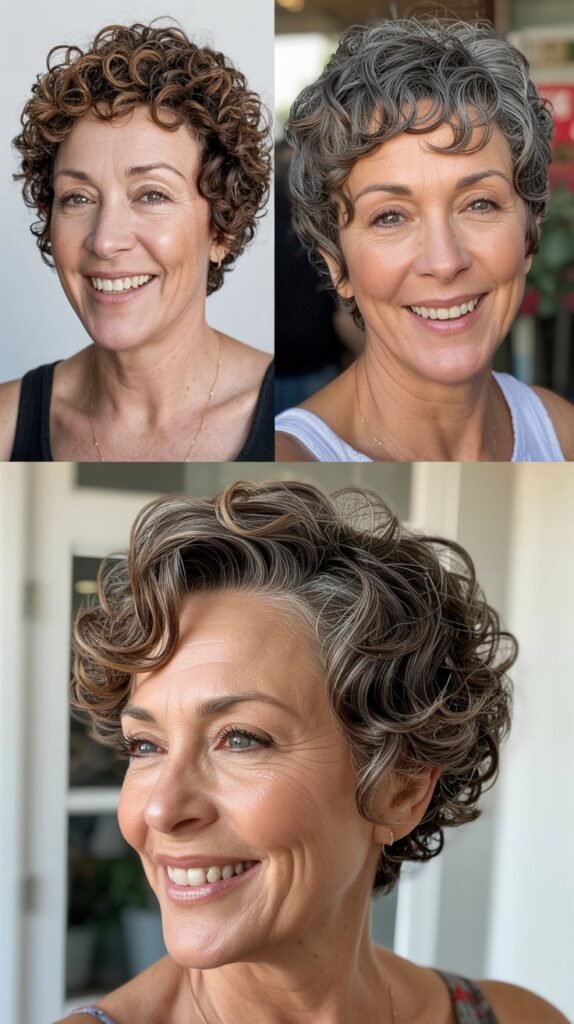
The curly pixie represents the ultimate low-maintenance short haircut for women over 50 who want to embrace their natural texture with confidence and style.
This cut typically features short sides and back with slightly longer, textured top sections that allow your curls to create natural volume and movement.
Classic Curly Pixie Features:
- Hair is typically cut to 1-3 inches throughout with variations in length between sections
- The sides and back are shorter (often tapered or clipper-cut) while the top maintains length for curl definition
- Face-framing pieces can be left slightly longer to soften facial features
- The cut emphasizes your natural curl pattern rather than requiring styling products or tools
- Works beautifully with all curl types from loose waves to tight coils when customized properly
Styling Versatility:
- Can be worn tousled and textured for casual everyday looks
- Easily dressed up with styling cream and strategic curl definition for formal occasions
- Requires minimal time investment—often just scrunch and go after showering
- Gray or silver hair looks particularly striking in pixie cuts, showcasing color beautifully
- Can incorporate headbands, clips, or small accessories for variety without complicated styling
Who Should Consider a Curly Pixie:
- Women ready to commit to very short hair and frequent trims every 4-6 weeks to maintain shape
- Those with oval or heart-shaped faces who can carry very short styles effortlessly
- Active women who want wash-and-go convenience without sacrificing style
- Anyone confident enough to make a bold statement with their hair
- Women with fine hair looking to maximize the appearance of volume and fullness
Maintenance Requirements:
- Requires regular trims to prevent the back and sides from growing out awkwardly
- Needs minimal product—usually just a curl cream or light gel for definition
- Air drying works perfectly for most curl types, eliminating heat damage concerns
- Between washes, simply spritz with water and scrunch to refresh curls
- The short length means hair dries quickly, making morning routines incredibly efficient
Variations to Discuss with Your Stylist:
- Tapered pixie: Very short at the nape, gradually lengthening toward the crown
- Asymmetrical pixie: One side cut shorter than the other for modern edge
- Undercut pixie: Dramatic short sides with longer, voluminous top section
- Soft pixie: Less aggressive tapering with more uniform length throughout for a softer appearance
- Textured pixie: Heavy texturizing techniques that create piece-y, defined curls
8. Curly Bob Variations for Maximum Definition
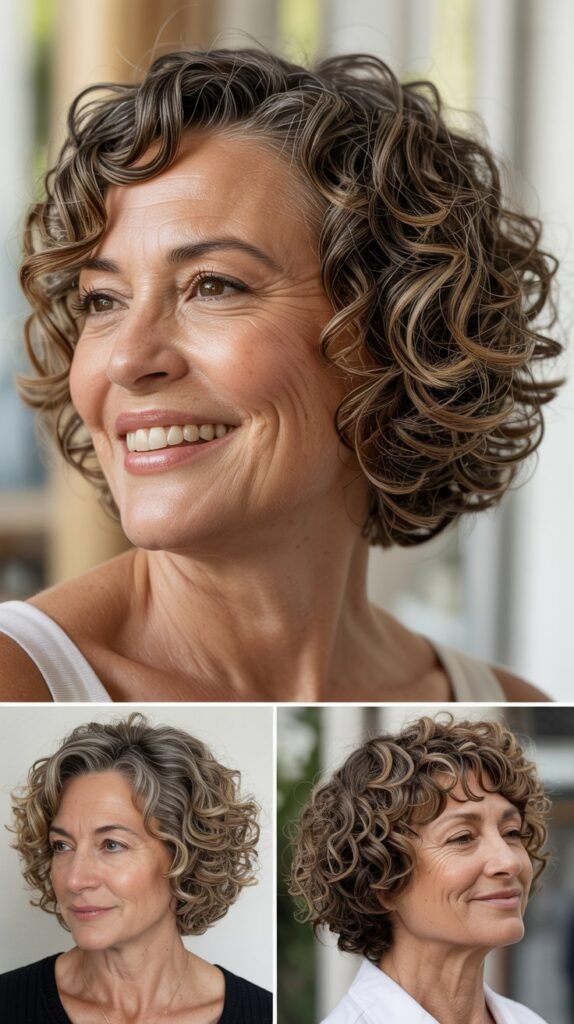
The curly bob remains one of the most popular and versatile short haircuts for women over 50, offering the perfect balance between manageability and femininity.
Ranging from chin-length to shoulder-grazing styles, curly bobs can be customized to flatter any face shape, curl pattern, and lifestyle preference.
Classic Chin-Length Curly Bob:
- Falls between the jawline and shoulders, creating a universally flattering length
- Allows curls to frame the face beautifully while maintaining enough length for versatility
- Works exceptionally well for curl types 2C through 3C that hold their pattern at medium lengths
- Can be worn with a center part, deep side part, or styled away from the face
- Requires trimming every 8-10 weeks to maintain shape and remove damaged ends
Angled Curly Bob (A-Line):
- Features shorter hair at the back that gradually lengthens toward the front
- Creates an elegant, sophisticated silhouette that elongates the neck
- The angle draws the eye forward, highlighting facial features and creating a face-lifting effect
- Works beautifully for round and square face shapes by adding vertical lines
- Requires skilled cutting to ensure the angle is maintained as curls spring and shrink
Stacked Curly Bob:
- Characterized by significant volume and roundness at the back of the head
- The back is cut shorter and layered heavily while the sides maintain more length
- Creates a youthful, voluminous shape that prevents flat, aging appearances
- Particularly flattering for women with fine or thinning hair who need volume boost
- The stacking technique must account for curl pattern to avoid excessive bulk
Inverted Curly Bob:
- Similar to stacked but with even more dramatic graduation from back to front
- The back may be cut as short as 1-2 inches while front pieces reach chin or shoulder length
- Creates striking, modern silhouettes that make strong style statements
- Best suited for women with thick, dense hair that can support the dramatic shape
- Requires commitment to regular maintenance as the cut grows out noticeably
Shoulder-Length Curly Bob:
- Also called a long bob or “lob,” this style hits at or just below the shoulders
- Offers maximum versatility including the ability to pull hair into small ponytails or clips
- Ideal for women transitioning from longer hair who aren’t ready for very short cuts
- Works well for all curl types and can incorporate various layering techniques
- Balances the practicality of short hair with some styling flexibility of longer lengths
Curly Bob with Bangs:
- Incorporating curly bangs adds dimension and can address face shape concerns
- Side-swept curly bangs soften angular features and disguise forehead lines
- Full curly bangs work best on heart-shaped faces and can make bold style statements
- Bangs require additional maintenance and styling to prevent awkward growing-out phases
- Must be cut with your natural curl pattern in mind to avoid pieces that spring up too short
9. The Curly Shag: Modern Texture and Movement

The curly shag has experienced a massive resurgence as one of the most flattering and contemporary short haircuts for women over 50, combining vintage appeal with modern cutting techniques.
This heavily layered style creates incredible movement, dimension, and effortless texture that celebrates natural curls while maintaining a youthful, edgy vibe.
Defining Characteristics:
- Multiple layers throughout create a shattered, piece-y appearance rather than a solid shape
- Layers of varying lengths allow curls to separate and define individually
- Often features face-framing pieces that are significantly shorter than the rest of the hair
- Creates volume at the crown while maintaining texture and lightness throughout
- The choppy, undone quality looks intentionally styled rather than messy or unkempt
Why Shags Work for Mature Curly Hair:
- The layering removes weight that can drag down aging hair and reduce curl definition
- Creates natural volume without requiring teasing, backcombing, or damaging techniques
- The textured, lived-in appearance means your hair looks great even on second or third-day curls
- Face-framing layers draw attention to your best features while providing soft, flattering movement
- Works exceptionally well with gray or silver hair, showcasing dimension and natural highlights
Styling the Curly Shag:
- Apply curl cream or mousse to damp hair, focusing on mid-lengths and ends
- Scrunch hair upward to encourage curl formation and remove excess water
- Either air dry or use a diffuser on low heat, scrunching periodically
- Once completely dry, gently shake out the roots for maximum volume
- Requires minimal daily maintenance beyond occasional refreshing with water
Best Curl Types for Shag Cuts:
- Medium curls (3A-3B) showcase the layers beautifully with defined, separate ringlets
- Loose waves (2B-2C) gain incredible body and movement from the heavy layering
- Tighter curls (3C-4A) work well but require careful cutting to prevent excessive volume
- Very tight coils (4B-4C) need modified shag techniques that account for shrinkage
Shag Variations:
- Choppy shag: Very short, dramatically varied layers for maximum edge and texture
- Soft shag: More subtle layering that creates movement without extreme texture
- Long shag: Extends past the shoulders while maintaining the layered, piece-y quality
- Shaggy pixie: Very short version that combines pixie convenience with shag texture
- Asymmetrical shag: Incorporates uneven lengths on different sides for modern appeal
Maintenance Considerations:
- Requires trims every 6-8 weeks to maintain the choppy, textured appearance
- Grows out relatively gracefully compared to more structured cuts
- The undone quality means perfect styling isn’t necessary—imperfection is part of the appeal
- May require more product than simpler cuts to define and separate all the layers
- Works best when you’re comfortable with tousled, textured styles rather than polished looks
10. Tapered Cuts for Natural Curl Definition

Tapered cuts represent a cornerstone technique in short curly haircuts, involving gradual length reduction from the top of the head down to the nape and around the ears.
This approach creates clean, polished silhouettes while allowing maximum curl definition on top where it’s most visible and flattering.
Tapering Fundamentals:
- Hair is longest at the crown and crown area, gradually decreasing in length down the sides and back
- The transition can be subtle (soft taper) or dramatic (high taper/fade) depending on preference
- Creates a triangular or rounded silhouette when viewed from the side or back
- Removes bulk at the bottom while maintaining volume where you want it most
- Provides a finished, professional appearance even as hair grows out
Benefits for Mature Women:
- Eliminates the heavy, aging look that can come from thick hair at the nape and sides
- Creates clean lines around the face that draw attention upward to your eyes and smile
- Prevents the mushroom or pyramid shape that often plagues curly haircuts
- Makes styling significantly easier by reducing the amount of hair requiring product and attention
- Allows you to showcase gray or silver hair in a contemporary, intentional style
Taper Heights and Styles:
- Low taper: Begins tapering around the middle of the head, creating gentle transitions
- Mid taper: Starts tapering higher, roughly at the temple area, for more dramatic definition
- High taper: Creates significant contrast between long top sections and very short sides/back
- Skin fade: Takes the shortest areas down to skin level for maximum contrast (very edgy)
- Taper fade: Blends the taper seamlessly into the skin without a hard line
Curl Patterns and Tapering:
- Loose curls (2A-3A) can handle any taper style, as the curl pattern remains visible even when short
- Medium curls (3B-3C) look fantastic with mid-to-high tapers that showcase curl definition on top
- Tight curls (4A-4C) require careful consideration of shrinkage when determining taper height
- Mixed curl patterns benefit from custom tapering that addresses each section’s unique behavior
Maintenance Requirements:
- Tapered sections grow out quickly, requiring touch-ups every 3-4 weeks for maintained appearance
- Many women handle taper maintenance with clippers at home between salon visits
- The top section can go 6-8 weeks between cuts while tapered areas are maintained more frequently
- Some stylists offer “taper touch-up” appointments that are shorter and less expensive than full cuts
Combining Tapers with Other Techniques:
- Tapered pixie: Combines classic pixie styling with clean, tapered sides and back
- Tapered TWA (Teeny Weeny Afro): Very short all over with subtle tapering for shape
- Tapered curly mohawk: Dramatic side tapers with voluminous curl definition on top
- Tapered bob: Maintains bob length on top while creating clean lines at the nape
- Undercut with taper: Combines disconnected undercut with gradual tapering for blended finish
11. Asymmetrical Curly Cuts for Modern Edge
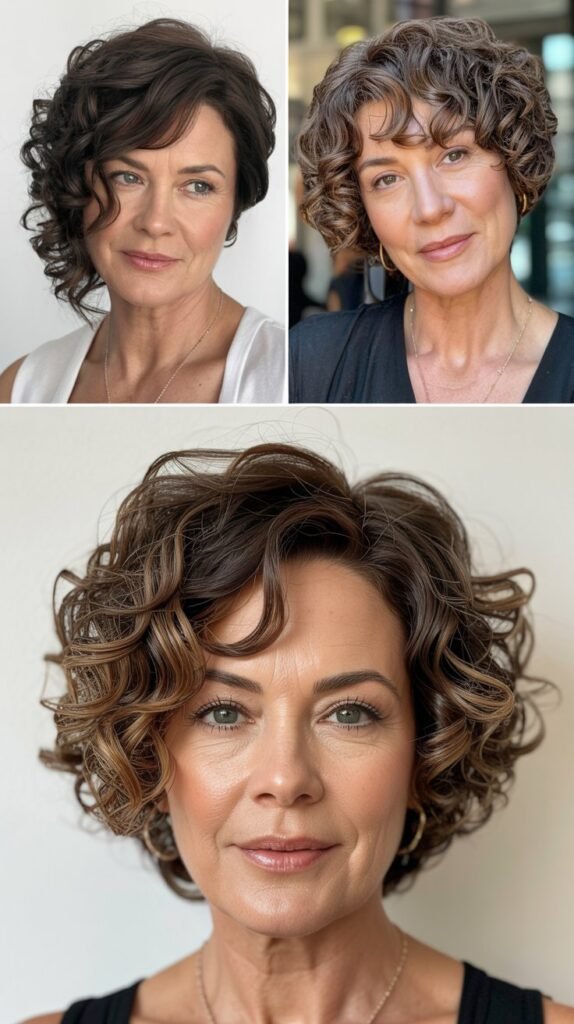
Asymmetrical curly haircuts bring contemporary sophistication to short styles by intentionally creating different lengths, shapes, or volumes on opposite sides of the head.
These cuts make bold style statements while remaining surprisingly wearable and flattering for women over 50 who want to showcase their personal style with confidence.
Types of Asymmetry:
- Length asymmetry: One side significantly longer than the other, creating dramatic angles
- Volume asymmetry: Equal length but different layering creates more volume on one side
- Part asymmetry: Deep side parts create visual asymmetry even with similar lengths
- Textural asymmetry: Different cutting techniques on each side create varied curl definitions
- Undercut asymmetry: One side features an undercut while the other maintains fuller coverage
Why Asymmetry Works After 50:
- Draws the eye across the face rather than highlighting any single area, creating overall balanced interest
- The modern, fashion-forward appearance counteracts outdated stereotypes about age-appropriate hair
- Can strategically camouflage specific concerns like hearing aids, facial asymmetry, or preferred angles
- Creates the illusion of fullness and volume even with fine or thinning hair
- Offers built-in versatility—wear it prominently displayed or style it more subtly depending on the occasion
Face Shape Considerations:
- Round faces benefit from longer sides that create vertical lines and elongate
- Square faces can soften angular jawlines with asymmetry that draws attention diagonally
- Heart-shaped faces should ensure the longer side falls around the jawline to balance the narrow chin
- Oval faces can wear any asymmetrical style successfully
- Long faces should avoid extreme asymmetry that adds vertical emphasis
Styling Asymmetrical Cuts:
- The shorter side often needs more product to maintain shape and prevent awkward flipping
- The longer side can be styled multiple ways—tucked behind the ear, swept forward, or curled outward
- Deep side parts enhance asymmetry naturally without requiring different cutting lengths
- Some days you may want to emphasize the asymmetry; other days style it more conservatively
- Headbands and clips can temporarily change how dramatically the asymmetry is displayed
Commitment Considerations:
- Growing out asymmetrical cuts takes patience as you’ll go through awkward intermediate phases
- Requires more frequent trims on the shorter side to maintain the dramatic difference
- May limit styling options compared to symmetrical cuts—pulling hair back or styling it sleek is more difficult
- Works best when you’re confident in your choice and comfortable standing out
- Consider starting with subtle asymmetry (like a deep side part) before committing to dramatic length differences
Communicating with Your Stylist:
- Bring multiple photos showing the asymmetrical cuts from various angles
- Discuss how much maintenance you’re willing to commit to maintaining the shape
- Ask about the growing-out process and whether you’ll be happy during transitions
- Consider starting with less dramatic asymmetry and increasing it if you love the effect
- Ensure your stylist has experience with asymmetrical curly cuts, as they require specialized skills
12. The Undercut: Hidden and Visible Options
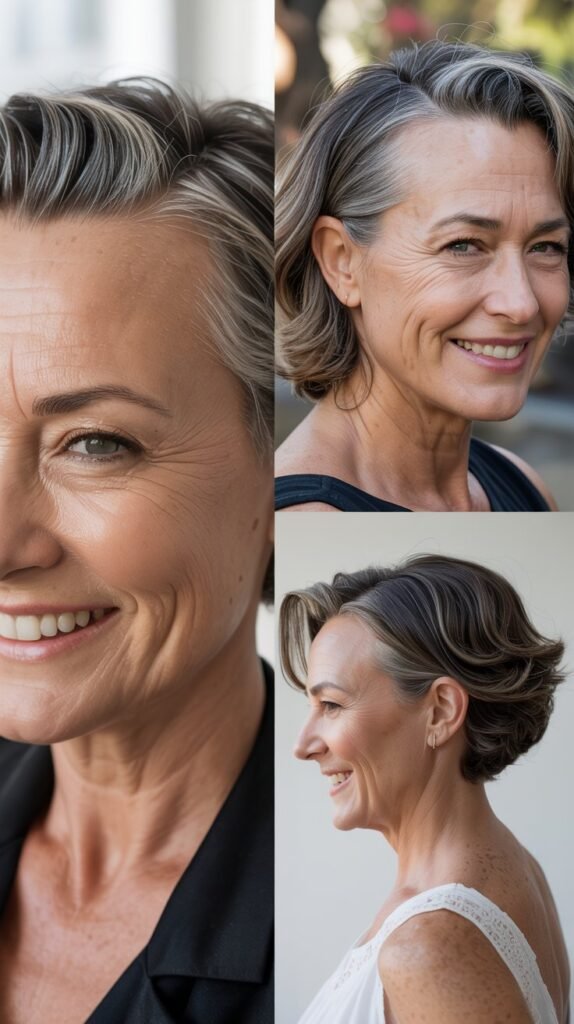
The undercut technique involves shaving or cutting one or more sections of hair extremely short while leaving other sections long, creating dramatic contrast and reducing bulk.
For women over 50 with thick curly hair, undercuts offer both aesthetic appeal and practical benefits, from temperature regulation to easier styling.
Undercut Placement Options:
- Nape undercut: Hidden beneath longer hair, shaved or buzzed at the back of the neck
- Side undercut: One or both sides cut short, often extending from the temple to behind the ear
- Full undercut: The entire back and sides are cut short, leaving only the crown and top sections long
- Partial undercut: Strategic sections are undercut for specific styling or bulk reduction
- Design undercut: Patterns or designs are shaved into the short sections for artistic expression
Benefits for Mature Women:
- Dramatically reduces bulk for women with thick, dense hair that can feel heavy and hot
- Creates cooling relief during hot flashes or warm weather
- Allows the top sections to have maximum volume without overwhelming bulk underneath
- Hidden undercuts can be conservative for professional settings but edgy when revealed
- Reduces drying time significantly—less hair means faster air drying or diffusing
Hidden vs. Visible Undercuts:
- Hidden undercuts are concealed when hair is down, revealing only when styled up or tucked
- Provide the practical benefits of reduced bulk without the bold visual statement
- Ideal for women in conservative professional environments
- Visible undercuts make deliberate style statements and require confidence to wear
- Can be softened or hidden by adjusting how you style the longer top sections
Styling Versatility:
- Wear hair down to completely conceal hidden undercuts for professional or conservative occasions
- Pull hair up into ponytails, buns, or clips to reveal undercut designs
- The contrast between short and long sections creates interesting visual effects
- Undercuts often reveal beautiful natural hair color, including gray patterns at the nape
- Can be decorated with temporary tattoos, henna, or hair jewelry for special events
Maintenance and Growing Out:
- Undercut sections grow out quickly, requiring maintenance every 2-4 weeks for clean lines
- Many women maintain their own undercuts with clippers between professional visits
- Growing out undercuts creates awkward phases where short sections stick out
- Consider whether you’re willing to commit to regular maintenance or eventual awkward growing-out period
- Some women choose to maintain undercuts indefinitely because they love the practical benefits
Curl Type Considerations:
- Thick, tight curls (3C-4C) benefit most from bulk reduction that undercuts provide
- Fine or thin hair should approach undercuts cautiously, as removing sections reduces overall volume
- Loose curls (2A-3B) can still benefit from hidden nape undercuts for comfort and manageability
- The longer top sections will behave differently without the weight and support of underneath hair
13. Wash-and-Go Short Curly Styles

Wash-and-go hairstyles represent the holy grail for busy women over 50 who want beautiful, defined curls without spending extensive time styling.
These short cuts are specifically designed to look their best with minimal intervention, relying on proper cutting techniques and curl-friendly product application rather than time-consuming styling routines.
What Makes a Cut “Wash-and-Go” Friendly:
- Proper layering that allows curls to fall naturally without creating awkward shapes
- Strategic length that prevents curls from becoming too heavy and losing definition
- Removal of bulk that causes curls to clump together unattractively
- Clean lines that maintain shape even as curls dry randomly
- Minimal need for root lifting, stretching, or manipulation during drying
The Wash-and-Go Method:
- Cleanse hair with sulfate-free shampoo or co-wash (conditioner washing) to maintain moisture
- Apply leave-in conditioner while hair is soaking wet to lock in hydration
- Work curl-defining cream or gel through hair using prayer hands or raking methods
- Scrunch hair upward toward the scalp to encourage curl formation and remove excess water
- Either air dry completely or diffuse on low heat without disturbing the curls
- Once dry, scrunch out any crunchiness from gel to reveal soft, defined curls
Best Short Cuts for Wash-and-Go:
- Tapered cuts that require minimal styling attention on the sides and back
- Chin-length curly bobs with proper layering that creates natural shape
- Curly pixies that spring up beautifully when scrunched and left alone
- Rounded shapes that look intentional even when curls dry randomly
- Styles without bangs or face-framing pieces that require specific placement
Product Selection:
- Leave-in conditioners provide moisture foundation without weighing down short curls
- Curl creams offer definition with soft hold, perfect for touchable everyday styles
- Gels provide stronger hold and definition for longer-lasting results
- Mousses work well for fine curls that need volume without weight
- Combination approaches (cream followed by gel) often give the best results
Troubleshooting Common Issues:
- Frizzy canopy: Apply more product to the outer layer or use a light oil to seal the cuticle
- Flat roots: Diffuse upside down or use root clips while drying to encourage volume
- Inconsistent curl pattern: Ensure you’re distributing product evenly and scrunching thoroughly
- Curls falling flat: Your cut may need more layers to remove weight, or you need stronger-hold products
- Excessive crunchiness: Use less gel or scrunch out the crunch more thoroughly once dry
Time Comparison:
| Styling Method | Time Required | Tools Needed | Skill Level |
|---|---|---|---|
| Wash-and-Go | 10-15 minutes | Hands, maybe diffuser | Beginner |
| Traditional Styling | 30-60 minutes | Brushes, dryer, tools | Intermediate |
| Heat Styling | 45-90 minutes | Flat iron, products | Advanced |
| Rod/Roller Sets | 90-180 minutes | Rods, dryer, products | Advanced |
14. Silver and Gray Curly Short Haircuts
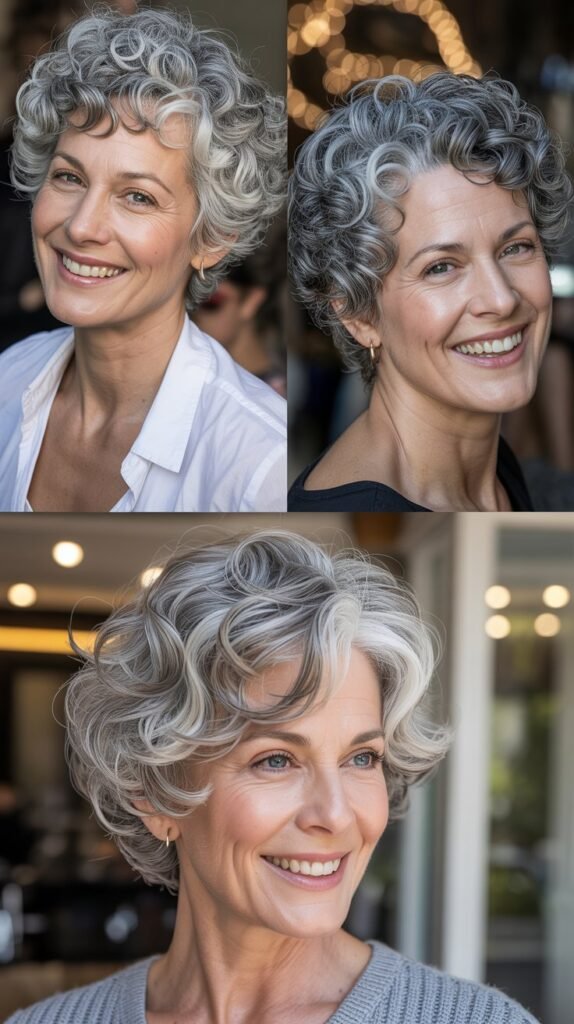
Embracing natural silver and gray curls in short haircuts creates stunning, contemporary looks that celebrate both texture and color with confidence.
Gray hair often has different textural properties than pigmented hair—typically coarser and sometimes curlier—making it particularly well-suited to the right short curly cuts.
Why Gray Curls Are Special:
- Gray hair reflects light differently, creating natural dimension and shine
- The coarser texture of gray hair often holds curl patterns beautifully
- Silver tones complement most skin tones and can brighten mature complexions
- Short cuts prevent gray roots from showing noticeably as hair grows
- Natural gray makes a confident style statement about embracing authenticity
Best Short Cuts for Gray Curls:
- Pixie cuts showcase silver color dramatically while keeping maintenance minimal
- Curly bobs allow enough length to display color variation from roots to ends
- Tapered cuts with longer tops highlight dimensional gray patterns beautifully
- Textured shags create incredible depth by revealing various gray and silver tones
- Asymmetrical cuts make bold statements that complement the confidence of going gray
Color Enhancement Options:
- Purple or silver-toning shampoos remove yellow tones and enhance cool gray tones
- Strategic highlights in platinum or bright silver can brighten predominantly gray hair
- Lowlights in darker gray or silver can add dimension to monochromatic gray
- Semi-permanent color glosses add shine without changing the gray tone
- Some women keep a few darker pieces for transition or dimension
Caring for Gray Curly Hair:
- Gray hair tends to be drier, requiring regular deep conditioning treatments
- Moisture-rich products specifically formulated for gray hair work best
- Protein treatments help strengthen coarser gray hair texture
- UV protection products prevent yellowing from sun exposure
- Gentle, sulfate-free cleansers maintain moisture without stripping natural oils
Styling Considerations:
- Gray hair can appear coarser or more wiry, requiring more smoothing products
- The natural texture changes may create tighter or looser curls than you had previously
- Some women experience increased volume with gray hair, making short cuts more manageable
- Gray curls often have beautiful natural shine that looks best with lightweight products
- Embrace the texture rather than fighting it—gray curls have their own character
Transitioning to Gray:
- Growing out gray in a short curly cut is easier than with straight or long hair
- The texture of curls naturally blends the line between gray roots and colored ends
- Strategic cuts can remove colored ends gradually as more gray grows in
- Lowlights in gray tones can ease the transition visually
- Many women choose to “big chop” and embrace fully gray hair immediately in short styles
15. Volume-Boosting Techniques for Fine Curly Hair
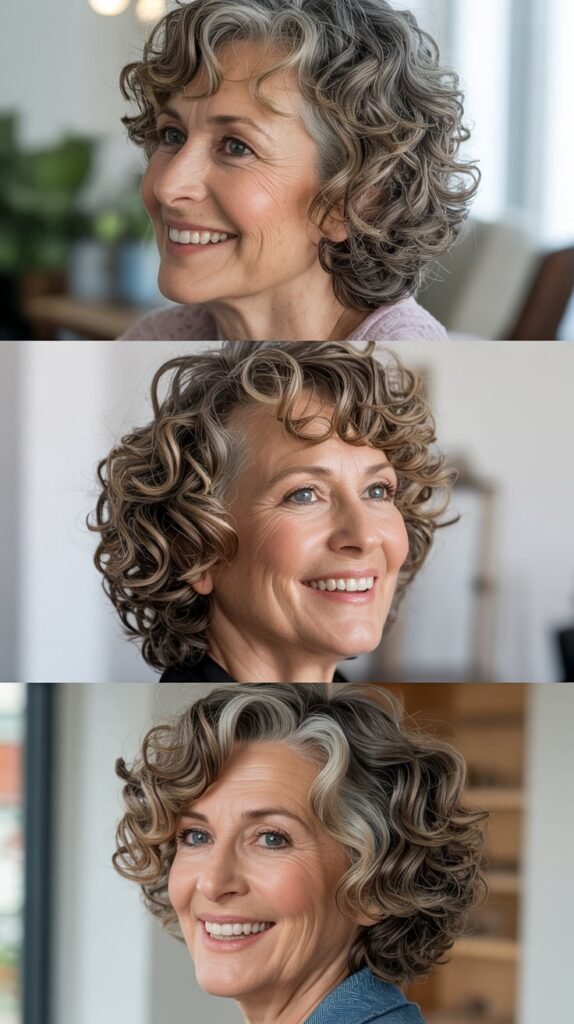
Fine curly hair presents unique challenges, as it lacks the density to create volume naturally but still has texture that requires specific cutting and styling approaches.
Strategic volume-boosting techniques in short haircuts can transform fine curls from limp and lifeless to full and fabulous.
Why Fine Curls Fall Flat:
- Individual strands lack the diameter to create volume naturally
- The weight of even moderate length can pull roots flat against the scalp
- Curl pattern may loosen or straighten when hair is weighed down
- Product buildup weighs down fine hair more dramatically than coarse hair
- Moisture loss causes fine curls to frizz rather than clump into voluminous ringlets
Cutting Techniques for Volume:
- Crown layering lifts the top sections by removing weight from the underlayers
- Graduated cuts create stacked volume at the back of the head
- Strategic undercuts remove hidden bulk while allowing top sections to spring upward
- Face-framing layers around the perimeter create the illusion of fuller hair throughout
- Texturizing techniques that create separation between curls increase perceived volume
Best Short Cuts for Fine Curly Hair:
- Pixie cuts with volume on top and tapered sides maximize lift at the crown
- Short curly bobs that end above the shoulders prevent weight from dragging curls down
- Layered shags create maximum volume through texture and movement
- Rounded cuts that add fullness at the crown rather than the sides
- Styles without bangs that allow all available hair to contribute to overall volume
Product Selection for Fine Curls:
- Lightweight mousses provide volume and hold without weight
- Volumizing sprays applied at the roots before styling lift hair from the scalp
- Light gels offer definition without the heaviness of creams
- Root-lifting powders or sprays create instant volume after styling
- Avoid heavy oils, butters, and creams that will weigh down fine curls
Styling Techniques:
- Diffuse upside down to encourage roots to lift away from the scalp
- Use root clips while air drying to train hair to dry with volume at the crown
- Apply products mid-shaft to ends rather than at roots to prevent weighing down
- Scrunch hair upward during drying rather than downward
- Once completely dry, gently shake roots to separate and maximize volume
Volume-Boosting Styling Sequence:
- Apply volumizing spray or mousse to damp roots
- Apply curl cream or light gel from mid-lengths to ends
- Place root clips at the crown while hair is still wet
- Diffuse or air dry completely without disturbing
- Remove clips and gently shake roots
- Apply root-lifting powder if additional volume is desired
- Avoid touching hair throughout the day to maintain volume
Common Mistakes to Avoid:
- Using too much product, which weighs down fine curls significantly
- Applying conditioner or heavy products to roots
- Touching or manipulating hair while it dries, which disrupts curl formation
- Waiting too long between trims, allowing weight buildup that flattens curls
- Using products designed for thick or coarse hair, which are too heavy for fine strands
16. Reducing Bulk in Thick Curly Hair
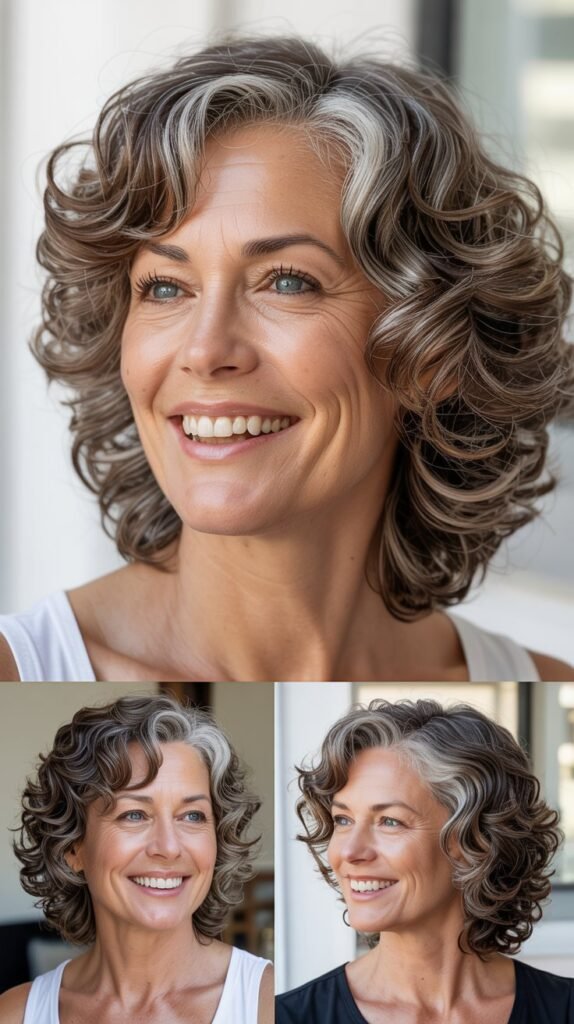
Thick, dense curly hair creates its own unique challenges in short haircuts—excessive volume, lengthy drying time, product absorption, and styling difficulty.
Strategic bulk reduction techniques transform overwhelming thickness into manageable, beautifully shaped short curly styles.
Understanding Bulk vs. Volume:
- Bulk refers to excessive density that creates shapeless mass
- Volume refers to intentional fullness that creates pleasing shape
- The goal is reducing bulk while maintaining or even increasing volume where you want it
- Proper bulk reduction creates definition, shape, and manageability
Internal Layering Techniques:
- Channel cutting removes weight from inside the hair shaft without shortening exterior length
- Point cutting at an angle thins ends while maintaining overall length
- Slide cutting (also called slithering) removes bulk along the shaft
- Thinning shears selectively remove density without creating visible layers
- Razoring (controversial for curls) can thin hair but must be done carefully to avoid frizz
Strategic Bulk Removal Areas:
- Behind the ears where hair tends to stick out awkwardly
- At the crown where excessive density creates pyramid shapes
- At the nape where thick hair can feel hot and heavy
- Interior sections that create too much width at the sides
- Underlayers that aren’t visible but contribute to overall bulk
Cuts That Manage Thick Curly Hair:
- Undercuts remove significant bulk from beneath while maintaining volume on top
- Heavily layered shags thin throughout while creating movement
- Graduated bobs remove weight at the bottom while maintaining shape
- Tapered cuts thin the perimeter while keeping length at the crown
- Asymmetrical cuts can strategically remove more bulk from one side if needed
Styling Products for Thick Curls:
- Lightweight gels provide hold without adding more weight to already heavy hair
- Curl creams should be applied sparingly to avoid greasy buildup
- Leave-in conditioners in spray form provide moisture without heaviness
- Styling mousses work well for thick hair that can support stronger-hold products
- Oil should be used very sparingly on ends only, as thick hair doesn’t need much
Drying Thick Curly Hair:
- Air drying can take hours, so using a diffuser on low heat is often necessary
- Microfiber towels or t-shirts absorb water more quickly than regular towels
- Plopping (wrapping damp hair on top of your head) removes excess water while forming curls
- Using products that speed drying time can reduce overall styling time significantly
- Diffusing in sections rather than randomly targeting the entire head works better
Common Thick Hair Challenges:
| Challenge | Solution | Product Recommendation |
|---|---|---|
| Excessive drying time | Use lighter products, diffuse efficiently | Quick-dry spray, microfiber towel |
| Pyramid/triangle shape | Strategic layering, taper sides | Professional cut every 6-8 weeks |
| Product not penetrating | Apply to soaking wet hair in sections | Water-based, lightweight formulas |
| Heat retention | Undercuts or short lengths at nape | Minimal product application |
| Daily styling difficulty | Wash-and-go friendly cuts | Simple gel-only routines |
17. Face-Framing Layers and Angles
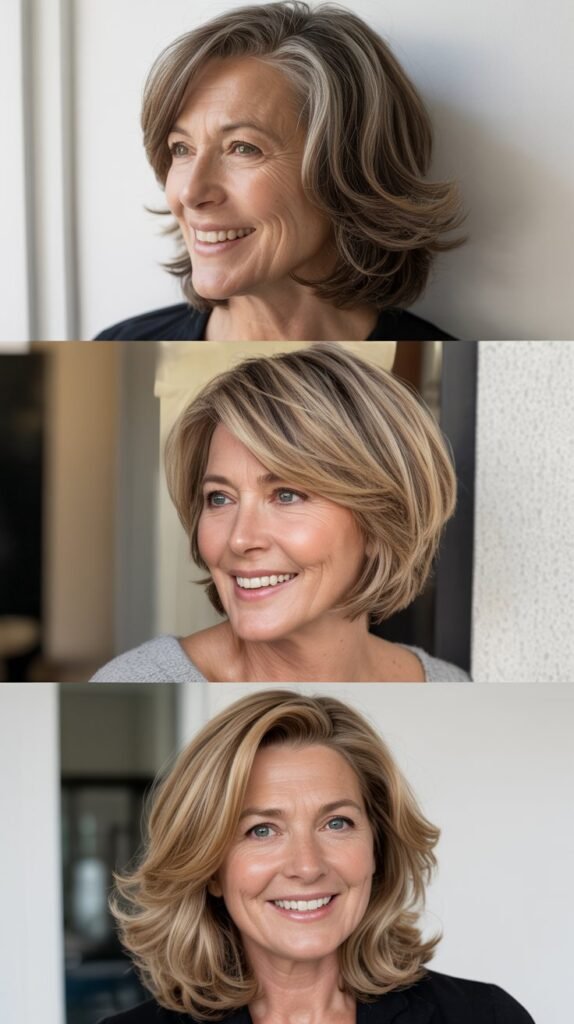
Face-framing layers represent one of the most transformative elements in short curly haircuts for women over 50, strategically drawing attention to your best features while softening the overall appearance.
These customized layers start around the face and can dramatically change how your features are perceived.
The Purpose of Face-Framing:
- Draws the eye toward your eyes, smile, and cheekbones
- Softens the overall silhouette of the haircut
- Creates movement and dimension near your face
- Can strategically camouflage areas you’re less confident about
- Provides styling versatility—worn forward or tucked back
Customizing Face-Framing to Face Shape:
- Round faces: Layers that start at the cheekbones or below elongate the face
- Square faces: Soft, curved layers that start at the temples soften angular jawlines
- Heart-shaped faces: Layers that add fullness at the jawline balance narrow chins
- Oval faces: Can wear layers starting at any point without proportion concerns
- Long faces: Layers that add width at the sides rather than length are most flattering
Starting Points for Face-Framing Layers:
- Temple-level layers create a soft, feminine frame around the entire face
- Cheekbone-level layers draw attention to your eyes and create dimension
- Jawline-level layers balance facial proportions and soften jaw areas
- Chin-level layers work well for women wanting gentle framing without dramatic changes
- Mixed-length layers combine multiple starting points for complex, dimensional looks
Styling Face-Framing Layers:
- Can be curled toward the face for soft, romantic looks
- Styled away from the face for more volume and openness
- Tucked behind ears to change the look completely day-to-day
- Left natural to frame the face in their organic curl pattern
- Pinned or clipped for occasional different styling without committing to different cuts
Maintenance Considerations:
- Face-framing pieces grow quickly and may require more frequent trims
- The shorter pieces can sometimes flip awkwardly during growing-out phases
- Proper styling product application on these pieces is essential for definition
- Some women find face-framing layers require more daily styling attention
- Despite extra maintenance, most women feel the flattering effect is worth it
Combining with Other Techniques:
- Face-framing layers work beautifully with tapered cuts for combined sophistication
- Asymmetrical cuts can incorporate different face-framing lengths on each side
- Undercuts reveal face-framing layers more dramatically when longer hair is pulled back
- Graduated bobs naturally incorporate face-framing through their angled structure
- Curly shags create face-framing through multiple layer lengths throughout
18. Curly Mohawk Styles for Bold Statements
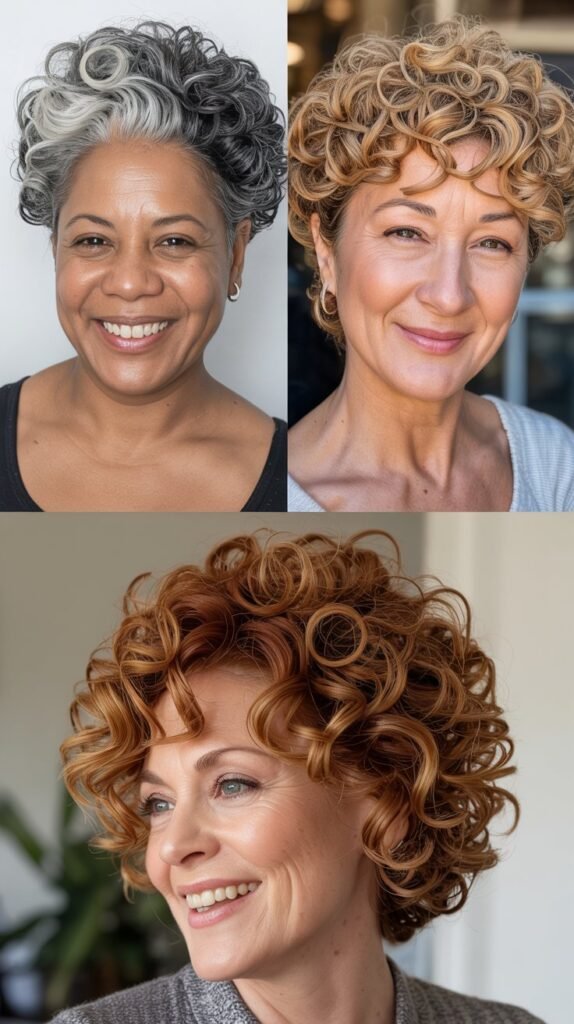
The curly mohawk represents one of the boldest and most dramatic short haircut options for confident women over 50, featuring significant length and volume down the center of the head with dramatically shorter or shaved sides.
This edgy style makes powerful statements about individuality, confidence, and refusal to conform to age-related expectations.
Mohawk Variations:
- Classic mohawk: Very short or shaved sides with a strip of significantly longer hair down the center
- Faux mohawk: Styled to appear like a mohawk but with less dramatic actual length differences
- Wide mohawk: A broader center section rather than a thin strip, providing more versatility
- Curly-hawk: Specifically designed to showcase natural curl volume at the top
- Tapered mohawk: Gradually blended sides rather than harsh lines between lengths
Why Women Over 50 Choose Mohawks:
- Makes bold statements about confidence, individuality, and refusing age-related limitations
- The dramatic contrast creates undeniable visual interest and style
- Removes significant bulk from sides where thick curly hair can be overwhelming
- Requires minimal styling time—simply enhance the top curls and go
- Gray or silver hair looks particularly striking in mohawk styles
Maintenance Requirements:
- Sides need frequent maintenance (every 2-3 weeks) to keep clean lines
- Many women maintain the sides at home with clippers between salon visits
- The top section still needs regular trims every 6-8 weeks for shape and curl health
- Growing out a mohawk requires patience through awkward intermediate phases
- Consider carefully before committing, as growing out takes many months
Styling the Curly Mohawk:
- Apply curl cream or gel to the damp top section, scrunching to encourage definition
- Use a pick or your fingers to lift curls at the roots for maximum height
- Some women use root clips while drying to train volume upward
- The sides require minimal attention beyond occasional tidying
- Accessories like headbands or scarves can change the look dramatically
Best Curl Types for Mohawks:
- Tight curls (3C-4C) create stunning, voluminous mohawks with natural height
- Medium curls (3A-3B) form beautiful definition and shape in the center section
- Loose waves (2B-2C) can work but may require more product for volume
- Very fine hair may struggle to create enough volume for dramatic mohawk effect
- Thick, dense hair benefits tremendously from the bulk reduction on the sides
Lifestyle Considerations:
- Mohawks work best for women in creative fields or retirement without professional dress codes
- May attract unwanted attention or comments—confidence is essential
- Difficult to style conservatively for formal occasions (though accessories can help)
- Swimming, hats, and physical activities are no problem with properly maintained mohawks
- Many women find the freedom and low maintenance worth any social trade-offs
Transitional Approaches:
- Start with a faux mohawk styling technique before committing to the cut
- Try a subtle undercut first to see how you like dramatically shorter sides
- Consider temporary hair tattoos or designs on the sides to test edgier looks
- Some stylists can create mohawk shapes using clipper guards rather than complete shaves
- Photos and virtual try-on apps can help visualize the dramatic change before cutting
19. Bangs with Short Curly Hair
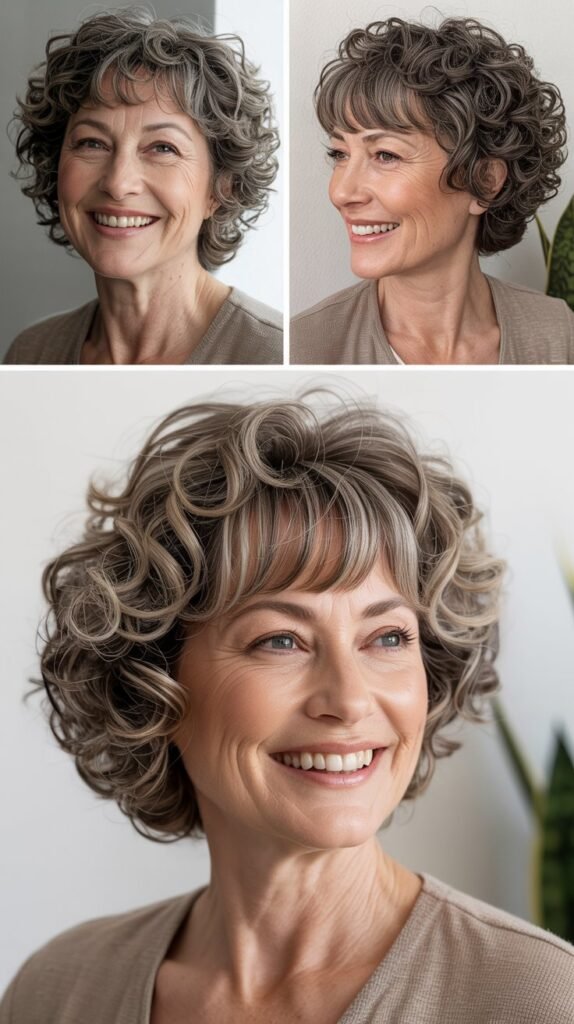
Incorporating bangs into short curly haircuts adds dimension, can address face shape concerns, and creates focal points that draw attention to your eyes.
However, curly bangs require specific considerations, as they behave differently than straight bangs and need customized cutting approaches.
Types of Curly Bangs:
- Side-swept curly bangs: Longer pieces that sweep across the forehead toward one side
- Full curly bangs: Bangs that span the entire forehead with curly texture
- Curly curtain bangs: Center-parted bangs that frame both sides of the face
- Wispy curly bangs: Lighter, more textured bangs with gaps and separation
- Micro bangs: Very short bangs (usually straightened) for dramatic, edgy looks
Challenges with Curly Bangs:
- Curls spring up significantly shorter than where they’re cut, requiring conservative lengths
- Humidity causes curly bangs to shrink and frizz unpredictably
- Maintenance is challenging—growing out curly bangs creates awkward phases
- They require daily styling attention to prevent awkward placement
- Forehead contact can cause oil buildup that affects curl definition
Face Shapes and Bang Selection:
- Round faces: Side-swept or wispy bangs that don’t add width across the forehead
- Square faces: Soft, textured bangs that soften angular features
- Heart-shaped faces: Full or curtain bangs that balance wide foreheads with narrow chins
- Oval faces: Any bang style works well with this balanced shape
- Long faces: Full bangs that shorten the vertical appearance
Styling Curly Bangs:
- Apply lightweight gel or cream to damp bangs, then air dry or diffuse
- Use small clips to direct bangs while drying if specific placement is needed
- Some women straighten bangs with flat irons for different looks
- Dry shampoo absorbs oil from forehead contact without requiring washing
- Bobby pins, headbands, or clips can manage bangs on difficult days
Maintenance and Growing Out:
- Curly bangs need trimming every 3-4 weeks to maintain intended length
- Growing out curly bangs takes patience—expect 3-6 months of awkward phases
- Strategic pinning, braiding, or accessorizing helps during growing-out periods
- Some women choose to straighten bangs temporarily while growing them out
- Regular trims during the growing-out phase keep bangs healthy and blended
Combining Bangs with Short Cuts:
- Curly pixies with bangs create soft, feminine frames
- Curly bobs with side-swept bangs offer romantic, face-framing beauty
- Shaggy cuts naturally incorporate bang-like face-framing pieces
- Tapered cuts can include longer top sections that function as textured bangs
- Asymmetrical cuts often feature bang-like pieces on the longer side
Questions to Ask Before Getting Curly Bangs:
- Am I willing to style my bangs separately from the rest of my hair daily?
- How will humidity in my area affect my curly bangs?
- What’s my plan if I don’t like them or during the growing-out phase?
- Do I have the curl pattern that will create the bang style I’m envisioning?
- Is my stylist experienced with cutting curly bangs specifically?
20. Product Recommendations for Short Curly Hair
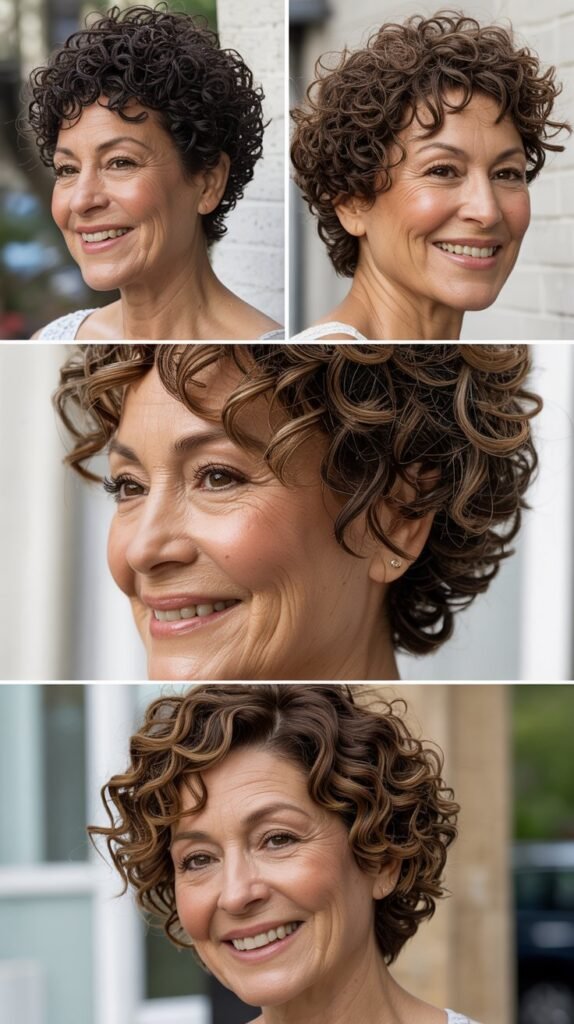
Selecting the right products for your short curly haircut dramatically impacts how your curls define, how long your style lasts, and how much time you spend styling.
Product needs change after 50 as hair texture evolves, making it essential to choose formulations designed for mature, textured hair.
Essential Product Categories:
- Sulfate-free cleansers: Remove buildup without stripping natural oils that mature hair needs
- Deep conditioners: Provide intensive moisture for drier, coarser gray or mature hair
- Leave-in conditioners: Offer ongoing hydration throughout the day
- Curl creams: Define curls while providing moisture and light hold
- Gels: Provide stronger hold for longer-lasting definition
- Oils and serums: Seal moisture and add shine to dull, aging hair
Products by Curl Type:
Type 2-3A (Loose Curls/Waves):
- Lightweight mousses for volume without weight
- Creams with light hold that won’t weigh down delicate curls
- Volumizing sprays for root lift
- Light gels for definition without crunchiness
Type 3B-3C (Medium Curls):
- Medium-hold curl creams for definition
- Gels that provide hold without stiffness
- Leave-in conditioners for ongoing moisture
- Refreshing sprays for second and third-day styling
Type 4A-4C (Coily Hair):
- Rich, butter-based creams for maximum moisture
- Strong-hold gels for definition on tight coils
- Heavy-duty deep conditioners for weekly treatments
- Oils to seal moisture and prevent dryness
Application Techniques:
- Prayer hands: Smooth products between palms, then press hands together around sections of hair
- Raking: Use fingers like a wide-tooth comb to distribute product through curls
- Scrunching: Apply product, then scrunch hair upward toward the scalp to encourage curl formation
- Shingling: Apply product to small sections individually for maximum definition (time-intensive)
Product Layering Order:
- Leave-in conditioner on soaking wet hair
- Curl cream applied in sections with prayer hands or raking
- Gel applied over cream using scrunching method
- Optional: Light oil on the exterior once curls are completely dry
Common Product Mistakes:
- Using too much product, which weighs down curls and creates buildup
- Applying products to dry or damp (not wet) hair, preventing proper distribution
- Touching hair while it dries, disrupting curl formation and creating frizz
- Not adjusting products seasonally (lighter in summer, heavier in winter)
- Continuing to use products that worked when younger but don’t suit mature hair texture
Budget-Friendly vs. Premium Options:
| Product Type | Budget Option | Premium Option | Key Difference |
|---|---|---|---|
| Leave-in Conditioner | Suave Essentials | DevaCurl Decadence | Ingredient quality, curl-specific formulation |
| Curl Cream | Garnier Fructis | Ouidad Advanced Climate | Hold strength, frizz control |
| Gel | LA Looks Sport | Biosilk Rock Hard | Hold without crunch, ingredient quality |
| Deep Treatment | VO5 Hot Oil | Olaplex No. 8 | Repair capabilities, lasting effects |
21. Styling Tools for Short Curly Hair
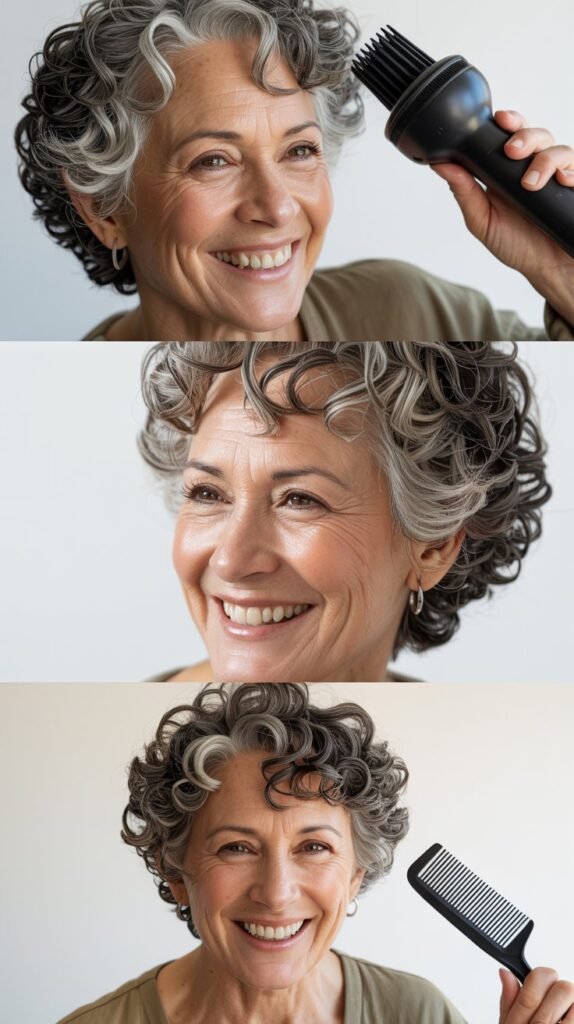
The right styling tools make the difference between frustration and effortless curl definition in short haircuts.
While curly hair generally requires fewer heat tools than straight hair, specific accessories and devices designed for textured hair significantly improve results.
Essential Tools:
Diffuser Attachment:
- Distributes heat evenly without disrupting curl patterns
- Look for diffusers with long fingers that reach the scalp
- Bowl diffusers work well for short hair lengths
- Use on low heat and low speed to prevent frizz
- Hover or cup curls gently rather than rubbing
Microfiber Towels or T-Shirts:
- Regular towels cause friction that creates frizz and breakage
- Microfiber absorbs water quickly without roughing up the cuticle
- T-shirt material is gentler than regular towels if microfiber isn’t available
- Scrunch or plop rather than rubbing to remove excess water
Wide-Tooth Comb:
- Used only on wet, conditioner-coated hair, never on dry curls
- Detangles without breaking curl patterns apart
- Start from ends and work toward roots to minimize breakage
- Many curly-haired women finger-detangle exclusively, skipping combs entirely
Denman Brush (Controversial):
- Some curl experts swear by Denman brushes for definition
- Others warn they disrupt natural curl patterns
- If using, only on soaking wet hair with product applied
- Brush small sections away from the scalp to create definition
- Not necessary for most short curly cuts
Root Clips:
- Metal clips placed at the roots while hair dries
- Lift roots away from scalp for volume
- Particularly helpful for fine hair or flat crowns
- Remove only after hair is completely dry
- Can create slight dents if not placed carefully
Silk or Satin Pillowcases:
- Reduce friction while sleeping, preserving curls overnight
- Cotton pillowcases absorb moisture and create frizz
- Satin bonnets or scarves offer even more protection
- Particularly important for very short cuts where sleep position affects style
Optional Advanced Tools:
Steamer:
- Professional-quality moisture penetration for deep conditioning treatments
- Helps products absorb more effectively
- Can be expensive but creates salon-quality results at home
- Not necessary for most people but beneficial for very dry or damaged hair
Hooded Dryer:
- Hands-free drying that’s gentler than handheld dryers
- Excellent for setting styles or deep conditioning treatments
- Takes longer but provides even heat distribution
- Investment piece that may not be necessary for wash-and-go short styles
Tools to Avoid:
- Fine-tooth combs that shred curl patterns and create massive frizz
- Brushes on dry hair that pull curls apart into frizzy masses
- High-heat blow dryers without diffusers that blast curls into submission
- Regular terrycloth towels that create friction and frizz
- Heat tools (flat irons, curling irons) that damage mature hair unnecessarily
22. Morning Refresh Techniques for Short Curls
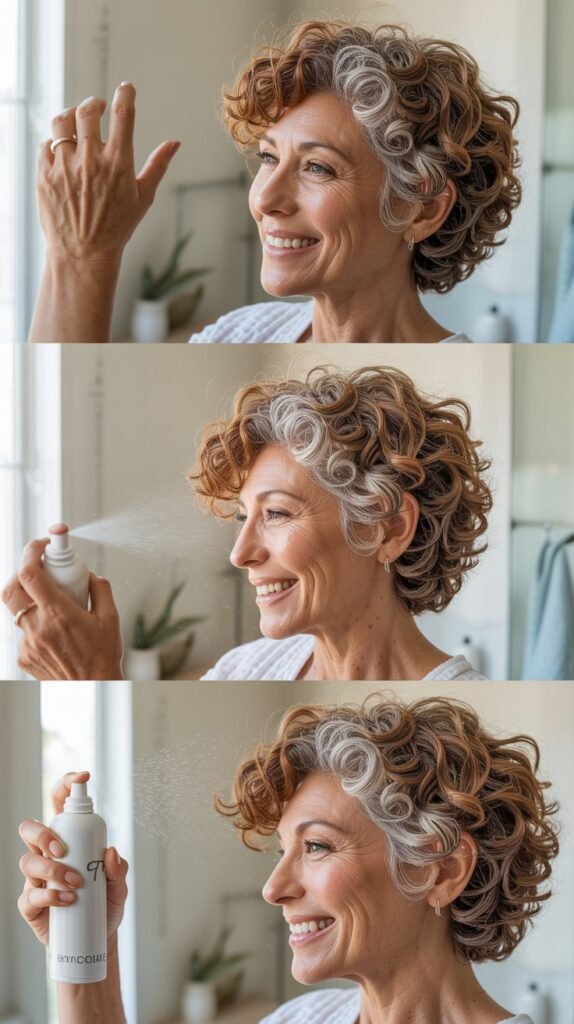
Refreshing short curly hair between wash days extends your style, saves time, and reduces manipulation that can cause breakage.
With proper techniques, second and even third-day curls can look as good as—or better than—day one.
Why Short Curls Need Refreshing:
- Sleeping flattens curls on one side regardless of protective measures
- Natural oils from your scalp can cause clumping or loss of definition
- Some curls inevitably get stretched or misshaped overnight
- Refreshing revives curl pattern without full washing and restyling
Basic Refresh Method:
- Lightly spray curls with plain water or water-based refresh spray
- Apply a small amount of curl cream or gel diluted with water
- Scrunch upward to encourage curl reformation
- Air dry or use a diffuser for a few minutes
- Fluff roots gently for volume once dry
Targeting Problem Areas:
- Flat side from sleeping: Spray generously and scrunch while diffusing
- Frizzy pieces: Apply light gel or oil to smooth without weighing down
- Lost definition: Rewet completely and reform curls with product
- Greasy roots: Use dry shampoo at roots, then refresh ends only
- Awkward flips: Pin while damp, remove once dry and set
Refresh Product Options:
- Plain water in a spray bottle: The simplest, most economical option
- Leave-in conditioner diluted with water: Adds moisture during refresh
- Curl refresh sprays: Specifically formulated to revive curls
- Diluted gel in spray bottle: Provides hold while refreshing
- Aloe vera juice and water: Natural option that provides light hold
Night Routine for Better Morning Curls:
- Pineapple method: Gather curls loosely on top of head with scrunchie
- Buff or bonnet: Wear satin protection over curls
- Silk pillowcase: Reduces friction even without protective styling
- Mini twists: Very short hair can be twisted into small sections overnight
- Bobby pin curls: Pin larger curls in place to maintain shape
When to Wash Instead of Refresh:
- Scalp feels itchy, uncomfortable, or excessively oily
- Product buildup is evident—hair feels sticky, crunchy, or stiff
- Curls won’t reform no matter how much you manipulate them
- It’s been more than 4-5 days since washing (for most people)
- You’ve been exercising heavily and scalp needs cleansing
Time Comparison:
- Full wash and style: 30-60 minutes
- Thorough refresh: 10-15 minutes
- Quick refresh: 3-5 minutes
- Spot refreshing problem areas only: 2-3 minutes
23. Dealing with Shrinkage in Short Cuts
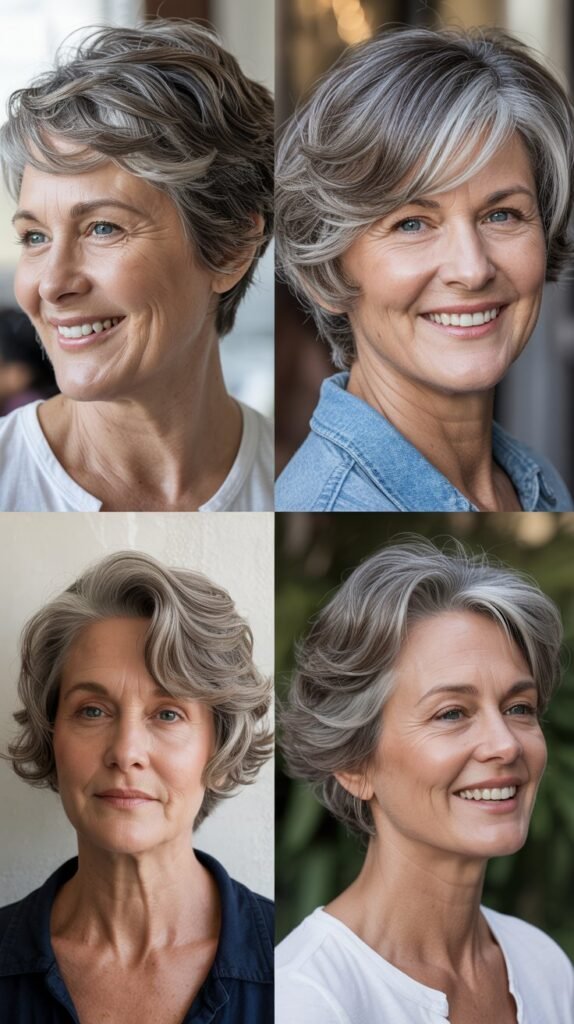
Shrinkage—the phenomenon where curly hair appears much shorter when dry than when stretched—affects all curl types but can be particularly dramatic in short haircuts.
Understanding and managing shrinkage helps you choose cuts that will meet your expectations and communicate effectively with your stylist.
Understanding Shrinkage:
- Type 3 curls typically shrink 20-30% of their stretched length
- Type 4A curls commonly shrink 50-60% of stretched length
- Type 4B-4C curls can shrink up to 75% or more
- Shrinkage is not damage—it’s a sign of healthy curl formation
- The tighter the curl pattern, the more dramatic the shrinkage
Cutting Considerations:
- Stylists must cut curly hair longer than the desired final length to account for shrinkage
- Dry cutting allows stylists to see actual length after shrinkage
- Wet cutting requires expertise to anticipate how much curls will shrink
- Communication is essential—show photos of desired length on similar curl types
- Consider bringing photos of your hair at various stages of drying
Managing Expectations:
- A “chin-length” curly bob may require cutting hair to shoulder length when stretched
- Very short pixie cuts on tight coils may appear almost buzzed when hair shrinks
- Bangs cut to eyebrow level when wet may shrink above eyebrows when dry
- Accept that shrinkage is part of having beautiful, defined curls
- Your curl pattern determines final length more than where scissors cut
Stretching Techniques (If Desired):
- Banding: Secure sections with multiple elastics down the length to stretch while drying
- African threading: Wrap thread down sections to stretch and protect overnight
- Blow drying with tension: Use cool air and gentle stretching (risks heat damage)
- Twist-outs or braid-outs: Create stretched styles with curl definition
- Roller sets: Create stretch while maintaining curl pattern
Why You Might Embrace Shrinkage:
- Shrinkage indicates healthy, properly moisturized curls
- Shrunken curls often have the most definition and spring
- Stretched styles require more manipulation that can cause breakage
- Natural shrinkage is part of your authentic curl pattern
- Many women find shrunken curls more versatile and easier to manage
Communicating with Your Stylist:
- Explain how much shrinkage your hair typically experiences
- If you’re new to wearing hair curly, ask the stylist to assess your shrinkage
- Request the stylist cut very conservatively at first, especially if cutting wet
- Bring reference photos of your curl type at various lengths
- Ask to check length at multiple stages during the cutting process
Shrinkage in Different Short Styles:
| Style Type | Shrinkage Consideration | Strategy |
|---|---|---|
| Pixie Cut | May appear almost buzzed on tight coils | Cut longer than anticipated or embrace ultra-short look |
| Curly Bob | Chin-length goal may require shoulder-length cutting | Communicate stretched vs. shrunken desired length |
| Tapered Cut | Sides may shrink up creating unusual shapes | Dry cutting essential for proper shaping |
| Shag | Multiple lengths shrink differently | Layer placement must account for varying shrinkage rates |
24. Seasonal Adjustments for Curly Hair Care

Short curly hair responds dramatically to seasonal weather changes, requiring adjustments to products, techniques, and even cuts throughout the year.
Understanding how humidity, temperature, and indoor heating affect your curls helps you maintain beautiful definition regardless of season.
Summer Challenges:
- High humidity causes frizz by allowing moisture to penetrate the hair shaft
- Heat and sun exposure can dry out hair and fade color
- Swimming in chlorinated or salt water damages curl definition
- Sweat at the scalp creates greasiness and potential odor
- Increased outdoor activity means more frequent washing needs
Summer Solutions:
- Use anti-humidity gels and serums that seal the cuticle
- Apply stronger-hold products that resist humidity better
- UV protection sprays or products prevent sun damage
- Pre-swimming conditioning treatments protect from chlorine and salt
- Lightweight products prevent heaviness in hot weather
- Consider slightly shorter cuts for cooler comfort
Winter Challenges:
- Low humidity and indoor heating create excessive dryness
- Static electricity makes hair flyaway and unmanageable
- Cold outdoor air followed by warm indoor air shocks hair
- Hats flatten curls and create awkward shapes
- Decreased moisture in the air means curls lose definition faster
Winter Solutions:
- Switch to heavier, more moisturizing creams and butters
- Use humidifiers indoors to restore environmental moisture
- Deep condition weekly to combat dryness
- Apply anti-static products or light oils
- Satin-lined hats prevent friction and flattening
- Consider slightly longer styles for more coverage and warmth
Spring/Fall Transition Strategies:
- Gradually adjust product weights as seasons change
- Pay attention to how your hair responds and adjust accordingly
- Keep both lightweight and heavy products available for fluctuating weather
- These transitional seasons often provide ideal curl conditions
- May be the best times to try new cuts or styles before extreme weather
Geographic Considerations:
Humid Climates:
- Require stronger-hold products year-round
- Anti-humidity formulations are essential
- More frequent trims to maintain shape and remove frizz-prone damaged ends
- Shorter cuts often more manageable than longer styles
Dry Climates:
- Need heavier moisturizing products consistently
- Leave-in conditioners and oils are essential
- Deep conditioning treatments should be weekly minimum
- May be able to use lighter gels since humidity isn’t a concern
Temperate Climates:
- Enjoy versatility of adjusting products seasonally
- May find spring and fall provide best natural curl conditions
- Can experiment with various product weights throughout the year
Product Rotation Strategy:
| Season | Cleansing | Conditioning | Styling | Frequency |
|---|---|---|---|---|
| Summer | Clarifying shampoo monthly | Light conditioner | Strong-hold gel | Wash every 2-3 days |
| Winter | Moisturizing co-wash | Deep conditioner weekly | Heavy cream + oil | Wash every 3-5 days |
| Spring/Fall | Balanced cleanser | Regular conditioner | Medium-hold cream/gel | Wash every 3-4 days |
25. Transitioning from Straight to Curly Styles
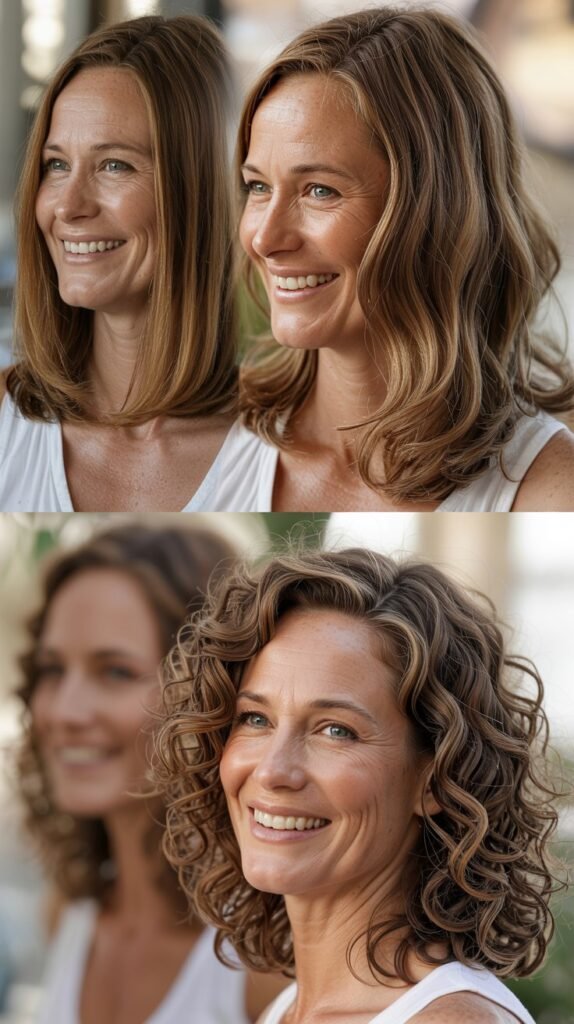
Many women over 50 spent decades straightening their naturally curly hair and are now ready to embrace their authentic texture.
Transitioning from heat-styled straight hair to natural curly styles in a short cut requires patience, proper cutting techniques, and relearning how to care for your curls.
Why Women Transition:
- Decades of heat damage become exhausting to maintain
- Desire to embrace natural texture and authenticity
- Heat styling becomes more damaging as hair ages
- Gray hair often has different, curlier texture than original colored hair
- Cultural and social acceptance of natural texture has increased
The Big Chop Approach:
- Cutting off all previously straightened hair at once
- Provides immediate freedom from damaged ends
- Can be emotionally challenging but ultimately liberating
- Best done with a curl-experienced stylist who can create a flattering short shape
- Allows you to immediately begin learning your natural curl pattern
Gradual Transition Approach:
- Slowly cutting away damaged ends over several months
- Allows psychological adjustment to shorter lengths
- May involve awkward phases with mixed straight and curly textures
- Transitional styles like twist-outs or braid-outs can bridge the gap
- Takes longer but may feel less dramatic
Understanding Your “New” Texture:
- Your natural curl pattern may have changed since you last wore it naturally
- Gray hair typically has different texture than pigmented hair
- Years of heat damage may have altered your curl pattern permanently in some areas
- Give your curls 3-6 months to recover and reveal their true pattern
- What you remember from your youth may not match your current curls
Learning Curve:
- Curly hair requires completely different products than straight hair
- Techniques like plopping, scrunching, and diffusing may be entirely new
- Expect trial and error finding the right products for your specific curl type
- Join online communities for support and product recommendations
- Consider booking consultations with curl specialists for education
Emotional Aspects:
- Seeing your natural texture after years can be surprisingly emotional
- Some women experience joy and liberation; others feel uncertain initially
- Give yourself time to adjust and learn to love your curls
- Surround yourself with supportive communities celebrating natural texture
- Remember that transitioning is a journey, not an instant transformation
Common Transition Challenges:
- Uneven curl patterns: Some sections may be more damaged than others—patience and cutting will eventually resolve this
- Different textures: Top layer often more damaged than underneath—protective styling helps
- Identity adjustment: You may feel you look different than expected—give yourself time to adjust
- Learning curve frustration: New techniques take practice—be patient with yourself
- Product overload: Too many recommendations can be overwhelming—start simple
26. Working with Multiple Curl Patterns

Many women experience multiple curl patterns throughout their head—loose waves at the crown, tighter curls at the nape, or varying patterns on different sides.
Short haircuts must address these mixed textures thoughtfully to create cohesive, flattering styles.
Why Multiple Patterns Occur:
- Genetic factors create naturally different curl patterns in different areas
- Damage from heat, chemicals, or manipulation affects sections differently
- Hormonal changes during menopause can alter curl patterns inconsistently
- Gray hair grows in with different texture than original pigmented hair
- Previous haircuts, styles, or treatments may have impacted various sections
Common Pattern Combinations:
- Loose waves (2B-2C) at crown with tighter curls (3A-3B) underneath
- Straight or slightly wavy bang area with curly back sections
- One side curlier than the other (often related to sleeping position)
- Tighter curls at the nape with looser curls at crown
- Mix of curl types creating overall inconsistent appearance
Cutting Strategies:
- Each section must be cut according to its specific curl behavior
- Looser curl areas may need more layers to prevent flatness
- Tighter curl sections may need bulk removal to prevent pyramid shape
- Transition areas require gradual blending between different patterns
- Dry cutting is essential for seeing how each section actually behaves
Product Application for Mixed Patterns:
- Heavier products on looser curls that need more definition
- Lighter products on tighter curls that already have strong pattern
- May require applying different products to different sections
- Volumizing products on flatter sections, defining products on curly sections
- Experiment to find what works for your specific pattern combination
Styling Approaches:
- Focus on creating overall harmonious shape rather than perfect uniform curls
- Embrace the variation as dimension and interest rather than fighting it
- Use techniques that enhance definition throughout, even if patterns differ
- Consider the overall silhouette more than individual curl uniformity
- Some women enhance looser sections with technique (denman brush, finger coils)
When to Seek Texture Services:
- If one section is significantly straighter from damage, consider curl-enhancing treatments
- Permanent waves can add curl to straighter sections for more uniformity
- Texturizers can loosen overly tight sections for better balance
- Discuss thoroughly with curl-experienced stylists before chemical treatments
- Many women prefer to simply work with their natural variation
Celebrating Your Unique Pattern:
- Multiple textures create natural dimension and visual interest
- Perfectly uniform curls can look artificial or forced
- Your unique pattern combination is part of your individual beauty
- Proper cutting makes multiple patterns look intentional rather than problematic
- Many women grow to love the character their mixed patterns provide
27. Color Considerations for Short Curly Hair

Color choices significantly impact how short curly haircuts appear, with some shades enhancing curl definition while others can flatten or age your appearance.
Strategic coloring techniques designed specifically for textured hair create dimension, depth, and contemporary style.
How Color Affects Curl Appearance:
- Multi-tonal color creates depth that makes curls appear more defined
- Solid, flat color can make curls look one-dimensional
- Highlights and lowlights separate individual curls visually
- Color placement can enhance or detract from face shape
- Damaged hair from over-processing loses curl definition
Coloring Techniques for Curly Hair:
Highlights:
- Painted freehand to follow curl patterns rather than in foils
- Creates natural-looking dimension that catches light beautifully
- Should be placed strategically to enhance face shape
- Can be subtle or dramatic depending on placement and tone
Balayage:
- Hand-painted color that creates soft, natural gradation
- Particularly flattering on short curly cuts
- Lower maintenance than traditional highlights
- Creates sun-kissed effect that complements most ages
Lowlights:
- Darker tones added to create depth
- Particularly effective in predominantly gray or silver hair
- Creates dimension in monochromatic color
- Can make hair appear fuller and thicker
Single-Process Color:
- All-over color application for complete coverage
- Simplest approach but can flatten curl appearance
- Best combined with glosses or toners for dimension
- Regular root touch-ups required every 4-6 weeks
Gray Blending:
- Strategic coloring that softens the contrast between gray and pigmented hair
- Creates gradual transition as more gray grows in
- Lower maintenance than full coverage
- Celebrates natural gray as part of the color palette
Best Colors for Women Over 50:
Warm Tones:
- Caramels, honey, golden browns enhance warm skin tones
- Create youthful, sun-kissed appearance
- Can brighten sallow or dull complexions
- Work beautifully with curls by creating natural-looking dimension
Cool Tones:
- Ash browns, champagne, cool blondes complement cool skin tones
- Can appear sophisticated and elegant
- Risk looking harsh if too dark or flat
- Silver and platinum shades embrace natural gray beautifully
Avoiding Common Color Mistakes:
- Very dark, flat colors can be aging and harsh against mature skin
- Overly light or bleached hair damages curl patterns significantly
- Red tones fade quickly and can appear brassy
- At-home box color rarely provides the dimension professional coloring achieves
- Over-processing destroys curl patterns—prioritize curl health over color
Maintaining Color on Curly Hair:
- Sulfate-free color-safe shampoos prevent rapid fading
- Deep conditioning treatments are essential after coloring
- Color-depositing conditioners maintain vibrancy between appointments
- UV protection products prevent sun fading
- Longer intervals between washing help color last longer
Color and Gray Hair:
| Approach | Maintenance | Effect | Best For |
|---|---|---|---|
| Full coverage | High—monthly touch-ups | Complete gray coverage | Women wanting no visible gray |
| Gray blending | Medium—every 6-8 weeks | Softened gray transition | Gradual transition to silver |
| Highlights only | Low—every 3-4 months | Dimensional with gray | Embracing natural gray |
| Fully natural gray | None—embracing natural | Authentic silver/gray | Confident in natural color |
28. Protective Styling for Short Curly Hair

Protective styling typically refers to styles that minimize manipulation and protect hair ends, but the concept looks different on short curly hair than on longer lengths.
These techniques help maintain curl health, reduce breakage, and extend time between styling sessions.
What Qualifies as Protective for Short Hair:
- Styles that minimize daily manipulation and combing
- Techniques that preserve moisture and prevent dryness
- Methods that protect hair during sleep
- Approaches that reduce exposure to environmental damage
- Strategies that extend styles between washing
Nighttime Protection:
Pineappling Method:
- Gather curls loosely on top of head with satin scrunchie
- Works best for hair at least 3-4 inches long
- Preserves curls overnight with minimal distortion
- Quick and easy nightly routine
Silk/Satin Bonnet or Scarf:
- Covers hair completely during sleep
- Prevents friction against cotton pillowcases
- Maintains moisture levels overnight
- Works for very short to medium-short lengths
Satin Pillowcase:
- Reduces friction even without actively protecting hair
- Works for women who don’t want to wear bonnets
- Less protective than covering hair but better than cotton
- Good option for pixie cuts too short for pineappling
Mini Twists or Braids:
- Very short hair can be twisted in small sections
- Preserves curl pattern while protecting overnight
- Creates stretched curl pattern when untwisted
- Requires some length—at least 2-3 inches
Low-Manipulation Styling:
Wash-and-Go:
- Ultimate low-manipulation style for short curly hair
- Apply products, encourage curl formation, then leave alone
- Minimal daily touching preserves definition and reduces breakage
- Refresh as needed rather than reapplying products daily
Finger Coiling:
- Defining individual curls by wrapping around finger
- Creates uniform curl pattern with minimal tool use
- Time-intensive but gentle on hair
- Results last multiple days with proper nighttime protection
Protective Products:
- Leave-in conditioners maintain moisture throughout wear
- Oils seal in moisture and protect against environmental damage
- Heat protectants essential if using any heat styling
- UV protection sprays prevent sun damage and color fading
Environmental Protection:
- Hats and scarves shield hair from harsh weather
- Satin-lined hats prevent friction that cotton or wool creates
- Swimming caps protect from chlorine and salt water
- Covering hair in heavy wind or extreme cold
When Short Hair Doesn’t Need Traditional Protection:
- Frequent trims naturally remove damaged ends before significant breakage
- Shorter lengths mean less mechanical damage from brushing, styling, or daily activities
- No long ends to split, tangle, or break off
- The focus shifts to maintaining scalp health and overall moisture balance
Signs Your Hair Needs More Protection:
- Excessive shedding or breakage despite regular trims
- Dryness and brittleness, especially at the ends
- Loss of curl definition and increased frizz
- Tangling or matting, especially after sleeping
- Curl pattern becoming damaged or loosening
29. Dealing with Thinning Hair and Curl Loss

Hair thinning and changes in curl pattern are common experiences for women over 50 due to hormonal shifts, aging, stress, and health factors.
Short curly haircuts can strategically address these changes, creating the illusion of fuller hair while working with reduced density.
Understanding Age-Related Hair Changes:
- Hormonal changes during and after menopause reduce hair density
- Individual hair strands may become finer in diameter
- Curl patterns often loosen or change completely
- Growth rate slows, making hair seem to stop growing
- Follicles may produce less hair overall, creating visible thinning
Strategic Cutting for Thin Curly Hair:
- Shorter lengths prevent weight from pulling curls flat
- Crown layering creates lift where thinning is most visible
- Removing bulk from sides focuses fullness at the top
- Graduated cuts create stacked volume at the back
- Face-framing layers draw attention away from thinning areas
Best Short Styles for Thinning Hair:
Textured Pixie:
- Removes weight while creating maximum volume on top
- Can be cut to camouflage specific thinning areas
- Frequent trims keep hair looking healthy and full
- Requires minimal styling that won’t further damage fragile hair
Curly Bob with Volume:
- Maintains enough length for curl definition
- Strategic layering creates illusion of fullness
- Can incorporate volumizing products effectively
- Versatile enough for multiple styling approaches
Curly Shag:
- Heavy texturizing separates curls, creating appearance of more hair
- Piece-y layers make individual sections look fuller
- Movement and texture distract from areas of thinness
- Works well with volumizing styling techniques
Product Solutions:
Volumizing Products:
- Mousses and foams add body without weight
- Root-lifting sprays create lift at the scalp
- Texturizing sprays make hair appear fuller and thicker
- Lightweight gels provide hold without weighing down thin hair
Growth-Stimulating Products:
- Caffeine-based treatments may promote growth
- Minoxidil (Rogaine) is FDA-approved for female hair loss
- Biotin and other supplements (consult doctor first)
- Scalp treatments that improve follicle health
Products to Avoid:
- Heavy creams and butters that weigh down fine hair
- Oils applied to roots that make thinness more visible
- Excessive product that causes buildup and flatness
- Harsh sulfates that strip already fragile hair
Styling Techniques for Fuller Appearance:
- Diffuse upside down to encourage root lift
- Use root clips while drying to train volume at crown
- Avoid tight hairstyles that stress hair follicles
- Gently shake roots once dry for maximum volume
- Apply products mid-shaft to ends, not at roots
Medical Considerations:
When to Consult a Doctor:
- Sudden, dramatic hair loss rather than gradual thinning
- Bald patches or circular areas of complete loss
- Accompanying symptoms like fatigue, weight changes, or scalp issues
- Family history of alopecia or autoimmune conditions
- If hair loss significantly affects quality of life or emotional wellbeing
Possible Medical Causes:
- Thyroid disorders (both hypo- and hyperthyroidism)
- Iron deficiency anemia
- Autoimmune conditions like alopecia areata
- Telogen effluvium from stress or illness
- Medication side effects
Treatment Options:
- Prescription medications like spironolactone or minoxidil
- Hormone replacement therapy (if appropriate)
- PRP (platelet-rich plasma) treatments
- Low-level laser therapy
- Addressing underlying medical conditions
Camouflaging Techniques:
- Strategic parting to cover thinning areas
- Volumizing powders that color the scalp
- Hair fibers that attach to existing hair
- Topical scalp concealers
- Strategic color placement that creates depth
30. Consultation Tips: Communicating with Your Stylist

Effective communication with your hairstylist is crucial for achieving short curly haircuts that meet your expectations, especially when curl patterns can behave unpredictably.
Proper preparation and clear communication prevent disappointments and build productive stylist-client relationships.
Pre-Consultation Preparation:
Gather Visual References:
- Save 5-10 photos of styles you love on similar curl types
- Include multiple angles (front, side, back) of preferred styles
- Find photos of people with similar face shapes and curl patterns
- Save examples of what you don’t want as well
- Consider bringing photos of your hair at various lengths and stages
Assess Your Lifestyle:
- How much time can you realistically spend styling daily?
- What’s your comfort level with maintenance between appointments?
- Do you have any physical limitations affecting styling ability?
- How much are you willing to spend on products and appointments?
- Are there professional dress codes or social considerations?
Understand Your Hair:
- What’s your curl type and pattern?
- How does humidity affect your hair?
- How much shrinkage do you typically experience?
- What’s your hair’s porosity and density?
- How has your hair changed over time?
Questions to Ask Your Stylist:
About Their Experience:
- How long have you been cutting curly hair specifically?
- Are you DevaCurl certified or trained in other curl-specific techniques?
- Do you wear your own hair curly or have extensive curly hair experience?
- Can I see before and after photos of curly cuts you’ve done?
- Do you have experience with my specific curl type?
About the Cut:
- How will this style look on my face shape and curl pattern?
- How much length will we lose accounting for shrinkage?
- What’s the maintenance schedule for this cut?
- How will this cut grow out over the next few months?
- What styling techniques will I need to use at home?
About Products and Maintenance:
- What specific products do you recommend for my hair?
- How should I style this cut at home?
- What’s your recommended wash schedule?
- How do I refresh this style between washes?
- When should I book my next appointment?
Red Flags to Watch For:
- Stylist who only cuts curly hair when it’s wet without discussing dry cutting
- Dismissive attitude toward your concerns or preferences
- Pressure to buy excessive expensive products
- Rushing through the consultation without listening
- No curl-specific training or experience
- Portfolio showing only straight hair or blow-dried curly hair
During the Appointment:
Speak Up:
- If you’re uncomfortable with how much length is being removed
- If you notice the style isn’t matching your reference photos
- If you don’t understand the stylist’s technique or reasoning
- If something feels wrong even if you can’t articulate exactly what
- Ask for pauses to check length and shape throughout
Ask for Education:
- Request that the stylist explain their technique as they work
- Ask about the reasoning behind specific cuts or angles
- Have them demonstrate styling techniques you’ll use at home
- Take photos of the styling process for reference
- Don’t be afraid to ask “silly” questions—it’s your hair
After the Cut:
Evaluate Honestly:
- Live with the cut for at least a week before judging finally
- Style it yourself at home to see realistic maintenance
- Take photos in various lighting and angles
- Consider whether issues are the cut itself or your styling
Follow-Up Communication:
- Contact the stylist if you have concerns or questions
- Book your next appointment before leaving if you love the cut
- Provide feedback (positive or constructive) to help them understand your preferences
- Build a relationship with a stylist who understands your hair
What to Do If You’re Unhappy:
- Contact the salon within a few days if the cut is significantly different than discussed
- Most reputable salons will correct issues or offer refunds
- Be specific about what you’re unhappy with
- If the relationship isn’t working, it’s okay to find a different stylist
- Leave honest reviews (both positive and negative) to help other curly-haired clients
Conclusion
Finding your perfect short curly haircut transforms more than just your appearance—it changes how you feel about yourself, how you spend your mornings, and how confidently you move through the world.
These 67 texture-loving short curly haircuts for women over 50 that define curls represent a celebration of natural beauty, practical styling, and the freedom that comes from embracing your authentic self.
Whether you choose a bold pixie that showcases your silver curls, a textured bob that frames your face beautifully, or a dramatic undercut that makes a statement, the right cut works with your unique curl pattern rather than against it.
Remember that your hair’s natural texture is not something to fight or hide but rather a distinctive feature to enhance and celebrate through strategic cutting, proper products, and techniques designed specifically for curls.
As you explore these options and communicate clearly with a curl-experienced stylist, you’ll discover that age isn’t a limitation—it’s simply another chapter where you get to define what beautiful means on your own terms.
Your curls, combined with the confidence that comes from decades of life experience, create a combination that’s both powerful and authentically you.
