
There’s something undeniably captivating about a woman who confidently rocks short hair, and the pixie bob sits perfectly at the intersection of boldness and femininity.
If you’ve been contemplating the chop but worried about losing your soft, feminine edge, 60 Soft Chic Pixie Bob Hairstyles That Feel Feminine is your ultimate guide to discovering that short hair can be just as romantic, delicate, and graceful as any flowing locks.
This style revolution combines the ease of a pixie with the versatility of a bob, creating looks that frame your face beautifully while keeping maintenance refreshingly simple.
Whether you’re drawn to wispy layers that dance around your cheekbones, textured cuts that add movement and dimension, or sleek styles that exude understated elegance, this collection showcases how the pixie bob transcends the “edgy” stereotype to embrace softness in all its forms.
From subtle styling techniques to color choices that enhance femininity, you’ll discover how strategic layering, face-framing pieces, and the right finishing touches can transform a simple short cut into a statement of sophisticated charm.
Get ready to explore dozens of variations that prove you don’t need length to feel utterly feminine, and find the perfect pixie bob that speaks to your personal style while celebrating the natural beauty of your features.
1. Classic Soft Pixie Bob with Side-Swept Bangs
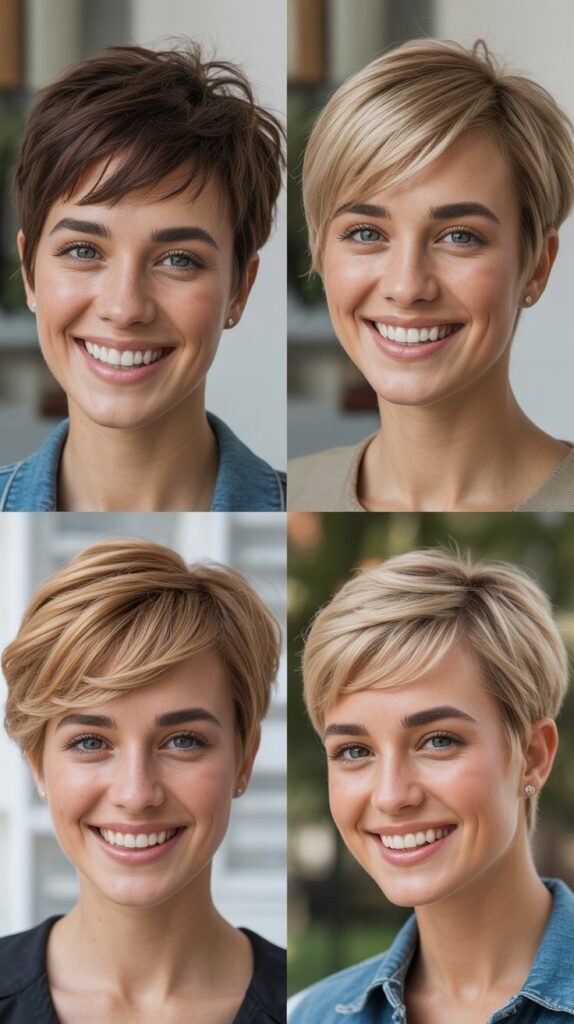
The classic soft pixie bob with side-swept bangs serves as the foundation for feminine short hair, offering a timeless silhouette that flatters virtually every face shape.
This versatile cut balances structure with softness through its carefully crafted layers and romantic fringe.
Key Features of This Timeless Cut
- The length typically falls between the ear and chin, creating a bob-like silhouette while maintaining pixie-cut ease and manageability.
- Side-swept bangs add instant femininity by creating asymmetry that draws attention to the eyes and softens angular features.
- Layers throughout the cut prevent bulkiness and add natural movement that keeps the style from appearing too severe or structured.
- The nape is kept slightly shorter to maintain the pixie element while the front remains longer for that signature bob characteristic.
- This cut works exceptionally well for those transitioning from longer hair, as it provides enough length to feel secure while embracing the freedom of short hair.
Styling Techniques for Maximum Softness
- Apply a lightweight mousse to damp hair to create natural volume without stiffness or crunchiness.
- Use a round brush while blow-drying to direct bangs to the side and create gentle curves throughout the cut.
- A flat iron can smooth the hair while adding subtle bends at the ends for a softer, less blunt appearance.
- Finish with a small amount of smoothing serum on the ends to eliminate frizz and add a healthy shine.
- For extra texture, wrap random sections around a curling iron briefly, then brush through for piece-y, touchable waves.
Best Face Shapes and Hair Types
- Oval faces carry this style effortlessly, as the balanced proportions complement the cut’s inherent symmetry.
- Heart-shaped faces benefit from the way side-swept bangs minimize a wider forehead while the length balances a narrower chin.
- Fine to medium hair textures work best, as the layers create the illusion of fullness without requiring excessive thickness.
- Straight to slightly wavy hair holds the style most reliably, though gentle waves can add romantic appeal.
- Those with thick hair can still achieve this look with proper thinning techniques and texturizing to prevent a heavy, triangular shape.
2. Layered Pixie Bob with Feathered Ends
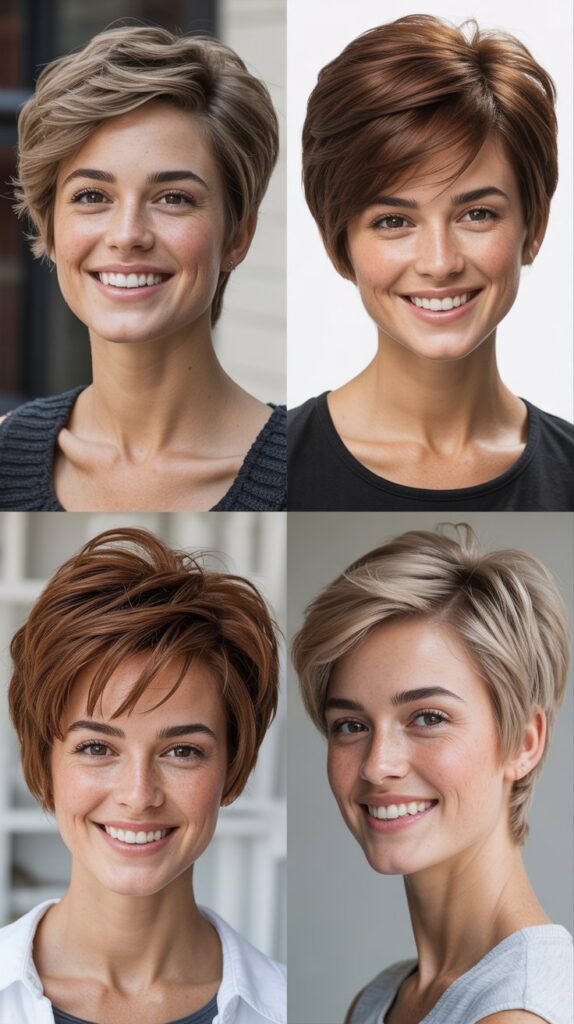
Feathered ends bring an ethereal quality to the pixie bob, creating movement and airiness that feels inherently feminine and soft.
This technique involves cutting the ends at angles that allow hair to separate naturally into delicate, wispy pieces.
The Art of Feathering for Feminine Appeal
- Feathering involves point-cutting or slide-cutting techniques that remove weight from the ends while creating texture and separation.
- The result is hair that moves independently rather than falling in a solid, heavy line that can appear masculine.
- Shorter layers around the crown add height and volume, while longer feathered pieces around the face provide softness.
- This technique works particularly well for creating that “I woke up like this” effortless beauty that modern femininity celebrates.
- The feathered approach prevents the blunt, geometric look that sometimes makes pixie cuts feel too harsh or androgynous.
Maintenance and Styling Requirements
- Regular trims every 4-6 weeks maintain the feathered texture and prevent the ends from appearing ragged or overgrown.
- A texturizing spray applied to damp hair enhances the piece-y separation that makes feathering so appealing.
- Blow-dry with your fingers rather than a brush to maintain the natural, undone quality of feathered ends.
- A small amount of pomade or wax can be worked through the ends to define individual pieces and add controlled separation.
- This style actually looks better with a bit of natural texture, so embrace your hair’s inherent movement rather than fighting it.
Color Techniques That Enhance Feathering
- Subtle highlights throughout the layers catch light differently on each feathered piece, creating dimension and visual interest.
- Balayage techniques work beautifully with feathered cuts, as the hand-painted color follows the natural movement of the hair.
- Lighter ends create the illusion of even more texture and make the feathering more visible and impactful.
- Multi-tonal color prevents the cut from appearing flat, especially important with shorter hair that has less surface area to showcase color.
- Warm tones like honey, caramel, and rose gold add softness, while cooler tones create a more modern, edgy-yet-feminine vibe.
3. Asymmetrical Pixie Bob for Modern Femininity
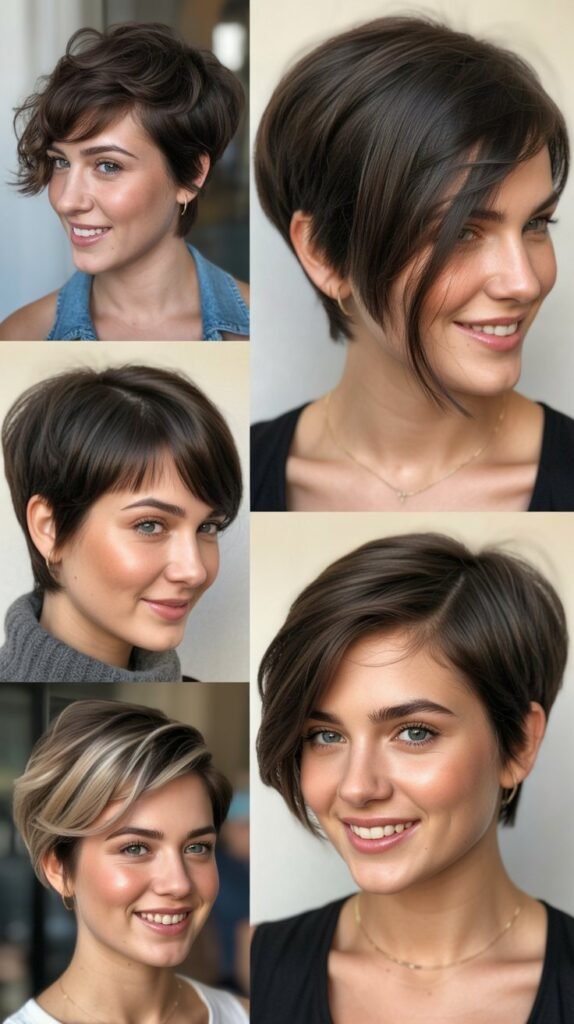
The asymmetrical pixie bob makes a bold statement while maintaining feminine appeal through its dramatic yet carefully balanced proportions.
This style features intentionally uneven lengths that create visual interest and frame the face in unexpected, flattering ways.
Understanding Asymmetry in Short Cuts
- One side is cut significantly shorter (often clippered or very close to the head) while the other maintains more length, typically reaching the chin or jaw.
- The dramatic difference in length creates a fashion-forward look that feels contemporary and confident without sacrificing softness.
- The longer side can be styled with waves, curls, or sleekness depending on the desired effect and occasion.
- This cut naturally directs attention to facial features, particularly the eyes and cheekbones, through its diagonal lines.
- Asymmetry adds an element of surprise and personality that allows for individual expression within the pixie bob framework.
Styling the Two Sides Differently
- The shorter side often looks best when styled close to the head with a bit of pomade for sleekness and definition.
- The longer side provides opportunities for various styling options including tucking behind the ear, sweeping across the face, or adding curls.
- Creating volume on the longer side while keeping the short side flat emphasizes the asymmetry and creates balanced proportions.
- Experimenting with different partings can completely transform the look, making this one cut feel like multiple hairstyles.
- The contrast between the two sides allows you to play with both edgy and soft elements simultaneously.
Who Should Choose This Bold Style
- Confident individuals who want their hair to make a statement and aren’t afraid of turning heads appreciate this distinctive cut.
- Oval and heart-shaped faces handle asymmetry particularly well, as the diagonal lines create flattering angles.
- Those with strong facial features can balance them with the bold lines of an asymmetrical cut.
- Fine hair benefits from the strategic use of length and shortness to create the illusion of fullness where needed.
- If you love changing your look frequently, the longer side offers styling versatility while the short side provides ease.
4. Textured Pixie Bob with Soft Waves
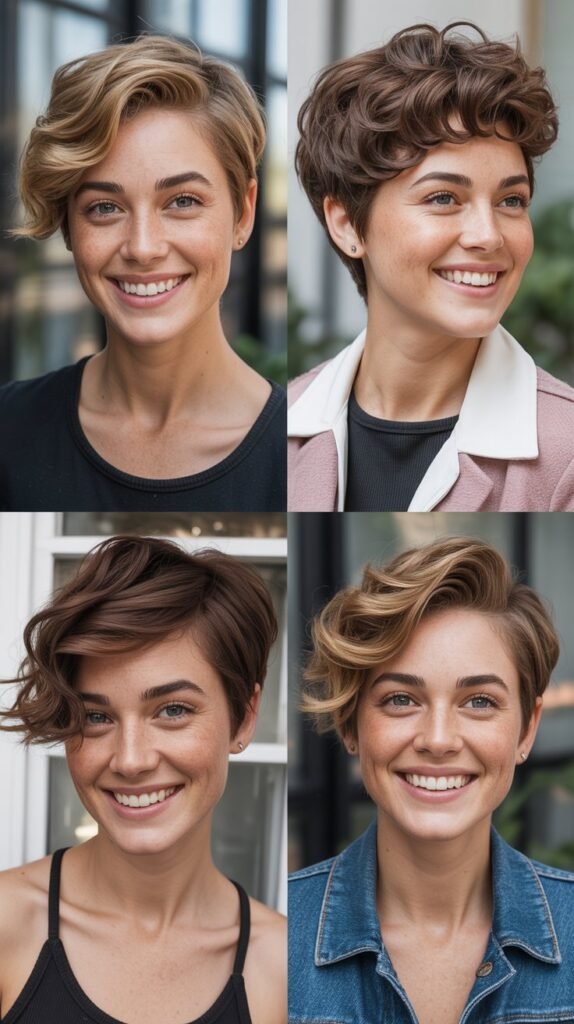
Soft waves transform the pixie bob from a structured cut into a romantic, touchable style that exudes feminine charm.
This approach adds dimension and movement through deliberate wave patterns that soften the overall silhouette.
Creating Natural-Looking Waves in Short Hair
- Use a small-barrel curling iron (3/4 inch to 1 inch) to create waves that are proportionate to the shorter length.
- Alternate the direction you wrap hair around the iron to create a more natural, less uniform wave pattern.
- Allow curls to cool completely before gently separating them with your fingers for soft, touchable waves.
- A sea salt spray applied to damp hair before styling enhances natural texture and makes waves hold longer.
- For extremely short sections, simply use your fingers to create bends and texture rather than attempting to curl them with tools.
Products That Enhance Wavy Texture
- Texturizing sprays add grip and separation that help waves hold their shape without appearing stiff or crunchy.
- Light-hold mousses provide structure and memory to fine hair that might otherwise fall flat.
- Curl-enhancing creams work on naturally wavy hair to define the pattern without weighing it down.
- Dry shampoo adds texture and volume at the roots, which helps support the wave pattern throughout the hair.
- Finishing sprays with flexible hold maintain the style while allowing movement and touchability.
Day-to-Night Styling Transitions
- For daytime, create loose, barely-there waves that look natural and effortless with minimal product.
- Transition to evening by adding more defined waves with a curling iron and using more styling product for hold.
- Incorporate accessories like small clips, pins, or headbands to elevate the wavy pixie bob for special occasions.
- Refresh morning waves by misting with water and scrunching to reactivate products and revive the texture.
- The beauty of wavy texture is its forgiveness—slightly messy waves often look even more appealing and feminine than perfect ones.
5. Pixie Bob with Wispy Face-Framing Layers
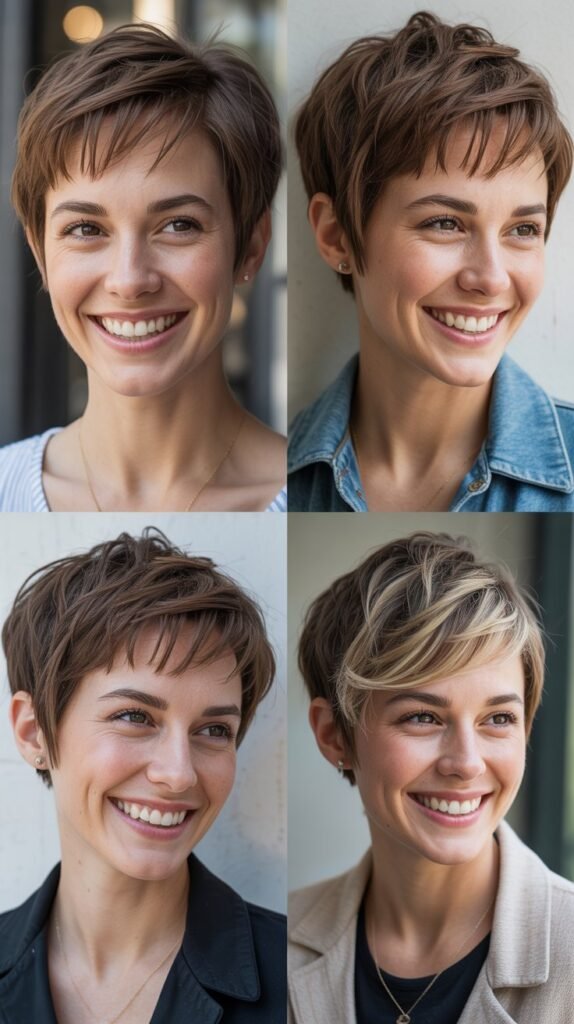
Face-framing layers are the secret to maximizing femininity in any pixie bob, creating soft tendrils that draw attention to your best features.
These strategic layers soften the face and add a romantic quality that longer hair often achieves through similar techniques.
Strategic Layer Placement for Face-Framing
- The longest layers typically fall around the cheekbones or jawline, creating a flattering frame that highlights these areas.
- Gradual layering from shorter crown layers to longer face-framing pieces creates seamless transitions and natural movement.
- Wispy, thinned-out ends on these face-framing pieces prevent them from appearing chunky or heavy against the skin.
- The layers should be cut to follow the natural curve of the face, creating a custom, tailored appearance.
- Extra texture at the ends of these layers allows them to bend and move naturally, catching light and creating dimension.
How Face-Framing Layers Enhance Features
- Layers that graze the cheekbones draw attention to the eyes and create a lifted, youthful appearance.
- Jawline-length pieces can soften a strong jaw or add definition to a weak one, depending on styling.
- These layers create shadows and highlights on the face that can slim rounder faces or add softness to angular ones.
- The movement of face-framing pieces as you turn your head adds a feminine, graceful quality to your overall presentation.
- Strategically placed layers can minimize concerns about ears, forehead size, or facial asymmetry through optical illusion.
Styling Tips for Maximum Impact
- Use a small round brush to curl face-framing layers under or away from the face, depending on your preference and face shape.
- A flat iron can create gentle bends in these pieces for a modern, piece-y look that still feels soft.
- Apply a small amount of lightweight serum to face-framing layers to add shine and prevent frizz that can diminish their delicate appearance.
- Pin one side back to showcase one ear and create asymmetry that highlights the beautiful layering on the opposite side.
- Let these layers air-dry for the most natural, effortless feminine look that works for everyday wear.
6. Choppy Pixie Bob with Soft Texture
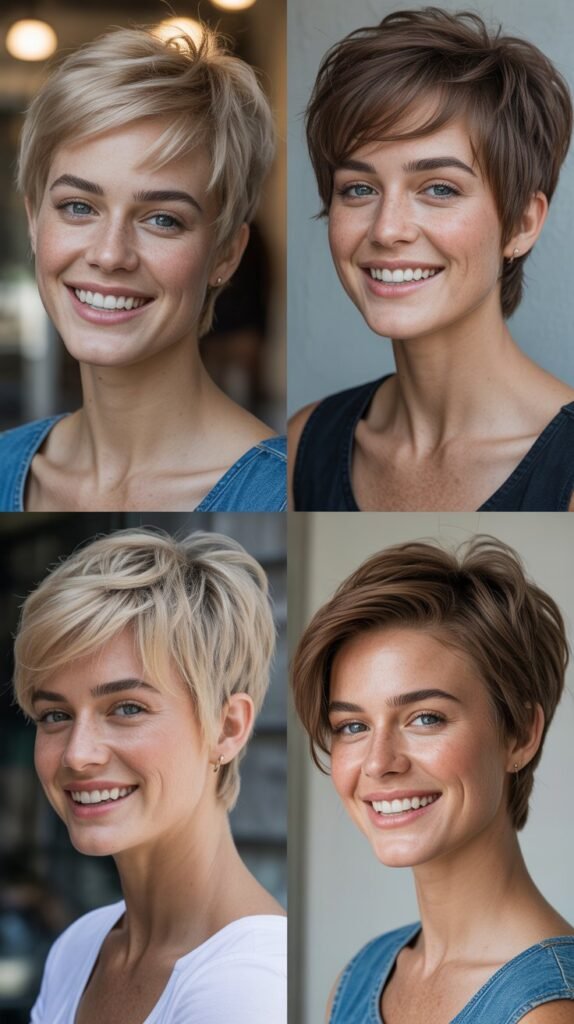
The choppy pixie bob combines edgy cutting techniques with soft styling to create a balanced look that’s both modern and feminine.
This style features deliberate, uneven layers that create texture and interest while maintaining an overall soft appearance.
The Choppy Cut Technique Explained
- Choppy layers are created through point-cutting, where scissors cut into the hair at angles rather than straight across.
- This technique removes weight and creates separation between hair sections for a textured, lived-in appearance.
- The varying lengths throughout the cut prevent a uniform, too-perfect look that can feel stiff or dated.
- Choppy doesn’t mean messy—the cut should still have shape and intention, with choppiness adding interest within a defined silhouette.
- This approach works especially well for thick hair, as it removes bulk while creating desirable movement and airiness.
Balancing Edge with Softness
- The key to keeping a choppy cut feminine lies in the styling—use soft products rather than heavy waxes or gels.
- Blow-dry with a round brush to add gentle curves that contrast with the choppy, straight-cut edges.
- Incorporate softer elements like side-swept bangs or longer front pieces to balance the texture throughout.
- Color choices can soften a choppy cut—warm tones and subtle highlights add dimension without harsh contrast.
- The overall shape should still follow classic flattering lines even if the internal texture is more contemporary and edgy.
Daily Styling for Choppy Texture
- Apply a volumizing mousse to damp hair, focusing on roots to create lift that showcases the choppy layers.
- Blow-dry with your fingers, scrunching and lifting to enhance the natural separation the cut creates.
- A texturizing spray or dry shampoo adds additional piece-y definition and keeps the style from falling flat.
- For a softer look, run a flat iron through sections while twisting your wrist slightly to create subtle bends.
- Embrace the imperfect nature of choppy cuts—they’re meant to look a bit undone and should never appear overly styled.
7. Rounded Pixie Bob with Volume at the Crown
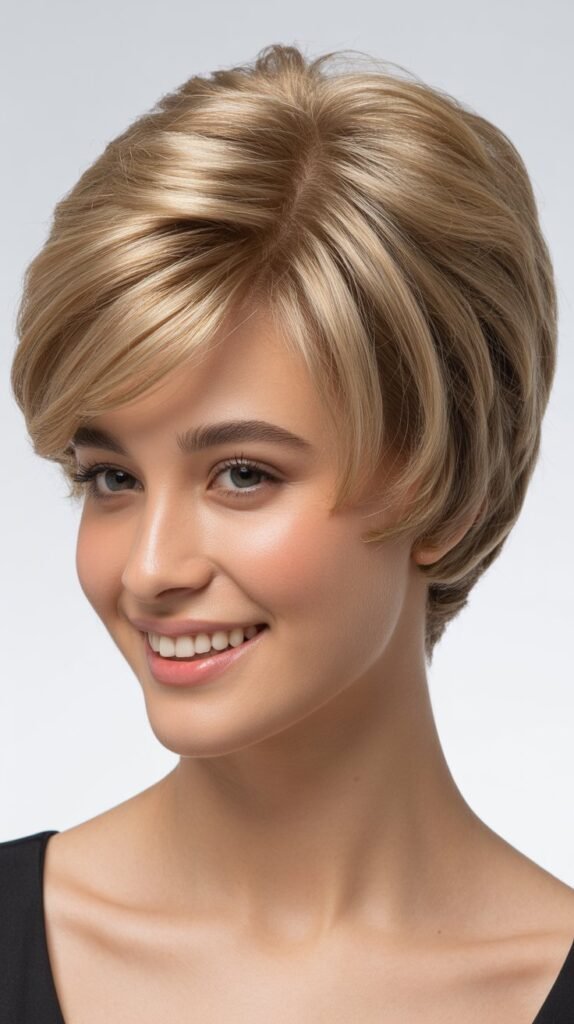
Crown volume transforms a pixie bob from flat and boyish to soft and feminine by creating lift and roundness at the top of the head.
This styling approach emphasizes the rounded, softer shape traditionally associated with feminine beauty.
Creating Natural-Looking Crown Volume
- Blow-dry with a round brush, rolling hair up and away from the scalp to create lift at the roots.
- Use Velcro rollers on the crown section while hair is still warm from blow-drying to set volume as hair cools.
- Tease very gently at the roots using a fine-toothed comb, then smooth the top layer for volume that doesn’t look messy.
- Apply volumizing powder directly to roots for instant lift that lasts throughout the day.
- The volume should create a gentle, rounded shape rather than an angular or spiky silhouette for maximum femininity.
Products Essential for Lasting Volume
- Volumizing mousses applied to damp hair at the roots create a foundation for lift that holds throughout the day.
- Root-lifting sprays work on fine hair that struggles to maintain volume, providing targeted support where needed most.
- Dry shampoos not only refresh hair but add texture and grip that help volume stay in place longer.
- Light-hold hairsprays misted underneath sections before styling lock in volume without making hair crunchy or stiff.
- Avoid heavy oils or serums at the crown, as these weigh down hair and eliminate the volume you’ve worked to create.
Volume for Different Hair Types
| Hair Type | Volume Strategy | Recommended Products | Expected Longevity |
|---|---|---|---|
| Fine | Use lightweight mousses and powders; over-directing during blow-dry | Volumizing mousse, root powder, light hairspray | 6-8 hours with refresh |
| Medium | Round brush blow-drying with heat protectant; Velcro rollers | Volumizing spray, medium-hold mousse | 8-12 hours |
| Thick | Focus on removing weight through layers; lift at roots only | Texturizing spray, light mousse | All day naturally |
| Curly/Wavy | Encourage natural lift by diffusing upside down | Curl-enhancing mousse, diffusing spray | All day naturally |
8. Sleek and Polished Pixie Bob
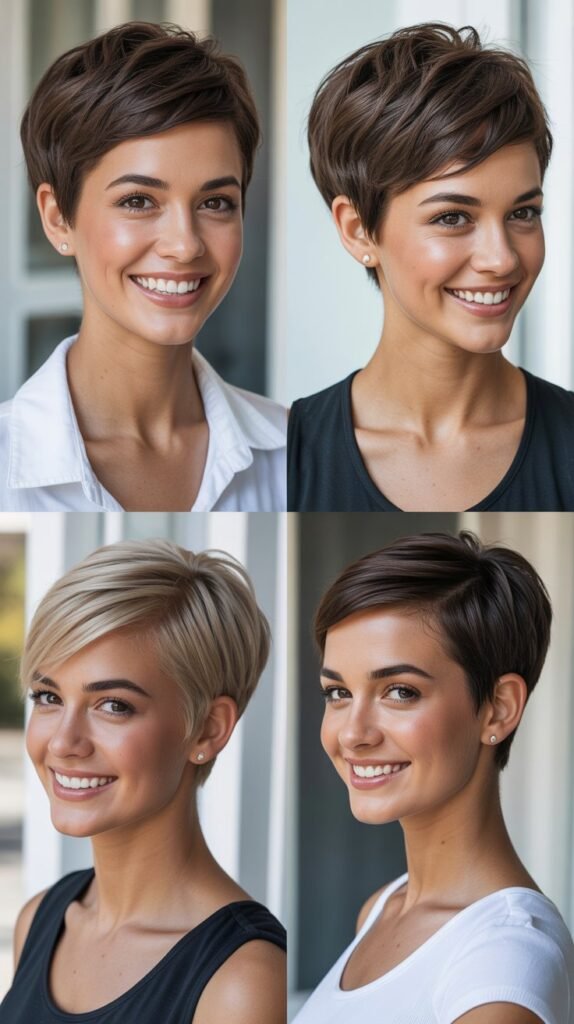
The sleek pixie bob offers sophisticated, refined femininity through its smooth, glossy finish and clean lines. This style proves that minimalism and simplicity can be just as feminine as textured, tousled looks.
Achieving the Perfect Sleek Finish
- Start with a smoothing shampoo and conditioner to create a sleek foundation from the washing stage.
- Apply a heat protectant and smoothing serum to damp hair before any heat styling to prevent frizz and add shine.
- Use a paddle brush and tension while blow-drying to stretch the hair smooth and eliminate any wave or curl.
- Follow with a flat iron on low-to-medium heat, working in small sections for a consistently smooth result.
- Finish with a lightweight shine spray or a tiny amount of smoothing oil on the mid-lengths and ends for a glossy, polished appearance.
When Sleek Works Best
- Professional settings where polished, put-together appearance is valued and expected.
- Evening events and formal occasions where elegance and sophistication are the desired aesthetic.
- Hot, humid weather when fighting natural texture becomes frustrating—embrace sleekness as your go-to summer style.
- When you want your cut and color to be the stars of the show without competing texture or volume.
- For special photographs or events where you want a timeless, classic look that won’t appear dated in future years.
Maintaining Sleekness Throughout the Day
- Carry a small amount of smoothing serum or anti-frizz cream for touch-ups when humidity threatens your style.
- Avoid touching your hair excessively, as oils from your hands can create texture and reduce shine.
- If you’ll be outside in wind or weather, consider a light-hold hairspray to lock in the smooth style.
- Sleep on a silk or satin pillowcase to maintain sleekness overnight if you style your hair the evening before.
- A quick once-over with a flat iron in the morning can refresh the sleek look without starting the entire styling process over.
9. Tousled Pixie Bob with Bedhead Appeal
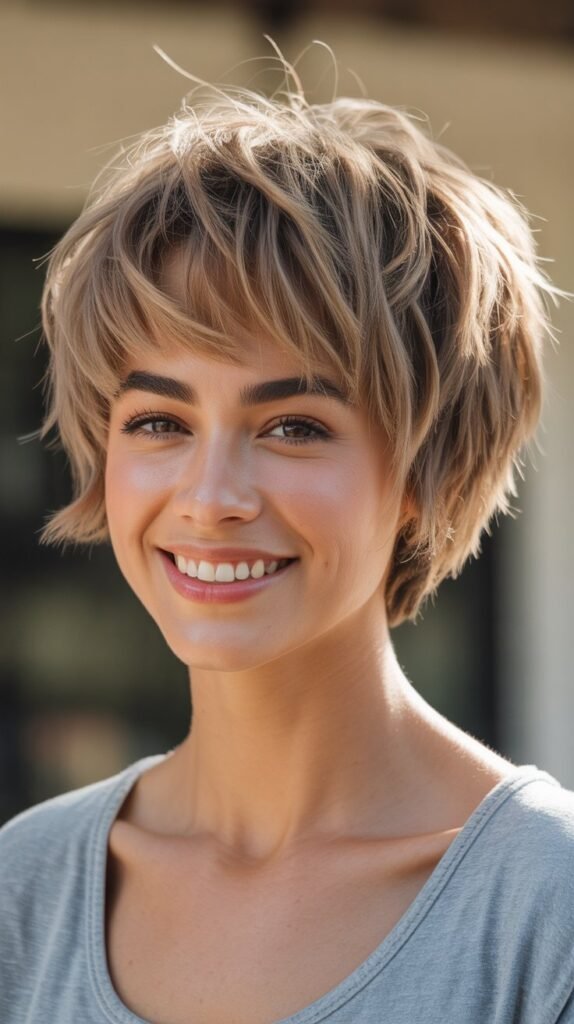
The tousled, deliberately messy pixie bob embraces effortless femininity through its casual, undone appearance.
This style celebrates natural texture and creates an approachable, relaxed vibe that still feels polished enough for most occasions.
The Art of Intentional Messiness
- The key difference between messy and sloppy is intention—tousled hair should still have shape and direction.
- Create texture by applying sea salt spray or texturizing spray to damp hair, then scrunching as you diffuse or air-dry.
- Use your fingers rather than brushes to style, which creates natural separation and prevents an overly groomed appearance.
- Strategic placement of messiness matters—keep some areas smoother while concentrating texture in others for balance.
- This style works best when you embrace your hair’s natural tendencies rather than fighting them, making it low-maintenance and authentic.
Products for Touchable, Messy Texture
- Sea salt sprays create that beachy, piece-y texture that defines the tousled aesthetic without stiffness.
- Texturizing pastes provide hold and definition while maintaining a matte finish that looks natural rather than styled.
- Dry shampoos add volume and grip, making hair easier to manipulate into perfectly imperfect positions.
- Light-hold mousses give fine hair enough structure to hold a tousled shape without falling completely flat.
- Avoid heavy waxes or gels that create definition—these work against the soft, casual vibe you’re trying to achieve.
Morning Routine for Effortless Bedhead
- Mist hair with water or leave-in conditioner spray to reactivate products and refresh the texture.
- Scrunch and tousle with your fingers, working product through from roots to ends for piece-y separation.
- If needed, use a diffuser on low heat to add volume while maintaining the natural, undone texture.
- The entire process should take less than five minutes—the appeal of this style is its quick, effortless nature.
- Some days you might literally wake up with perfect bedhead and need to do nothing, which is the ultimate goal.
10. Pixie Bob with Tapered Nape
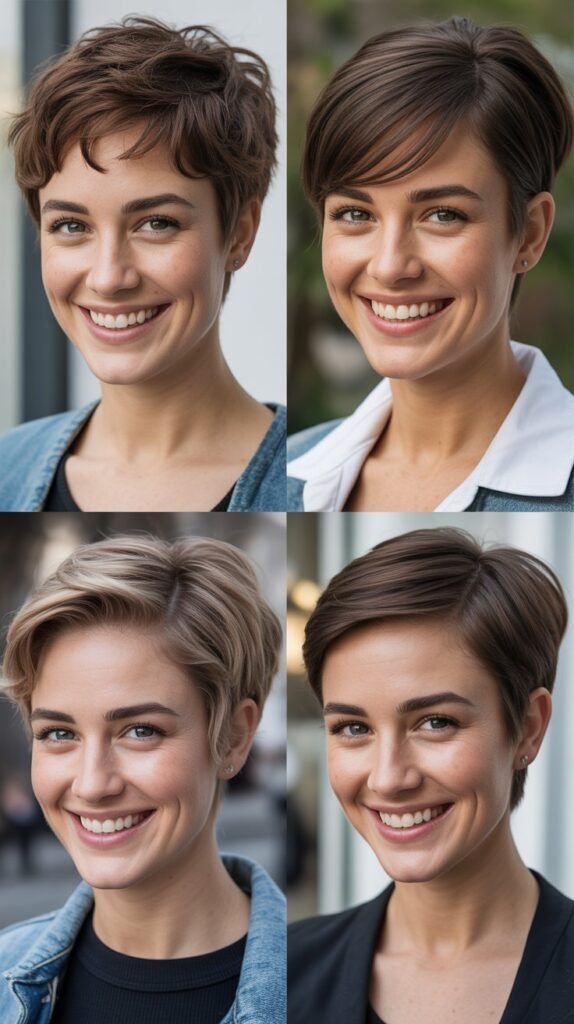
A tapered nape adds clean, refined finishing to a pixie bob while keeping the overall look soft and feminine.
This technique involves gradually decreasing length from the mid-head down to the hairline, creating a smooth, elegant back view.
Understanding the Taper Technique
- Tapering uses clippers or scissors to create a gradual fade from longer hair above to shorter hair at the neckline.
- Unlike harsh undercuts, tapers blend seamlessly and maintain a soft, feminine transition rather than a stark line.
- The degree of taper can be subtle (maintaining more length) or dramatic (very short at the nape) depending on preference.
- A properly tapered nape eliminates the bulkiness that can accumulate at the back of the neck with traditional bobs.
- This technique requires regular maintenance every 3-4 weeks to keep the taper looking fresh and clean.
Tapering vs. Undercuts: Choosing Femininity
- Tapers create soft, gradual transitions that feel more traditionally feminine and less edgy than harsh undercut lines.
- Undercuts create intentional, visible lines of demarcation that make a bolder statement and require different styling approaches.
- For maximum femininity, choose a gentle taper that blends smoothly rather than a dramatic undercut with stark contrast.
- The taper can be customized—longer tapers maintain more versatility for styling, while shorter ones offer ultra-low maintenance.
- Consider your lifestyle and how much time you want to spend styling when deciding on the degree of taper.
Styling the Tapered Nape
- The beauty of a tapered nape is that it requires minimal styling—the cut does the work for you.
- Keep the nape close to the head with a tiny bit of pomade or wax for a polished, finished appearance.
- If you have naturally curly hair, the tapered section can be kept very short while length on top embraces your curls.
- Showcase your tapered nape by wearing hair pulled up or forward, making the clean neckline a focal point.
- In professional settings, the tapered nape creates a polished, put-together appearance that looks intentional and well-maintained.
11. Pixie Bob with Long Side Bangs
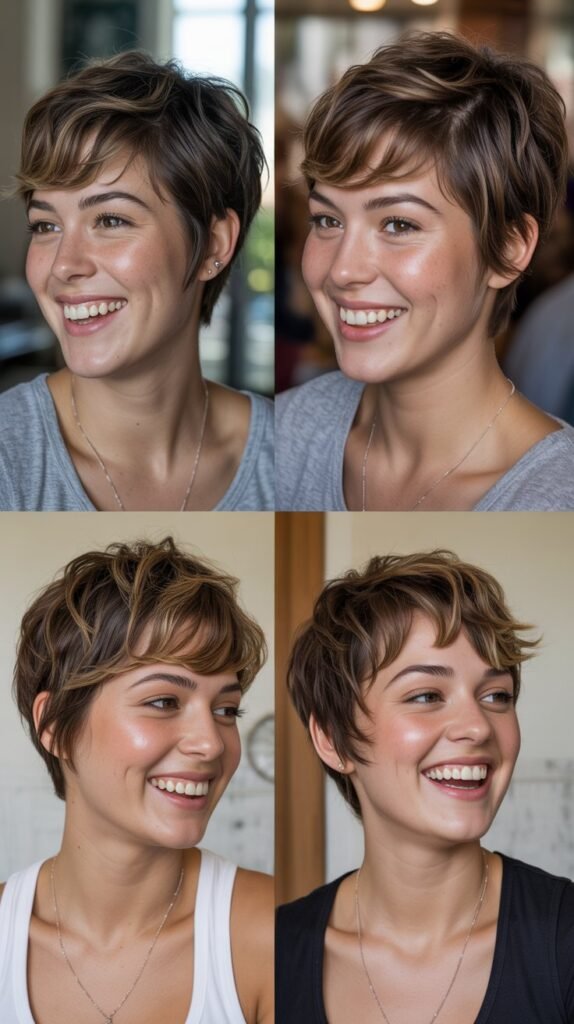
Long side bangs add drama and versatility to the pixie bob while maintaining an undeniably feminine aesthetic.
These extended fringe pieces create asymmetry and can be styled multiple ways to change your entire look.
The Perfect Length for Side Bangs
- Ideal side bang length ranges from cheekbone to chin, long enough to tuck behind the ear or leave sweeping across the face.
- Longer side bangs balance the shorter back and sides of a pixie bob, preventing the cut from appearing too severe.
- The bangs should be cut on a diagonal to create a sweeping effect rather than a blunt horizontal line.
- Textured, thinned-out ends on the bangs prevent them from appearing heavy or overwhelming on the face.
- The length should be customized to your face shape—longer for rounder faces, potentially shorter for longer faces.
Styling Versatility of Long Side Bangs
- Sweep bangs dramatically to one side for a classic, elegant look suitable for formal occasions.
- Part down the middle and let bangs frame both sides of the face for a softer, more romantic appearance.
- Tuck behind one ear to expose your face and create asymmetry while keeping hair out of your eyes.
- Add curls or waves to the bangs for extra texture and dimension that increases the feminine appeal.
- Straighten bangs with a flat iron for a sleek, polished look that creates clean, graphic lines.
Growing Out or Transitioning Side Bangs
- Long side bangs serve as excellent transition pieces when growing out a pixie into a longer style.
- As they grow, they can be incorporated into face-framing layers that blend with the rest of the haircut.
- Regular trims keep the bangs looking intentional rather than like awkward, in-between growth.
- Styling products help control bangs during the growing-out phase, keeping them styled rather than flopping in your face.
- Consider clipping or pinning back bangs with decorative accessories during the transition period for different looks.
12. Curly Pixie Bob with Definition
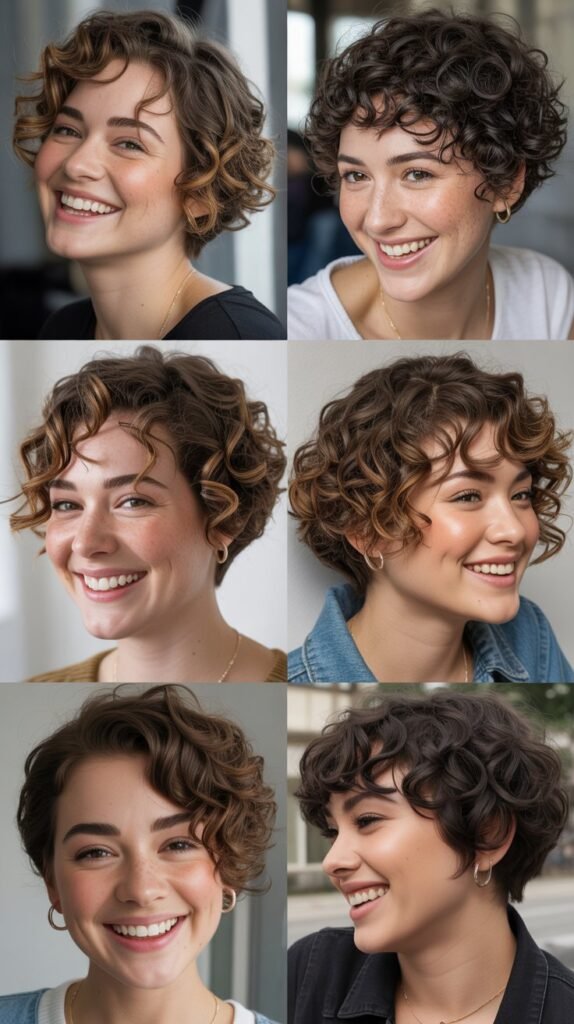
Curly hair brings natural softness and femininity to the pixie bob, creating volume and dimension that straight hair must achieve through styling.
The key is enhancing your natural curl pattern while maintaining the shape of the cut.
Cutting Curly Hair for Pixie Bob Success
- Curly hair should ideally be cut dry so the stylist can see how curls naturally fall and shape them accordingly.
- The cut needs more length than straight hair pixie bobs because curls shrink up significantly when dry.
- Layers are essential to prevent the triangular shape that curly hair naturally wants to form when cut short.
- Remove weight from the interior while maintaining length on the perimeter for movement without bulk.
- Each curl should be evaluated individually—some may need more length, others less, depending on the curl pattern.
Products and Techniques for Curl Definition
- Start with a leave-in conditioner on soaking wet hair to provide moisture that curls desperately need.
- Apply a curl-defining cream or gel using the praying hands method to smooth it over curls without disrupting the pattern.
- Scrunch hair gently with a microfiber towel or t-shirt to encourage curl formation and remove excess water.
- Diffuse on low heat with a diffuser attachment, or air-dry for the softest, most natural results.
- Once completely dry, scrunch out any crunch from gel with a tiny bit of oil for soft, touchable, defined curls.
Maintaining Curl Health in Short Cuts
- Deep condition weekly to combat the dryness that comes from heat styling and environmental factors.
- Avoid sulfates and silicones in your hair products, as these can dry out curls and create buildup.
- Sleep on a silk or satin pillowcase to reduce friction that causes frizz and disrupts curl patterns.
- Refresh curls between washes by misting with water and reapplying a small amount of curl cream.
- Get regular trims every 6-8 weeks to remove damaged ends and maintain the shape of your curly pixie bob.
13. Platinum Blonde Pixie Bob
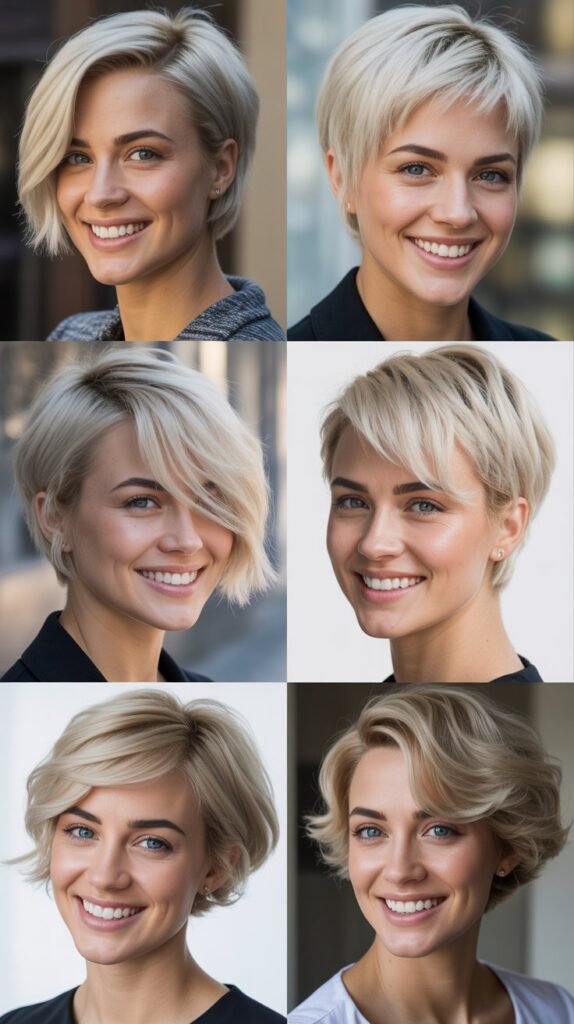
Platinum blonde brings an ethereal, ultra-feminine quality to the pixie bob through its striking lightness and luminous appearance.
This dramatic color choice creates a soft, almost angelic aesthetic when paired with the right cut and styling.
Achieving and Maintaining Platinum Color
- Platinum requires significant lightening, often multiple sessions if starting from darker hair, to avoid damage and ensure even color.
- A toner is essential to eliminate yellow or brassy tones and achieve that cool, icy platinum shade.
- Purple or blue shampoo should be used weekly to maintain the cool tone and prevent warmth from creeping back in.
- Deep conditioning treatments are non-negotiable with platinum hair, as the lightening process compromises hair health.
- Plan for color touch-ups every 4-6 weeks as roots grow, or embrace a shadow root for lower maintenance.
Styling Platinum Hair for Maximum Impact
- The lightness of platinum hair shows every texture and styling detail, making technique especially important.
- Waves and curls create dimension in platinum hair, as the color catches light differently on each textured surface.
- Sleek, straight platinum hair creates a modern, edgy-yet-feminine look with maximum shine and luminosity.
- Platinum works beautifully with both warm and cool skin tones when the correct undertone is chosen for the blonde.
- Consider adding subtle lowlights or babylights for dimension, as all-over platinum can sometimes appear flat.
Platinum Pixie Bob Care Requirements
| Maintenance Task | Frequency | Purpose | Product Recommendation |
|---|---|---|---|
| Purple Shampoo | 1-2x weekly | Tone out brassiness | Violet-tinted shampoo for blonde hair |
| Deep Conditioning | Weekly | Restore moisture and elasticity | Protein-rich mask for damaged hair |
| Root Touch-Up | 4-6 weeks | Cover regrowth | Professional salon service |
| Toner Refresh | 6-8 weeks | Maintain icy tone | Demi-permanent cool blonde toner |
| Bond Repair Treatment | Bi-weekly | Rebuild damaged bonds | Bond-building treatment system |
14. Dimensional Brown Pixie Bob
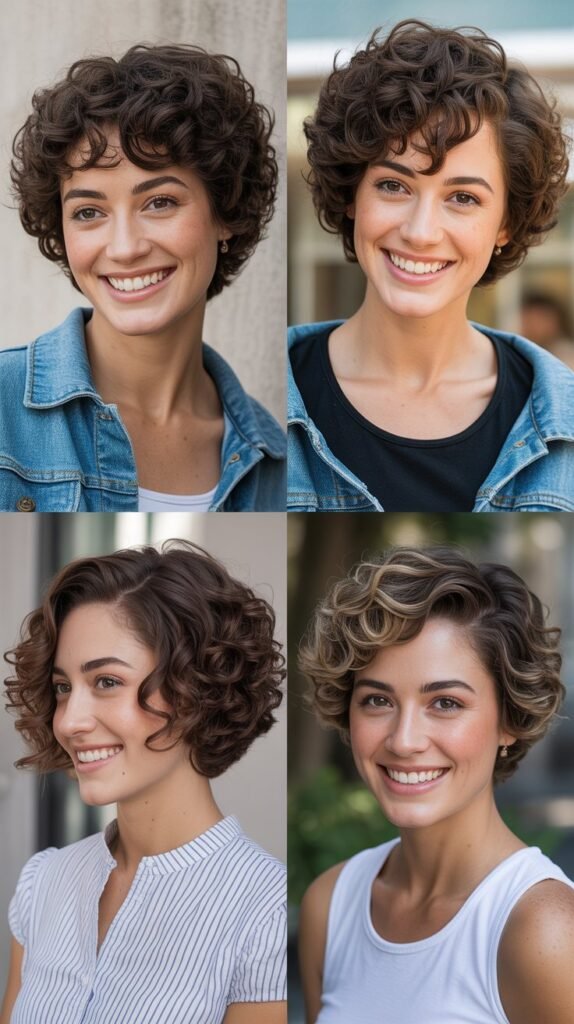
Rich brown tones with dimensional highlights create depth and warmth in a pixie bob, offering sophisticated femininity through color variation.
This approach prevents flat, one-dimensional color while maintaining a natural, elegant appearance.
Creating Natural-Looking Dimension
- Balayage techniques paint lighter tones onto the surface and around the face where sun would naturally lighten hair.
- Highlights should be placed strategically to follow the movement of the cut and enhance layers and texture.
- Multiple tones within the brown family (chocolate, chestnut, caramel, honey) create realistic, sun-kissed dimension.
- Face-framing highlights brighten the complexion and draw attention to facial features in a flattering way.
- The contrast between the darkest and lightest tones should be gradual, not stark, for the most natural appearance.
Best Brown Tones for Different Skin Tones
- Warm skin tones with golden undertones shine with rich chocolate, caramel, and honey brown combinations.
- Cool skin tones with pink or blue undertones look beautiful with ash brown, mocha, and cool-toned chestnut.
- Olive skin tones can wear almost any brown beautifully, from warm golden browns to cool espresso shades.
- Fair skin pairs well with lighter browns and more pronounced highlights for contrast and definition.
- Deep skin tones are stunning with rich, dark browns enhanced by subtle golden or copper highlights for dimension.
Low-Maintenance Color Strategies
- Choose a base color close to your natural shade so roots blend seamlessly as they grow.
- Place highlights and dimension through the mid-lengths and ends rather than at the root for extended time between appointments.
- Balayage and other hand-painted techniques grow out more gracefully than traditional foil highlights with harsh lines.
- Use color-depositing conditioners in brown tones to refresh color between salon visits and enhance richness.
- Gloss treatments every 6-8 weeks add shine and can slightly adjust tone without the commitment of permanent color.
15. Pixie Bob with Undercut Design
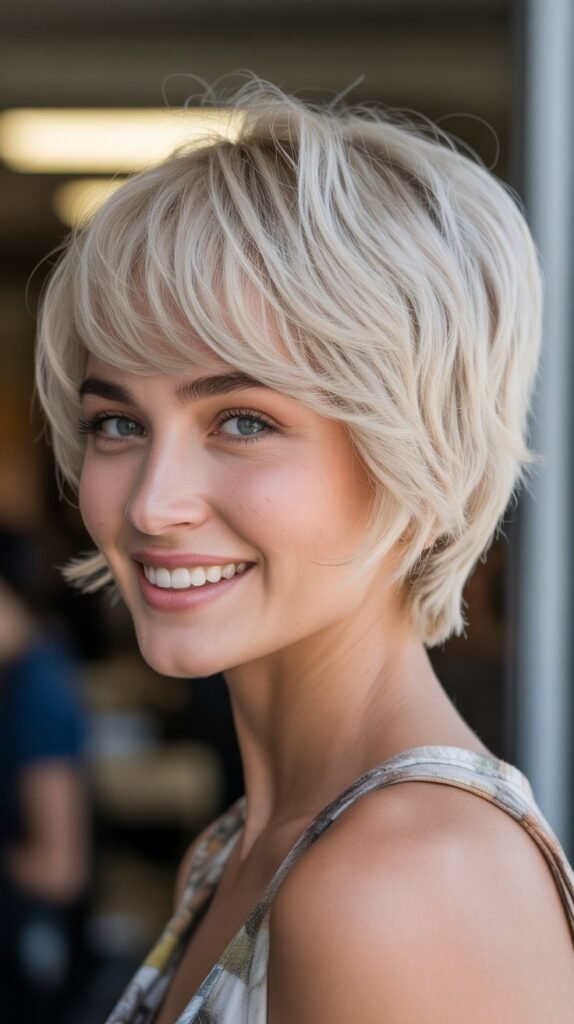
An undercut design adds an unexpected element of personality to the pixie bob while maintaining femininity through the contrast between the shaved design and softer top sections.
This style balances edge with elegance through thoughtful design placement.
Choosing Feminine Undercut Designs
- Delicate designs like flowers, stars, geometric patterns, or swirls maintain femininity while adding visual interest.
- Placement matters—side undercuts are most versatile, visible when you want to show them but coverable when you don’t.
- The nape offers another canvas for designs that appear when hair is worn up or pulled forward.
- Size should be proportionate to your head and not so large that it overwhelms the softness of the pixie bob.
- Intricate, detailed designs require more frequent maintenance than simple lines or shapes as hair grows.
Maintaining Undercut Designs
- Shaved designs require touch-ups every 2-3 weeks to stay crisp and visible as hair grows.
- Some designs fade more gracefully than others—simple lines stay recognizable longer than complex patterns.
- Consider the commitment level before choosing a very elaborate design that demands frequent professional maintenance.
- Between professional touch-ups, you can maintain the overall undercut with clippers at home if comfortable doing so.
- Have a plan for growing out the design—some people choose to maintain it long-term while others enjoy changing designs seasonally.
Styling to Show or Hide Undercut Designs
- Style hair over the undercut for professional settings or when you want a more conservative appearance.
- Gel or pin back sections to reveal the design when you want to showcase it at social events or casual settings.
- The versatility of being able to hide or display the design makes undercuts appealing for those who navigate different dress codes.
- Add temporary color to the design area for special occasions—pastels or metallics show beautifully on buzzed hair.
- Part hair on the opposite side of the undercut to completely conceal it, or part directly over it to intentionally reveal it.
16. Soft Pastel Pixie Bob
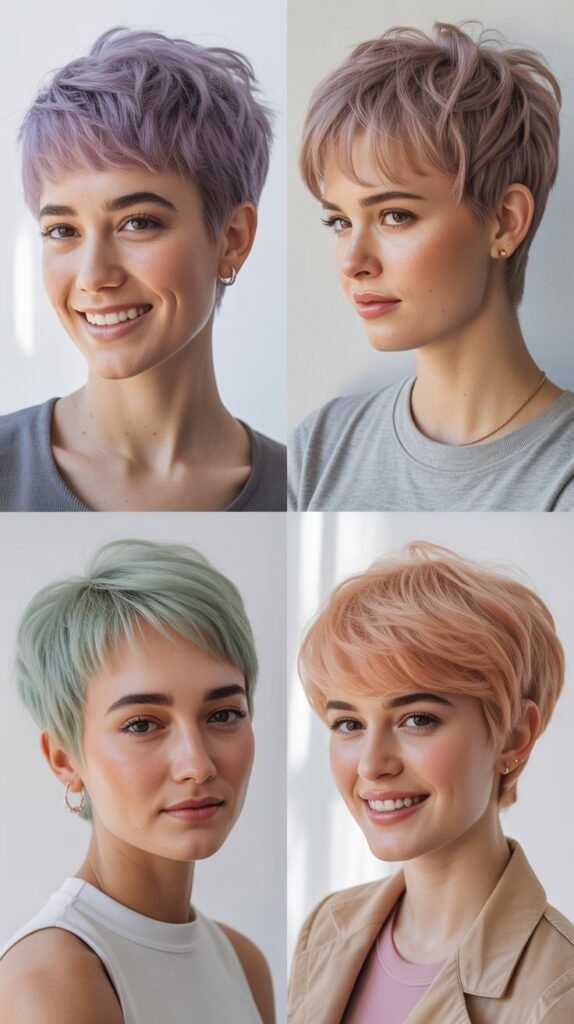
Pastel colors bring whimsy and ultra-feminine appeal to the pixie bob, creating a dreamy, ethereal aesthetic that feels romantic and playful.
These soft hues require commitment to maintenance but deliver stunning, unique results.
Popular Pastel Shades for Feminine Appeal
- Rose pink and blush tones create romantic, ultra-feminine looks that feel soft and delicate.
- Lavender and lilac offer a cooler pastel option that still maintains femininity through its softness.
- Peach and apricot tones bring warmth while staying in the pastel family for a vintage-inspired aesthetic.
- Mint and seafoam greens create unique, statement-making pastels that still feel soft and feminine.
- Blended pastels (like pink fading into purple or blue into lavender) add dimension and artistic flair.
Achieving Pastel Colors Successfully
- Hair must be pre-lightened to a very pale blonde (level 9-10) for pastels to show true-to-color and vibrant.
- The lighter your base, the more true-to-formula your pastel will be and the longer it will last before fading.
- Semi-permanent pastel dyes are most common, meaning they fade with each wash rather than growing out with roots.
- Some natural blondes can achieve pastels with direct dye application, but most people need professional lightening first.
- Pastel colors fade quickly, typically looking best for 2-4 weeks before requiring refresh depending on washing frequency.
Maintaining Pastel Hair Health and Color
- Wash hair infrequently with cool water to slow color fading and maintain vibrancy as long as possible.
- Use sulfate-free, color-safe shampoos specifically formulated for color-treated or pastel hair.
- Refresh pastels at home between salon visits with color-depositing conditioners in matching shades.
- Deep condition regularly, as the lightening process required for pastels can compromise hair health significantly.
- Protect hair from sun exposure, which fades pastels quickly, by wearing hats or using UV-protectant hair products.
17. Pixie Bob with Micro Bangs
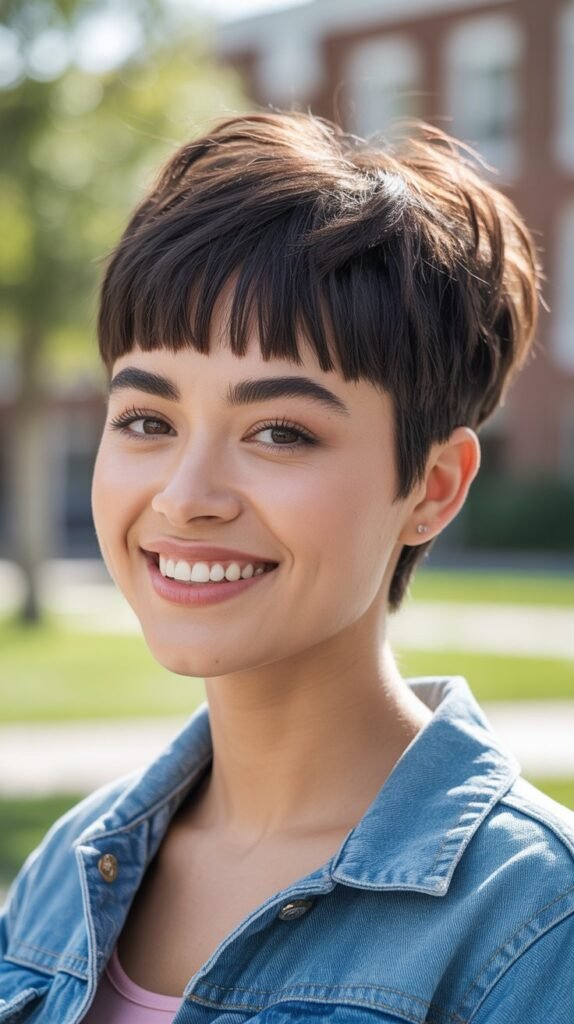
Micro bangs create a bold, fashion-forward statement that paradoxically enhances femininity through their delicate, doll-like appearance.
These ultra-short bangs sit well above the eyebrows and completely transform the pixie bob aesthetic.
The Appeal and Challenge of Micro Bangs
- Micro bangs create a striking, memorable look that draws attention to the eyes and emphasizes facial bone structure.
- They work best on those with smaller foreheads or strong, defined brows that can handle the emphasis short bangs create.
- The commitment level is high—micro bangs grow out awkwardly and require frequent trims every 2-3 weeks.
- They demand confidence, as this bold choice makes a statement and won’t suit everyone’s personal style or comfort level.
- Styling micro bangs is relatively simple since their short length limits what can be done with them.
Styling Micro Bangs Successfully
- Keep micro bangs straight and blunt for the most impactful, fashion-forward appearance.
- Use a small amount of pomade or wax to add definition and keep individual hairs in place.
- A flat iron can ensure micro bangs lay completely flat and straight for a polished finish.
- Avoid adding texture or piece-iness to micro bangs—their power comes from their blunt, geometric precision.
- The contrast between textured or soft pixie bob hair and straight micro bangs creates visual interest.
Growing Out Micro Bangs Gracefully
- The awkward grow-out phase lasts several months as bangs transition from micro to a more standard length.
- Pin bangs back with decorative bobby pins or clips during the in-between phase to keep them out of your eyes.
- Gradually trim bangs longer in small increments rather than trying to grow them out all at once for less awkwardness.
- Consider changing the entire pixie bob style as bangs grow to maintain a cohesive, intentional appearance.
- Some people choose to maintain micro bangs indefinitely rather than dealing with the challenging grow-out process.
18. Pixie Bob with Balayage
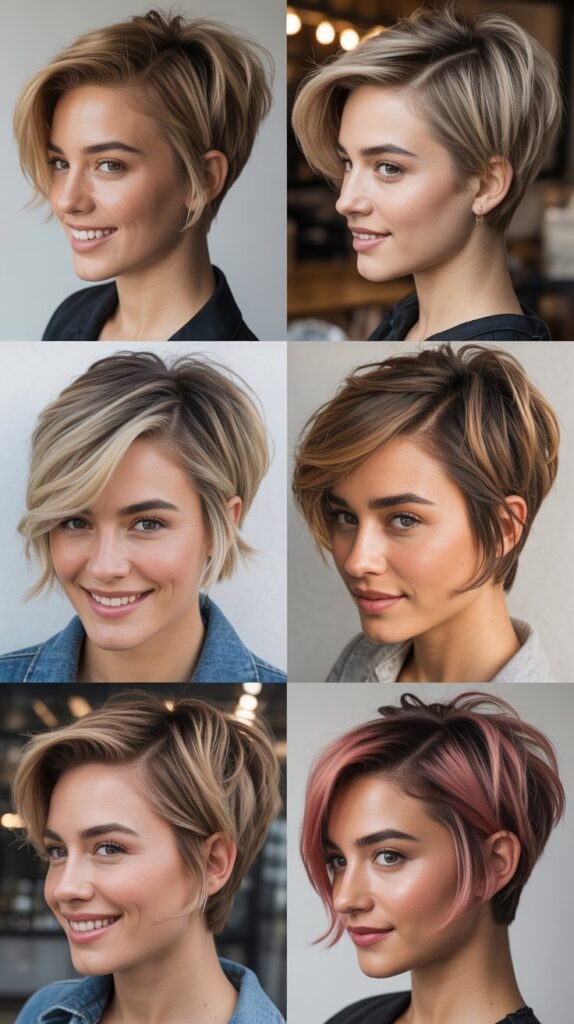
Balayage adds natural-looking dimension and movement to the pixie bob through hand-painted highlights that enhance the cut’s shape and layers.
This coloring technique creates soft, sun-kissed results that feel effortlessly feminine.
Understanding Balayage for Short Hair
- Balayage on short hair focuses on face-framing pieces and the top sections where color is most visible.
- The hand-painted technique allows for customized placement that enhances your specific cut and face shape.
- Lighter pieces typically concentrate around the face and crown where they brighten the complexion most effectively.
- The seamless blend from dark to light creates natural-looking dimension without harsh lines or obvious regrowth.
- Balayage requires less maintenance than traditional highlights since it grows out beautifully without a stark line of demarcation.
Color Combinations That Enhance Femininity
- Brunette bases with caramel and honey balayage create warm, rich dimension that feels sophisticated and feminine.
- Blonde bases with brighter blonde and platinum balayage add lightness and luminosity for an ethereal quality.
- Red bases with copper and strawberry blonde balayage create fiery dimension while maintaining natural appearance.
- Dark bases with subtle highlights just a few shades lighter create dimension without dramatic contrast.
- Cool-toned balayage uses ashy highlights for a modern, fashion-forward look that still feels soft and feminine.
Balayage Maintenance Schedule
| Timeline | Service | Purpose | Cost Consideration |
|---|---|---|---|
| Initial | Full balayage application | Create dimension and lightness | Higher investment ($150-300+) |
| 8-12 weeks | Optional toner refresh | Adjust tone, add shine | Low ($30-60) |
| 12-16 weeks | Partial balayage touch-up | Add lightness to regrown areas | Moderate ($100-200) |
| 6-8 months | Full balayage refresh | Reapply throughout for freshness | Higher ($150-300+) |
| As needed | Gloss treatment | Enhance shine and tone | Low ($30-60) |
19. Shaggy Pixie Bob with Movement
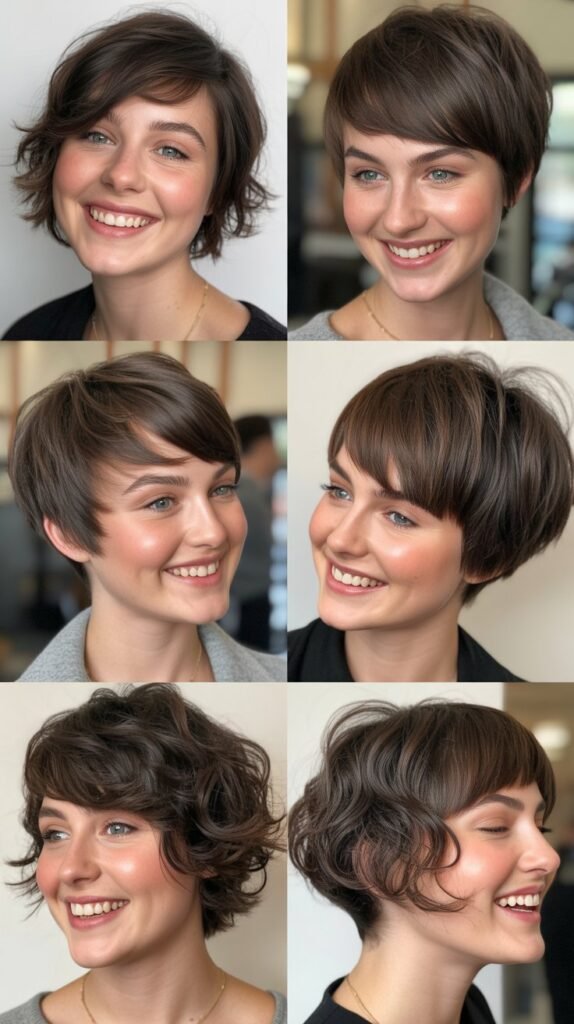
The shaggy pixie bob embraces layers, texture, and movement for a relaxed, bohemian femininity that feels free-spirited and effortless.
This style celebrates natural texture and creates an undone, lived-in aesthetic that remains perpetually on-trend.
Creating the Perfect Shag
- Numerous layers throughout create the piece-y, separated texture that defines the shag aesthetic.
- Razoring techniques remove weight and create those wispy, feathered ends characteristic of shag cuts.
- The layers should vary significantly in length, with some quite short and others longer, for maximum movement.
- A shaggy pixie bob typically features more length on top and shorter, layered sides and back for shape.
- The cut should look intentionally messy, with no section appearing too uniform or perfectly styled.
Styling for Effortless Texture
- Air-drying works beautifully with shag cuts, allowing natural texture to create the desired piece-y effect.
- A bit of texturizing spray or sea salt spray on damp hair enhances separation and prevents clumping.
- For more polished occasions, use a diffuser on low heat to add volume while maintaining the natural, undone texture.
- Scrunch hair with your fingers while styling to encourage the piece-y separation rather than smoothing it out.
- The messier and more undone it looks, the better—perfectionism works against the shag’s inherent appeal.
Why Shaggy Cuts Feel Feminine
- The soft, layered edges create a gentleness that contrasts with blunt, harsh lines typically associated with masculine cuts.
- Natural movement and texture appear effortless and carefree, qualities culturally associated with feminine beauty ideals.
- The versatility allows for both casual, tousled looks and more refined styling depending on the occasion.
- Face-framing layers within the shag soften features and create that coveted feminine quality.
- The low-maintenance, “I woke up like this” vibe aligns with modern ideals of natural, authentic beauty.
20. Pixie Bob with Hidden Rainbow
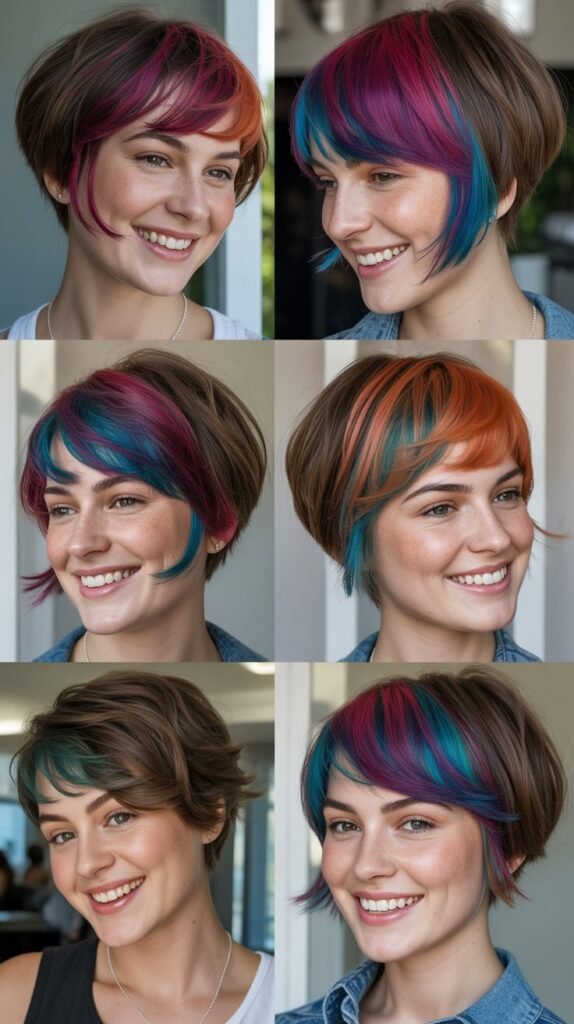
Hidden rainbow colors offer playful, feminine fun while maintaining versatility for professional settings. These vibrant hues peek out from underneath more natural top layers, creating a secret pop of personality.
Strategic Color Placement
- Vibrant colors are applied to the underneath sections, nape, or sides where they remain hidden when hair is down.
- Natural-colored hair on top can be styled over the colors for conservative settings, then pulled back to reveal them.
- The pixie bob length means hidden colors show more easily than in longer hair, so placement requires careful planning.
- Consider which sections are most visible when you style your hair in different ways to determine ideal placement.
- Multiple colors can create a true rainbow effect, or stick to 1-2 complementary shades for a subtler approach.
Best Color Combinations for Femininity
- Pinks, purples, and blues create a dreamy, ultra-feminine palette that feels whimsical and romantic.
- Warm tones like coral, peach, and rose gold offer feminine vibrancy without the coolness of traditional rainbow brights.
- Pastel rainbow combinations maintain the fun of multiple colors while keeping things soft and feminine.
- Jewel tones like emerald, sapphire, and ruby create rich, sophisticated hidden colors rather than neon brights.
- Monochromatic schemes using different shades of one color family create dimension without the full rainbow effect.
Maintaining Vibrant Hidden Colors
- Fashion colors fade quickly, especially bright and pastel shades, requiring frequent refreshing to maintain vibrancy.
- Use color-depositing conditioners in matching shades to extend the life of your colors between salon visits.
- Wash hair with cool water and color-safe, sulfate-free products to slow fading and preserve intensity.
- The underlayer placement means these sections experience less sun exposure, which helps colors last longer.
- Be prepared for colors to fade into unexpected tones—blues might fade green, pinks might fade peachy—and plan accordingly.
21. Graduated Pixie Bob
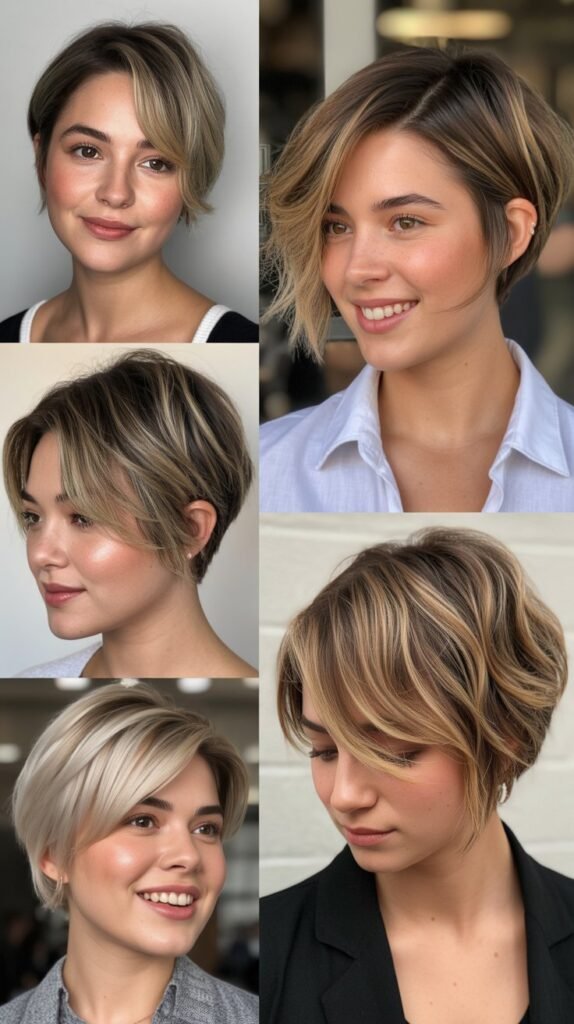
The graduated pixie bob features length that increases from the back to the front, creating an elegant, sophisticated silhouette with built-in shape and structure.
This classic technique delivers timeless femininity through its carefully crafted lines.
Understanding Graduated Cutting
- Graduation means each layer is slightly longer than the one below it, creating a stacked effect when viewed from the side.
- The shortest point sits at the nape, while the longest falls somewhere between the ear and chin, depending on preference.
- This technique creates natural volume at the crown without requiring styling products or tools.
- The angle of graduation can be subtle for gentle shaping or dramatic for bold, striking silhouettes.
- Graduated cuts require precision cutting to maintain clean, even lines that create the desired shape.
Styling the Graduated Shape
- The built-in volume means minimal styling is needed—blow-dry with a round brush to emphasize the shape.
- The graduation creates natural movement and fullness that works with rather than against your hair’s natural tendencies.
- Smooth the front sections with a flat iron for a sleek, polished look while letting the back maintain its stacked volume.
- This cut looks beautiful both straight and wavy, offering versatility in daily styling choices.
- The structure inherent in the graduation means even wash-and-go days look intentional and styled.
Maintenance Requirements
- Graduated bobs require regular trims every 4-6 weeks to maintain the precise shape and prevent overgrowth.
- The back grows out most noticeably, potentially losing the stacked volume that makes this cut special.
- As the front grows longer, the graduation angle becomes less pronounced, eventually requiring reshaping.
- Between cuts, styling techniques can help maintain the appearance, but regular professional maintenance is essential.
- This is a higher-maintenance pixie bob variation, ideal for those committed to regular salon visits.
22. Pixie Bob with Curtain Bangs
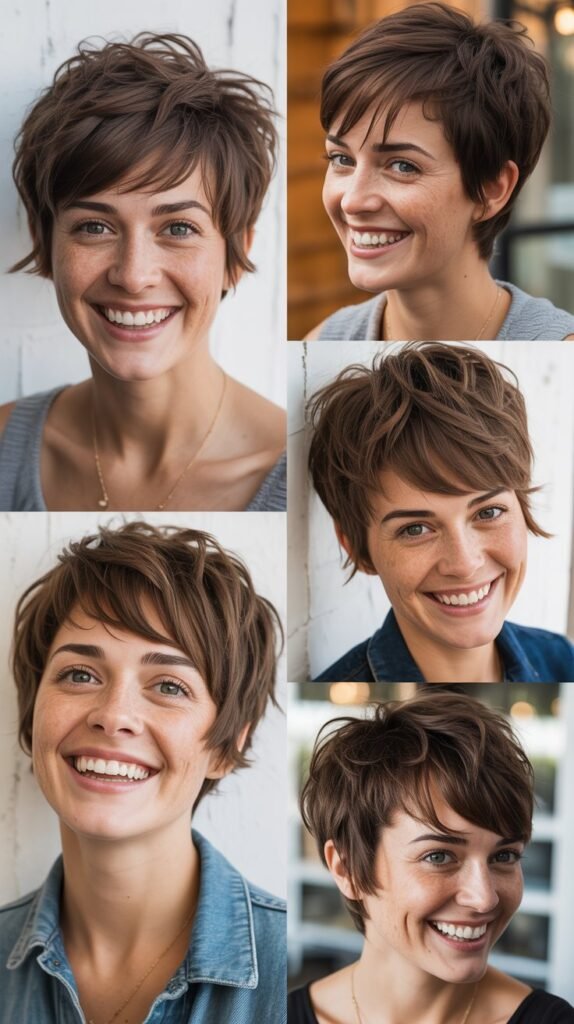
Curtain bangs add romantic, face-framing softness to the pixie bob by parting down the center and sweeping to each side. This 70s-inspired element brings vintage femininity to contemporary short cuts.
Creating the Perfect Curtain Bang
- Curtain bangs are cut in an inverted V-shape, shortest at the center part and gradually lengthening toward the sides.
- The length typically ranges from just above the eyebrows at the center to cheekbone length at the sides.
- Textured, thinned-out ends prevent curtain bangs from appearing heavy and allow them to blend seamlessly with the rest of the cut.
- The bangs should be long enough to tuck behind ears but short enough to frame the face when worn down.
- Proper layering ensures the bangs curve naturally away from the face rather than hanging straight down.
Styling Curtain Bangs Daily
- Use a small round brush to curl curtain bangs away from the face while blow-drying for that signature swooping shape.
- A flat iron can create the gentle bends that make curtain bangs curve naturally to the sides.
- Part bangs precisely down the center for symmetrical framing, or slightly off-center for an asymmetrical variation.
- When growing out, curtain bangs transition easily into face-framing layers without an awkward in-between phase.
- On lazy days, apply a bit of styling cream and scrunch curtain bangs for a more relaxed, textured appearance.
Face Shapes That Love Curtain Bangs
- Oval faces carry curtain bangs beautifully since they don’t require any particular balancing or correction.
- Heart-shaped faces benefit from the added width at the cheekbones that curtain bangs create.
- Long faces appear shorter when curtain bangs add horizontal lines and break up vertical space.
- Round faces should ensure curtain bangs are long enough to create vertical lines rather than emphasizing roundness.
- Square faces are softened by the curves and movement that curtain bangs introduce around angular jawlines.
23. Pixie Bob with Side Part
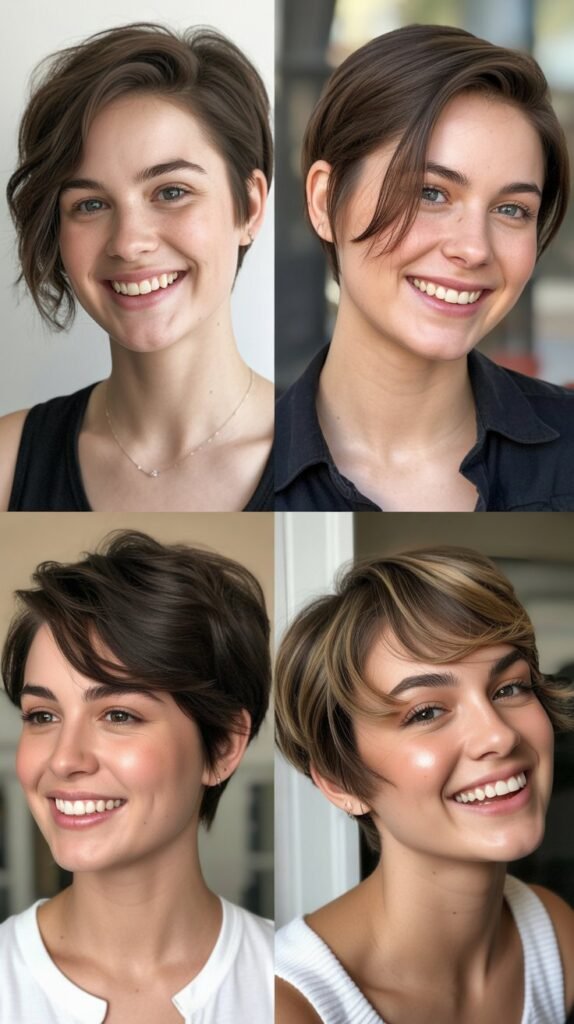
A deep side part adds instant sophistication and classic femininity to any pixie bob by creating asymmetry and volume on one side.
This simple styling choice dramatically impacts the overall aesthetic and flatters most face shapes.
Determining Your Perfect Part Placement
- The deepest point of your side part should typically align with the arch of your eyebrow or the outer edge of your iris.
- Experiment with part placement—moving it even slightly can change your entire look and how face-framing pieces fall.
- Consider which side showcases your features best or which side you prefer to have more volume.
- Some people have a natural part where hair wants to fall; working with this creates easier styling.
- Use the end of a rat-tail comb to create a precise, clean part for the most polished appearance.
Creating Volume with Side Parts
- The side with more hair naturally has more volume, which can balance facial features strategically.
- Blow-dry hair on the fuller side away from the face and upward to maximize volume and height.
- Use volumizing products at the roots on the fuller side to maintain lift throughout the day.
- The side with less hair can be smoothed close to the head or styled with face-framing pieces, depending on preference.
- Side parts naturally create the asymmetry that keeps pixie bobs from appearing too severe or boyish.
Switching Your Part for Different Looks
- One of the joys of pixie bobs is the ability to change your part and completely transform your appearance.
- When you first change your part, hair may resist—use bobby pins or clips to train it into the new position.
- Wetting hair and blow-drying in the new part direction helps set and maintain the change.
- Alternating your part placement can also prevent hair loss in one area from constant tension.
- If you always wear the same part, try switching sides for a fresh look that makes you feel like you have a new haircut.
24. Textured Crop Pixie Bob
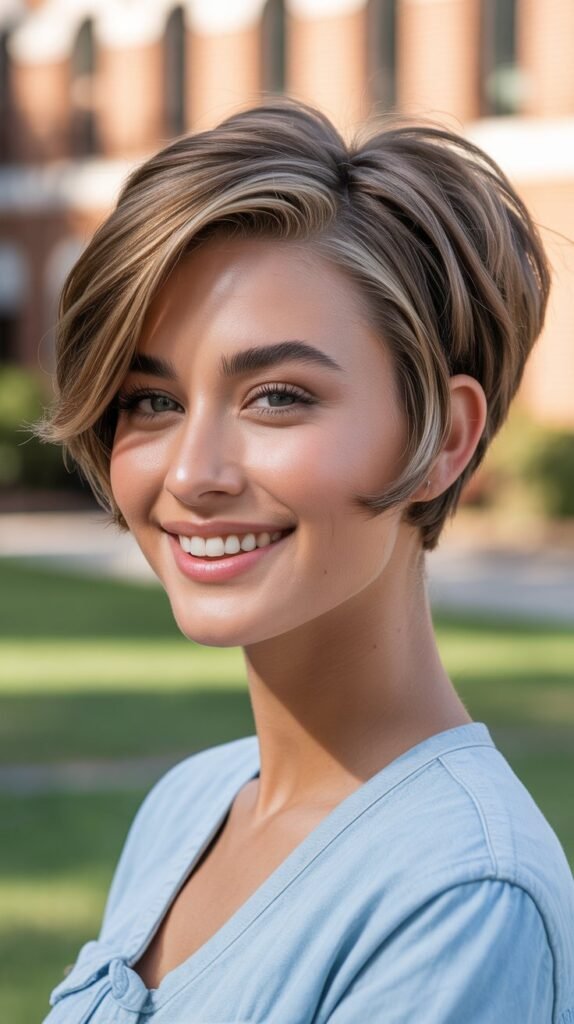
The textured crop combines the best of both worlds—the structure of a pixie and the length of a bob—with heavy texturizing for a modern, fashion-forward yet feminine result.
This style embraces piece-y, choppy texture throughout.
Cutting Techniques for Texture
- Point-cutting, razoring, and slide-cutting all create texture by removing weight and creating uneven, piece-y ends.
- The cut should appear deconstructed and a bit unfinished, which paradoxically requires significant skill and precision.
- Different sections can have varying textures—more choppy on top, slightly softer around the face for balance.
- The goal is controlled messiness where every piece seems to have its own intention and direction.
- Regular dry-cutting allows the stylist to see how texture falls naturally and adjust accordingly.
Products for Enhanced Texture
- Matte-finish pomades and clays separate pieces and create definition without shine or stiffness.
- Texturizing sprays add grip and make hair easier to manipulate into that perfect piece-y position.
- Sea salt sprays create beachy texture that works beautifully with textured crops for casual, undone styling.
- Dry shampoo (even on clean hair) adds texture and volume at the roots that supports the overall style.
- Avoid smoothing serums and heavy oils that would eliminate the texture you’re trying to create and enhance.
Feminizing the Textured Crop
- Keep some length around the face rather than cropping it all ultra-short for maintained softness.
- Balance heavy texture on top with slightly smoother sides or back to prevent overwhelming edginess.
- Softer colors like warm browns, honey blondes, or pastels feminize textured crops that might otherwise appear harsh.
- Ensure the overall shape still flatters your face shape despite the heavy texturing throughout.
- Styling determines whether this cut reads edgy or feminine—soft, piece-y styling maintains femininity despite the choppy texture.
25. Pixie Bob with Longer Front Pieces
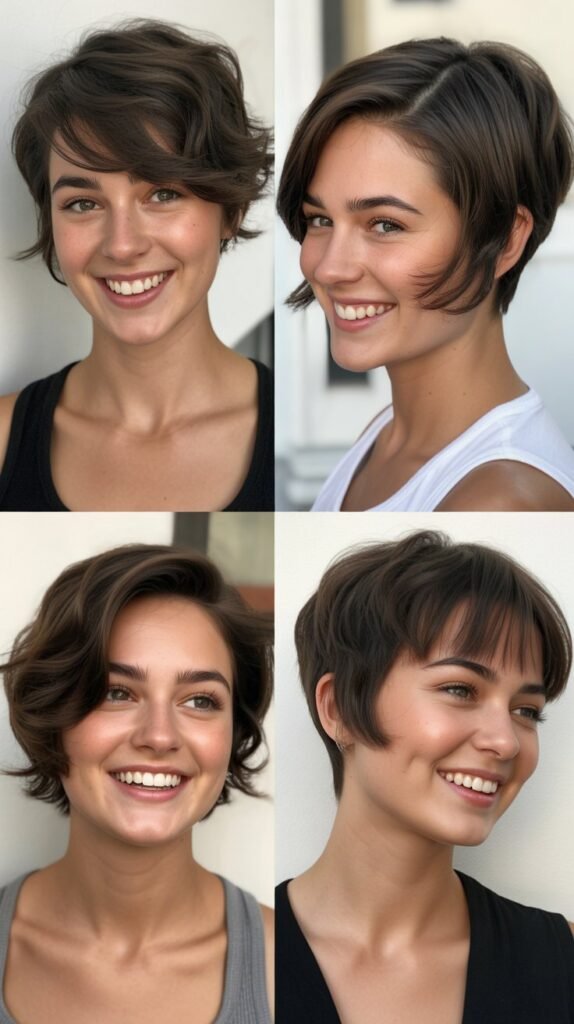
Longer front pieces create beautiful face-framing and offer versatility within the pixie bob structure, allowing for various styling options while maintaining the ease of short hair.
This variation provides security for those nervous about going too short.
Ideal Front Piece Length
- Front pieces typically range from chin to collarbone length, depending on personal preference and face shape.
- The length should be proportionate to the rest of the cut—dramatically longer pieces require shorter backs and sides.
- Longer front pieces can tuck behind ears, be styled forward, or even be pulled back into a small ponytail.
- This length provides the security of being able to “hide” behind hair if needed while still enjoying short hair benefits.
- Consider your styling commitment—longer pieces require more daily attention than a uniform pixie bob.
Styling Options for Versatility
- Straight, sleek front pieces create a modern, sophisticated look that contrasts beautifully with textured shorter sections.
- Curl or wave the longer pieces for romantic, soft femininity that plays up the length difference.
- Braid the longer front sections for a bohemian touch that keeps hair out of your face functionally.
- Incorporate the longer pieces into updos or half-up styles for occasions requiring more formal styling.
- The length allows for accessories like small clips, pins, or headbands that shorter pixie bobs can’t accommodate.
Transitioning and Growing Out
- This cut serves as an excellent transition style when growing out a very short pixie into a bob.
- As the back grows, the overall cut gradually becomes a more uniform bob without awkward in-between stages.
- Alternatively, this can be a permanent style choice for those who love the versatility of different lengths.
- Maintenance focuses on keeping the back short while allowing the front to grow or trimming the front while growing the back.
- The built-in versatility means this cut adapts to your changing preferences without requiring a complete style overhaul.
26. Disconnected Pixie Bob
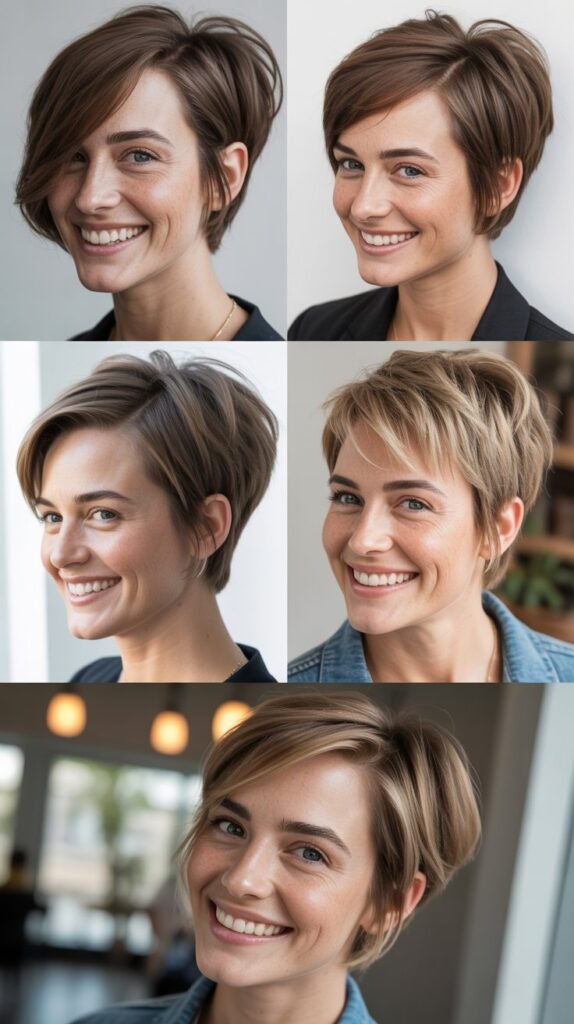
The disconnected pixie bob features intentionally unblended sections where different lengths don’t graduate into each other, creating dramatic contrast and modern edge while maintaining femininity through careful styling.
This avant-garde approach creates visual interest through unexpected transitions.
Understanding Disconnection in Cutting
- Disconnection means one section of hair is cut significantly shorter or longer than adjacent sections without blending.
- Common disconnections include long top sections sitting on very short sides, or long front pieces over short backs.
- The lack of gradual transition creates graphic lines and distinct sections that make a bold statement.
- This technique requires precision and planning to ensure the disconnection looks intentional rather than like a cutting mistake.
- The contrast between sections can be subtle or dramatic depending on personal style preference.
Styling Disconnected Sections
- The contrast is the point, so style each section differently to emphasize rather than hide the disconnection.
- Longer sections might be curled or textured while shorter sections are slicked down for maximum contrast.
- Use products with different finishes—matte on short sections, glossy on long sections—to further define the separation.
- The styling should make the disconnection read as intentional, artistic, and fashion-forward rather than accidental.
- Changing how you style different sections allows one cut to create multiple distinct looks.
Maintaining the Disconnected Look
- The precision required means regular salon visits every 4-6 weeks to maintain clean, intentional lines.
- As hair grows, disconnections can start to blend slightly, which may or may not be desirable depending on preference.
- Communicate clearly with your stylist about which sections should remain disconnected and which can soften.
- Home maintenance can include trimming the very short sections if you’re comfortable with clippers or scissors.
- This style requires commitment to upkeep for it to maintain its impactful, intentional appearance.
27. Pixie Bob with Rounded Silhouette
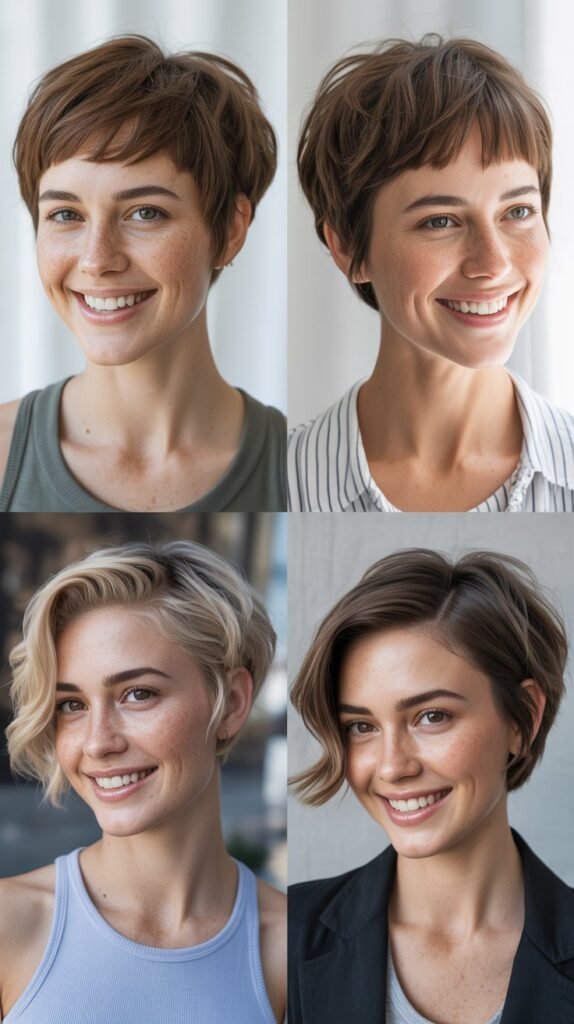
A rounded, curved silhouette brings maximum femininity to the pixie bob by creating soft, circular lines that feel gentle and romantic rather than angular or severe.
This shaping approach celebrates traditionally feminine curves.
Creating the Rounded Shape
- Layering focuses on creating lift at the crown while keeping sides and back closer to the head for a dome-like curve.
- The cutting angle maintains length through the top while removing weight from sides and back to prevent squareness.
- Curved cutting lines rather than straight horizontal or diagonal lines create the round, soft shape throughout.
- The overall silhouette should appear circular when viewed from all angles rather than angular or triangular.
- Proper graduation and layering ensure the rounded shape doesn’t collapse or appear flat.
Styling to Maintain Roundness
- Blow-dry with a round brush, rolling hair up and under to encourage the curved shape from all angles.
- Focus volume at the crown while keeping the sides smooth and close to the head for maximum roundness.
- Avoid flat ironing or creating too much texture, which can disrupt the smooth, curved lines of the cut.
- Use products that provide hold without weight to maintain lift and shape throughout the day.
- The goal is a smooth, polished finish that showcases the beautiful rounded silhouette rather than textured piece-iness.
Face Shapes That Benefit from Roundness
- Long, narrow faces are balanced and appear wider with a rounded pixie bob that adds horizontal volume.
- Angular faces with strong jawlines or cheekbones are softened by the curves in a rounded silhouette.
- Heart-shaped faces appreciate the balance a rounded shape creates, especially when there’s volume through the back.
- The universal appeal of rounded shapes means most face shapes can wear this cut successfully with proper customization.
- The key is adjusting where the most volume sits—higher for longer faces, lower for rounder faces.
28. Pixie Bob with Nape Undercut
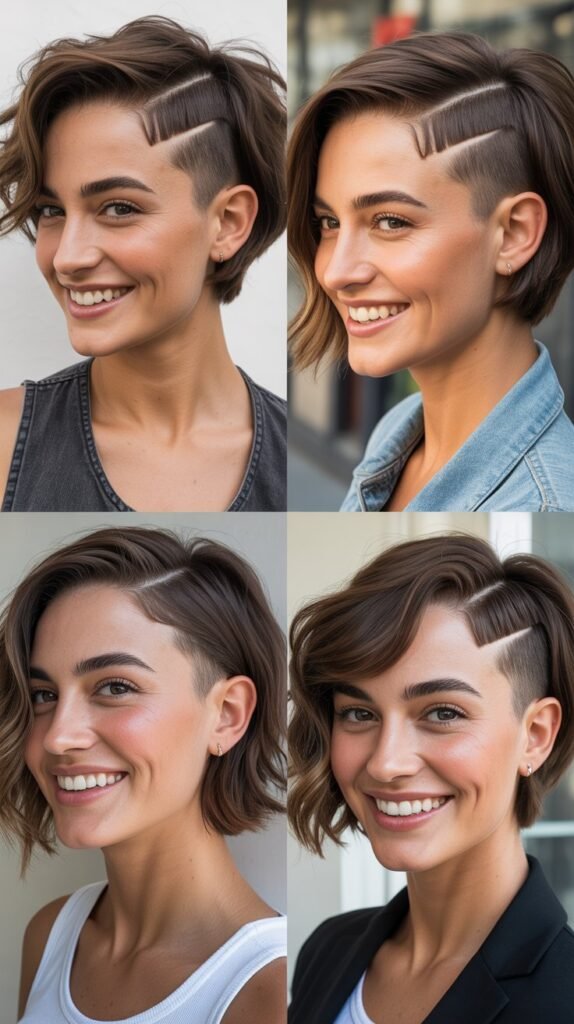
A nape undercut maintains femininity from the front while offering edgy contrast at the back, creating a versatile style that reads differently from various angles. This placement is more conservative than side undercuts while still providing edge and easy maintenance.
Nape Undercut Variations
- The undercut can start anywhere from just below the occipital bone to quite high up the back of the head.
- Lower undercuts are more conservative and easier to conceal, while higher ones make a bolder statement.
- The transition from undercut to longer hair can be blended softly or disconnected for different effects.
- Some people choose to add shaved designs within the undercut for additional personality and flair.
- The width of the undercut (just at the nape versus extending to the sides) significantly impacts the overall look.
Benefits of Nape Undercuts
- The undercut eliminates the common problem of hair sticking out awkwardly at the nape in humid weather.
- It provides dramatic reduction in drying time and overall hair volume, which is refreshing in hot climates.
- The undercut remains hidden during professional settings when hair is down, offering versatility.
- Wearing hair up or in certain styles reveals the undercut for a completely different aesthetic.
- The cool feeling of buzzed hair at the nape is surprisingly comfortable and freeing.
Growing Out Nape Undercuts
- The grow-out process for nape undercuts is less awkward than other placements since the area isn’t prominently visible.
- As it grows, the hair at the nape can blend with the rest of the cut or be maintained as a shorter, tapered section.
- Most people find nape undercuts easier to commit to because they can be concealed during the grow-out phase.
- The decision to grow out or maintain depends on personal preference and how much you enjoy the undercut’s benefits.
- Some choose to let it grow, reshape the overall cut, and repeat the undercut seasonally for variation.
29. Pixie Bob with Face-Framing Money Pieces
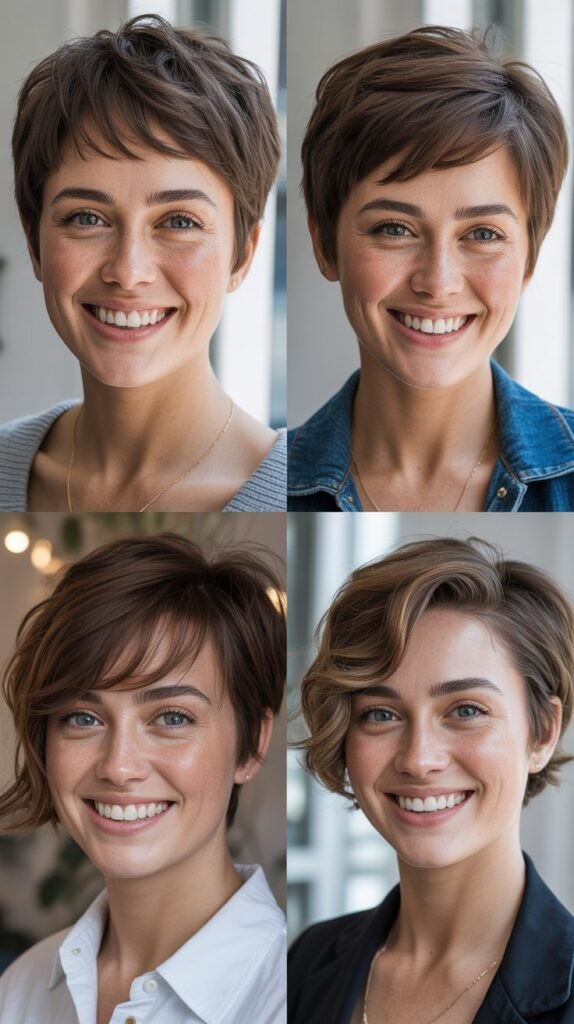
Money pieces—bright, face-framing highlights—add instant lift and youthfulness to a pixie bob while drawing attention to the face in the most flattering way. These strategic highlights create dimension and light around the features.
Strategic Placement of Money Pieces
- Money pieces should be placed at the very front sections that frame the face, typically starting at the temple or hairline.
- The width can vary from very thin slivers to chunky sections depending on desired impact and personal style.
- These highlights should be several shades lighter than the base color to create the brightening effect that defines money pieces.
- Placement can extend from roots to ends or start slightly away from roots for a more natural, sun-kissed appearance.
- Both sides should have money pieces for balance, though they don’t need to be perfectly symmetrical.
Color Choices for Maximum Impact
- Platinum or icy blonde money pieces create the most dramatic contrast against dark bases like brown or black.
- Warm golden or honey tones work beautifully with warm brown bases for a sun-kissed, natural-looking glow.
- Caramel and butterscotch shades on medium brown bases create subtle but impactful face-framing without stark contrast.
- For blonde bases, even lighter blonde or platinum money pieces still create definition and brightness.
- Consider your skin tone—cool-toned money pieces (ash, platinum) versus warm-toned (gold, honey) will complement accordingly.
Maintaining Money Pieces
- Toner every 4-6 weeks keeps blonde money pieces from becoming brassy or yellow, maintaining their bright appearance.
- Purple shampoo used specifically on the highlighted sections helps maintain cool tones between salon visits.
- Root touch-ups depend on whether you prefer a rooted look or want highlights starting at the scalp.
- The high contrast means regrowth is more visible than with subtle highlights, requiring more frequent maintenance.
- Protecting money pieces with heat protectant and UV protection prevents premature fading and brassiness.
30. Soft Pixie Bob for Fine Hair
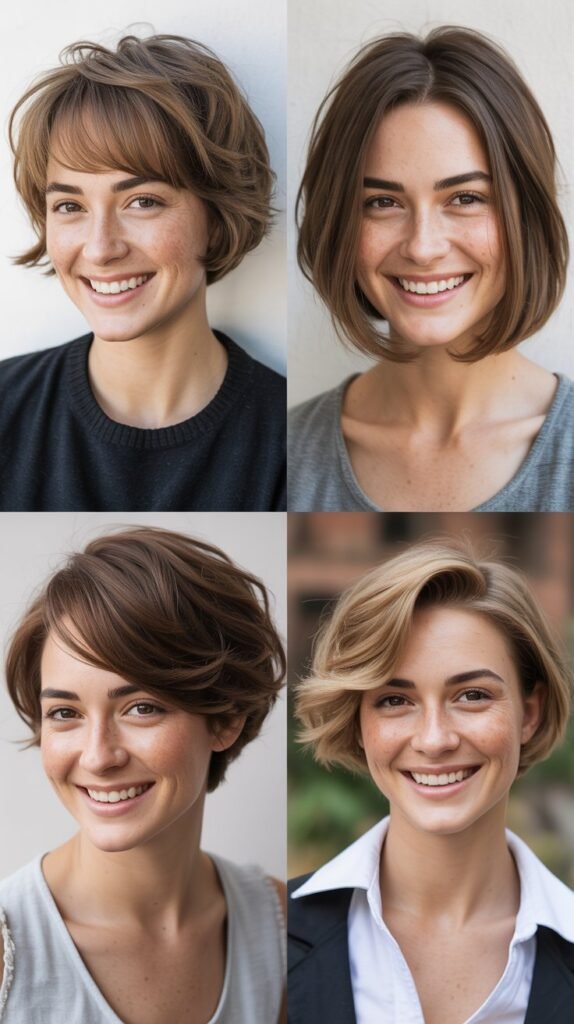
Fine hair requires specific cutting and styling techniques to create the illusion of fullness while maintaining the soft, feminine aesthetic of a pixie bob. Strategic choices make fine hair appear thicker and more voluminous.
Cutting Techniques for Fine Hair
- Blunt cutting rather than extensive layering maintains the appearance of density by keeping ends fuller.
- Strategic layers only where needed for shape prevent over-thinning that can make fine hair look wispy and sparse.
- Texturizing should be minimal and focused on creating movement without removing precious density.
- Slightly longer pixie bobs often work better for fine hair, as very short cuts can appear too sparse.
- Internal layering removes weight without affecting the perimeter density, creating movement while maintaining fullness.
Styling for Maximum Volume
- Volumizing mousses and root lifts are essential products for creating and maintaining volume in fine hair.
- Blow-drying with a round brush and over-directing creates lift at the roots that makes hair appear fuller.
- Setting hair in Velcro rollers while still warm from blow-drying locks in volume as hair cools.
- Avoid heavy oils and serums that weigh fine hair down, causing flatness and limpness.
- Dry shampoo adds texture, grip, and volume to fine hair, making it appear and feel thicker.
Best Pixie Bob Styles for Fine Hair
| Style Element | Why It Works | What to Avoid |
|---|---|---|
| Blunt lines | Maintains density appearance | Over-layering, heavy thinning |
| Gentle layers | Creates movement without sparse ends | Razoring, excessive texturizing |
| Longer length | More hair creates fuller look | Very cropped styles |
| Crown volume | Makes overall style appear fuller | Flat, close-to-scalp cuts |
| Minimal texturizing | Keeps all available hair density | Heavy point-cutting, feathering |
31. Pixie Bob with Thick Hair
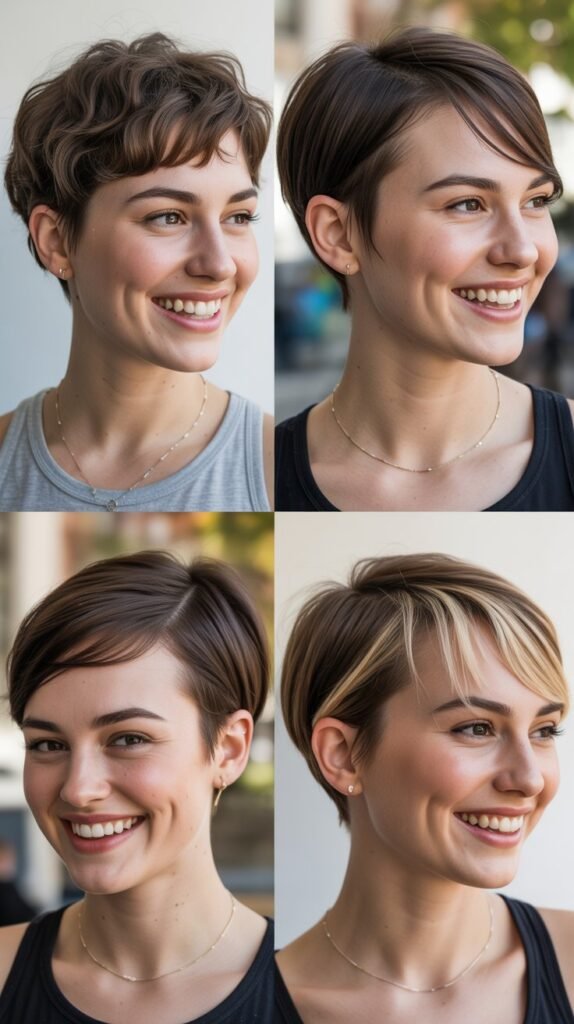
Thick hair presents unique opportunities for pixie bobs, as the natural volume and density create fullness that requires different management than fine hair. The key is removing bulk while maintaining shape and femininity.
Thinning and Texturizing Thick Hair
- Interior layering removes bulk from within the haircut without affecting the outer shape or silhouette.
- Texturizing with thinning shears throughout prevents the triangular, pyramid shape that thick hair naturally creates when cut short.
- Point-cutting and slide-cutting techniques remove weight from ends while maintaining length and density where desired.
- The goal is to lighten and add movement to thick hair without creating a sparse, thin appearance.
- Multiple thinning techniques used in combination create the best results for managing thick, heavy hair.
Styling Challenges and Solutions
- Thick hair can appear heavy and bulky in pixie bobs if not properly thinned and styled correctly.
- Use lighter styling products that won’t weigh down thick hair or make it appear greasy or dirty.
- Blow-drying with a paddle brush smooths thick hair while maintaining some natural volume and movement.
- Thick hair holds styles well naturally, requiring less product and manipulation than fine hair.
- Embrace your hair’s natural body and volume rather than fighting it—thick hair creates enviable fullness in pixie bobs.
Benefits of Thick Hair in Pixie Bobs
- Natural volume means minimal styling is needed to achieve full, voluminous looks that fine hair must work to create.
- Pixie bobs can dramatically reduce styling time for thick hair, which often takes extensive time to manage when long.
- The density allows for more creative cutting techniques and bold styles that might look too sparse on fine hair.
- Thick hair holds shape and structure well, meaning pixie bobs maintain their form throughout the day.
- With proper thinning, thick hair in a pixie bob achieves the perfect balance of volume and manageability.
32. Pixie Bob with Gray or Silver Hair
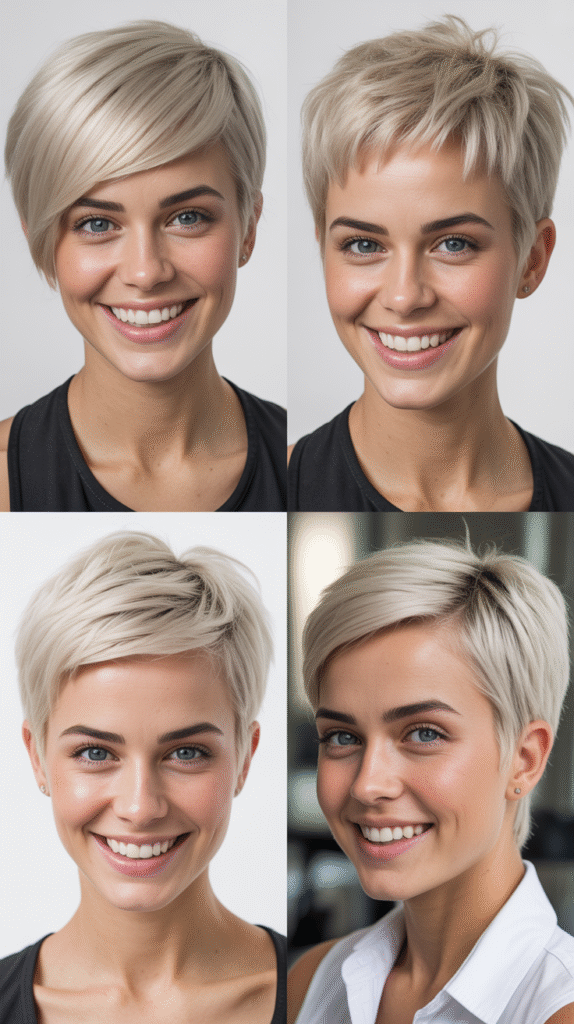
Gray and silver hair brings distinguished elegance to the pixie bob, creating a sophisticated, modern aesthetic that celebrates natural aging while maintaining feminine beauty. This color choice paired with the right cut creates stunning, head-turning results.
Enhancing Natural Gray
- Purple or blue-toned shampoos remove yellow or brassy tones from gray hair, maintaining pure, cool silver shades.
- Regular glossing treatments add shine to gray hair, which can sometimes appear dull or coarse without treatment.
- Proper hydration through deep conditioning is essential, as gray hair tends to be drier and more prone to frizz.
- Showcase gray’s natural highlights and lowlights through strategic cutting that creates dimension and movement.
- Consider adding subtle lowlights or highlights in complementary gray tones for additional dimension if natural gray appears flat.
Transitioning to Gray Gracefully
- Growing out gray roots while maintaining a pixie bob is relatively easy due to the frequent trimming schedule.
- Lowlights that match your natural gray can be added to dyed hair, making the transition less stark as gray grows in.
- Cutting hair very short speeds the transition process significantly, as you remove dyed hair with each trim.
- Some people choose to use temporary color to blend the line between dyed and gray hair during transition.
- The pixie bob’s shorter length means the entire transition to fully gray hair can happen in just a few months.
Styling Gray Pixie Bobs
- Gray hair often has different texture than pigmented hair—it may be coarser, wavier, or more resistant to styling.
- Smoothing products help tame wiry gray hair while adding shine and polish to the finished style.
- Violet-toned styling products can help maintain cool tones and prevent yellowing between washes.
- Gray hair shows off texture beautifully, so consider wavy or tousled styles that celebrate natural movement.
- The stark contrast of silver against skin can be softened with makeup choices, or embraced for dramatic, striking appearance.
33. Pixie Bob with Red Hair
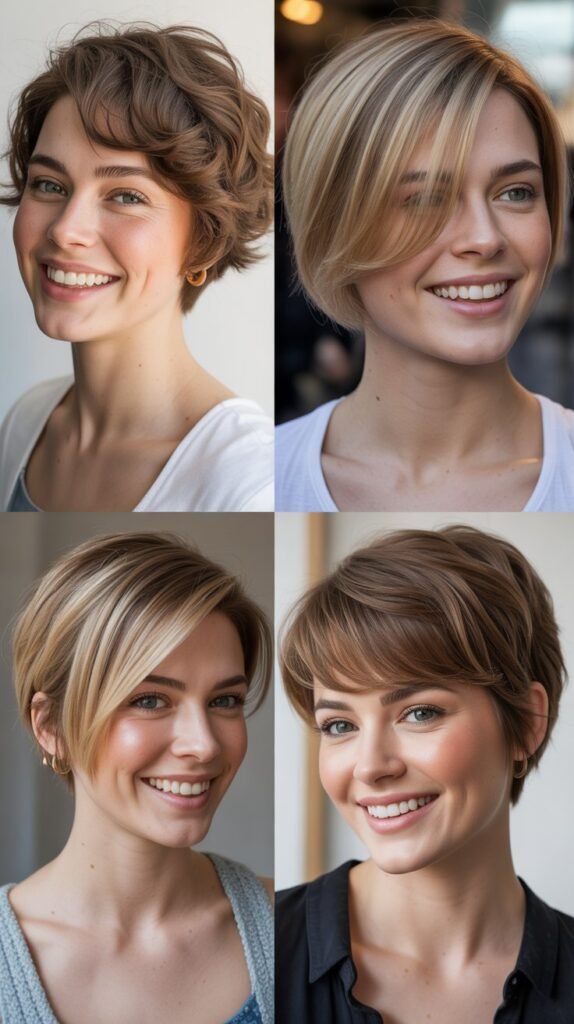
Red hair creates vibrant, eye-catching pixie bobs that feel feminine and fiery simultaneously. From subtle auburn to bold copper or vivid crimson, red tones add warmth and personality to short cuts.
Spectrum of Red Tones
- Auburn offers a natural, sophisticated red that works beautifully in professional settings while still making a statement.
- Copper creates warm, glowing tones that catch light beautifully and feel playful yet refined.
- Burgundy and wine reds provide depth and richness with a slightly edgier, more dramatic appearance.
- Bright, vivid reds make bold statements and require commitment to maintenance but deliver stunning results.
- Strawberry blonde bridges the gap between blonde and red for those wanting warmth without full red commitment.
Maintaining Red Color Vibrancy
- Red hair color fades fastest of all shades, requiring dedicated maintenance to keep it vibrant and true-to-tone.
- Color-depositing shampoos and conditioners in red tones extend the life of your color between salon visits.
- Wash with cool water and sulfate-free products to slow fading and prevent color from washing down the drain.
- Avoid excessive heat styling, which accelerates red color fading more dramatically than other shades.
- Plan for color refreshes every 4-6 weeks for vivid reds, or 6-8 weeks for more natural auburn and copper tones.
Complementing Red with Cuts and Styles
- Red hair shows dimension and highlights beautifully, so layered pixie bobs showcase the color’s depth effectively.
- Glossy, sleek styles make red hair appear more sophisticated and intense by maximizing shine and reflection.
- Textured, tousled styles create a playful, fun aesthetic that complements the warmth of red tones.
- Face-framing pieces in slightly lighter red tones create beautiful dimension and brightness around the face.
- The vibrancy of red makes simple cuts look interesting, as the color itself becomes a major design element.
34. Pixie Bob with Blunt Bob Elements
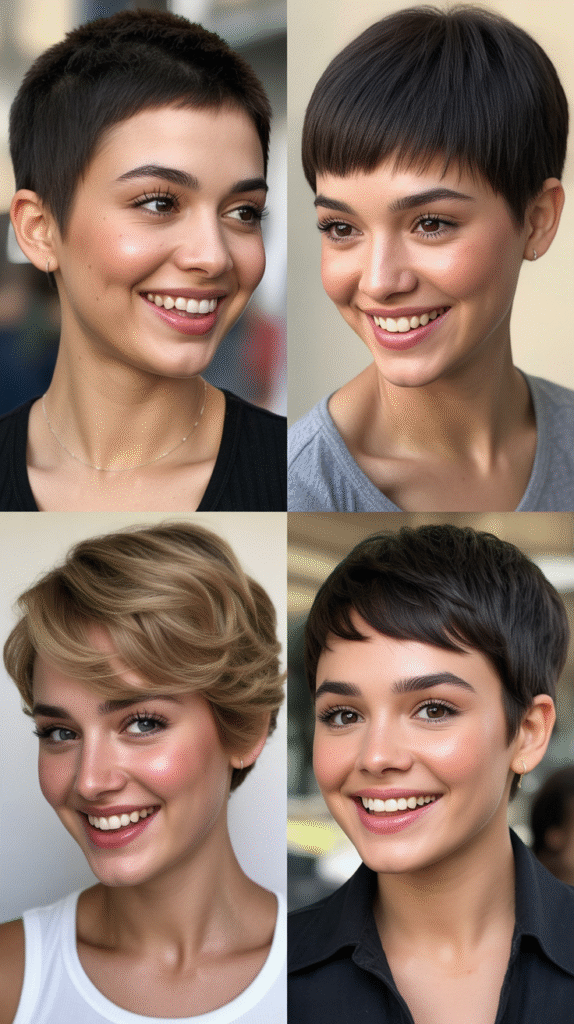
Incorporating blunt bob elements into a pixie bob creates a hybrid style that’s structured yet soft, modern yet timeless. The combination of blunt lines with pixie elements creates interesting contrast and versatility.
Defining Blunt Elements
- Blunt-cut perimeter creates a strong, clean line around the face and nape rather than graduated or textured ends.
- The bluntness typically appears at the longest sections, often around the face, while shorter sections maintain pixie characteristics.
- This creates a beautiful duality—structured, intentional blunt lines with softer, shorter pixie layers throughout.
- The contrast between blunt and layered sections adds visual interest and keeps the style from appearing too severe.
- Precision cutting is essential to maintain clean, straight blunt lines that look intentional rather than choppy.
Styling Blunt Pixie Bobs
- Blow-dry blunt sections with a paddle brush to maintain straight, sleek lines that emphasize the bluntness.
- A flat iron creates perfectly smooth blunt sections that showcase the precision of the cut.
- The shorter, pixie sections can be textured while blunt sections remain smooth for beautiful contrast.
- Products with light hold maintain the clean lines without making hair stiff or crunchy.
- The blunt elements work best when kept relatively straight, as too much curl or wave obscures the clean lines.
Who Should Choose Blunt Elements
- Those with straight or slightly wavy hair showcase blunt elements best, as the lines remain clean and visible.
- Oval and heart-shaped faces carry blunt lines beautifully without the lines overwhelming their features.
- If you love clean, modern aesthetics and prefer polished looks over tousled ones, blunt elements align with this preference.
- People who enjoy precision and structure in their hairstyles appreciate the intentional lines of blunt cuts.
- Fine hair benefits from blunt cutting that maintains the appearance of density and fullness at the ends.
35. Pixie Bob with Wispy Nape
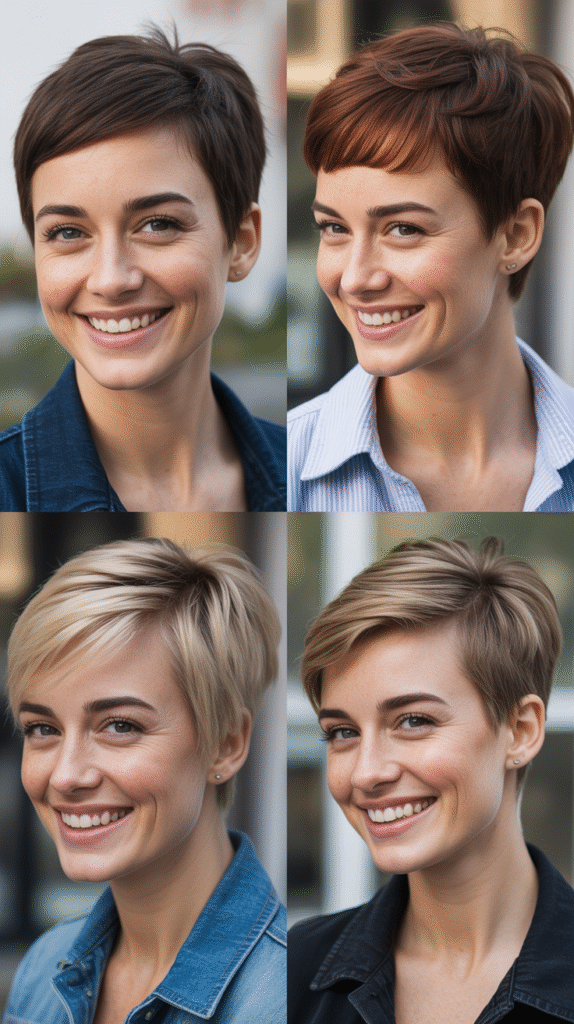
A wispy, feathered nape softens the back of a pixie bob while maintaining the clean, short silhouette that makes this cut so appealing. This delicate finishing creates femininity even in areas typically not visible to the wearer.
Creating Wispy Nape Texture
- Point-cutting and feathering techniques create thin, delicate ends that separate naturally into wispy pieces.
- The nape hair should be light enough to move with air rather than sitting heavily against the neck.
- Gradual tapering toward the hairline creates a soft transition rather than a blunt, heavy edge.
- Each wispy piece should appear delicate and intentional rather than ragged or messy.
- The wispy nape contrasts beautifully with fuller, more substantial sections on top and around the face.
Benefits of the Wispy Nape
- The soft, feathered texture prevents the pixie bob from appearing too harsh or masculine from the back.
- Wispy ends lay softly against the neck without the irritating feeling of blunt-cut hair scratching the skin.
- This technique works beautifully for those with fine or thin hair at the nape, making the most of limited density.
- The delicate appearance adds an element of softness and femininity that balances shorter lengths elsewhere.
- Wispy napes photograph beautifully, creating ethereal, romantic imagery in profile and back-view shots.
Maintaining Wispy Texture
- Regular trims every 4-6 weeks maintain the wispy texture and prevent it from growing out heavy and blunt.
- Between cuts, avoid tucking shirts or scarves into the nape area, which can break and damage the delicate wisps.
- Use minimal product at the nape—heavy products weigh down and clump wispy pieces, eliminating their delicate appearance.
- A tiny amount of light serum can add shine to wispy ends without weighing them down or making them greasy.
- Embrace the natural, airy quality of wispy napes rather than trying to control or perfect every piece.
36. Pixie Bob with Vintage Waves
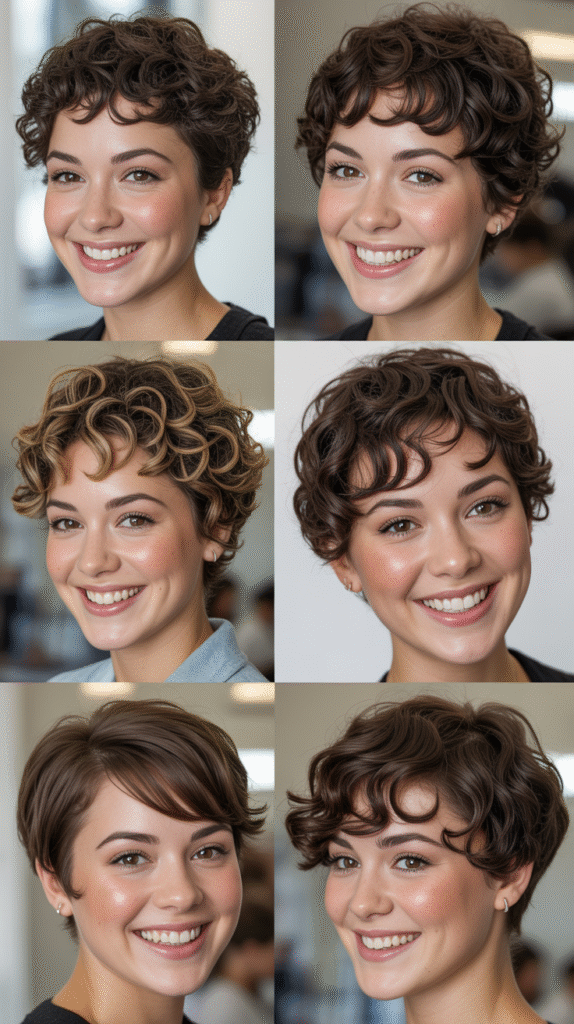
Vintage-inspired waves bring old Hollywood glamour to the modern pixie bob, creating romantic, feminine styling that feels both classic and contemporary. This styling approach works for special occasions or everyday elegance.
Creating Finger Waves in Short Hair
- Apply strong-hold gel or mousse to damp hair for the grip needed to form and hold waves.
- Use fingers and a fine-toothed comb to push hair into S-shaped waves, securing each with clips until dry.
- The waves should follow a consistent pattern throughout the head for that authentic vintage appearance.
- Allow hair to air-dry completely or sit under a hooded dryer before removing clips to ensure waves set properly.
- Finish with light hairspray to maintain the wave pattern without making hair crunchy or stiff.
Pin Curls for Soft Vintage Waves
- Section damp hair and wrap small sections around your finger to form flat pin curls against the scalp.
- Secure each curl with a bobby pin or clip, creating a consistent direction pattern (all forward, all back, or alternating).
- Allow curls to dry completely—this can take hours or be done overnight for convenience.
- Gently brush through the curls with a soft brush to create smooth, connected waves rather than separate ringlets.
- The result is softer than finger waves but still delivers that vintage, glamorous aesthetic.
Modern Vintage Styling Tips
- Combine vintage wave technique with modern elements like textured ends or subtle highlights for updated looks.
- Reserve full vintage waves for special occasions, but incorporate elements (like a slight wave pattern) into everyday styling.
- Accessories like vintage-inspired clips, headbands, or flowers enhance the retro aesthetic beautifully.
- Pair vintage hairstyles with modern makeup and clothing for an eclectic, fashion-forward vibe rather than costume appearance.
- Photograph vintage-styled pixie bobs from the side to showcase the beautiful wave patterns most effectively.
37. Pixie Bob with Colored Tips
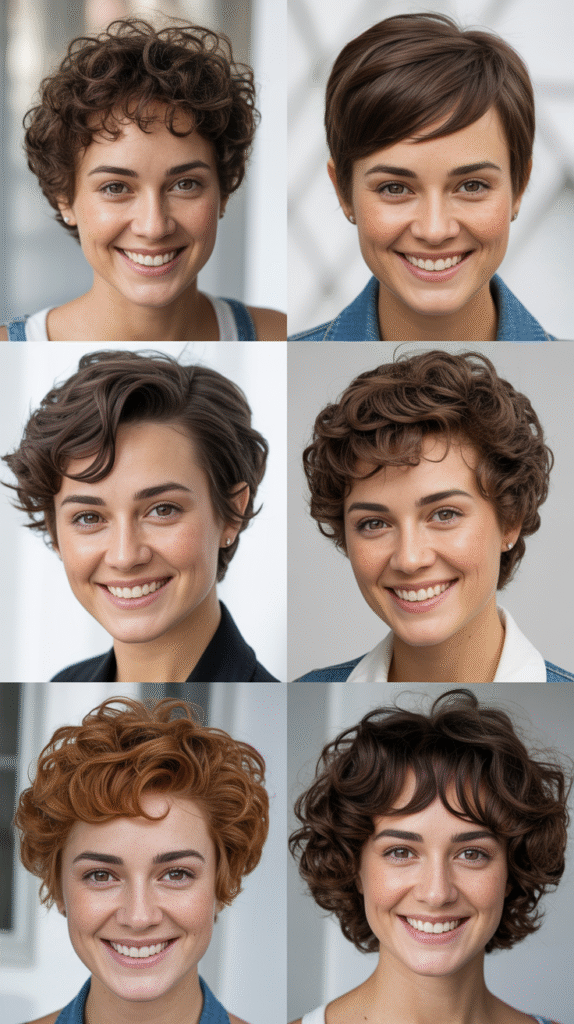
Colored tips add a playful, modern element to pixie bobs through subtle or dramatic color placed only at the ends. This low-commitment color choice allows for creativity while maintaining versatility and easy grow-out.
Color Placement Strategies
- Tips can be colored in natural tones slightly lighter than the base for subtle, sun-kissed dimension.
- Bold, unnatural colors at the tips create playful pops of personality without full-color commitment.
- The amount of tip colored varies from just the very ends to several inches, depending on desired impact.
- Multiple colors can create a rainbow effect at the tips for maximum fun and creativity.
- Strategic placement around the face creates brightness and dimension where it’s most visible and flattering.
Best Colors for Tipped Pixie Bobs
- Pastels like pink, lavender, or mint create soft, whimsical tips that feel feminine and playful.
- Bright neons make bold statements and work beautifully against dark base colors for maximum contrast.
- Metallics like rose gold, silver, or copper add sophisticated shimmer to tips for elevated looks.
- Natural colors like honey, caramel, or platinum create dimension without obvious “colored” appearance.
- Jewel tones like sapphire, emerald, or ruby create rich, sophisticated tip colors for those wanting drama without neon brightness.
Maintaining and Changing Tip Colors
- Colored tips grow out naturally without obvious regrowth lines, making this extremely low-maintenance color.
- When you’re ready for change, simply cut off the colored portions or allow them to fade and recolor in new shades.
- Semi-permanent colors work best for tips, as they fade gradually and can be refreshed or changed easily at home.
- The pixie bob length means colored tips are easily visible without needing long hair to showcase them.
- Experiment freely with tip colors—they’re the lowest-commitment way to try fashion colors without full-head application.
38. Pixie Bob with Soft Undercuts
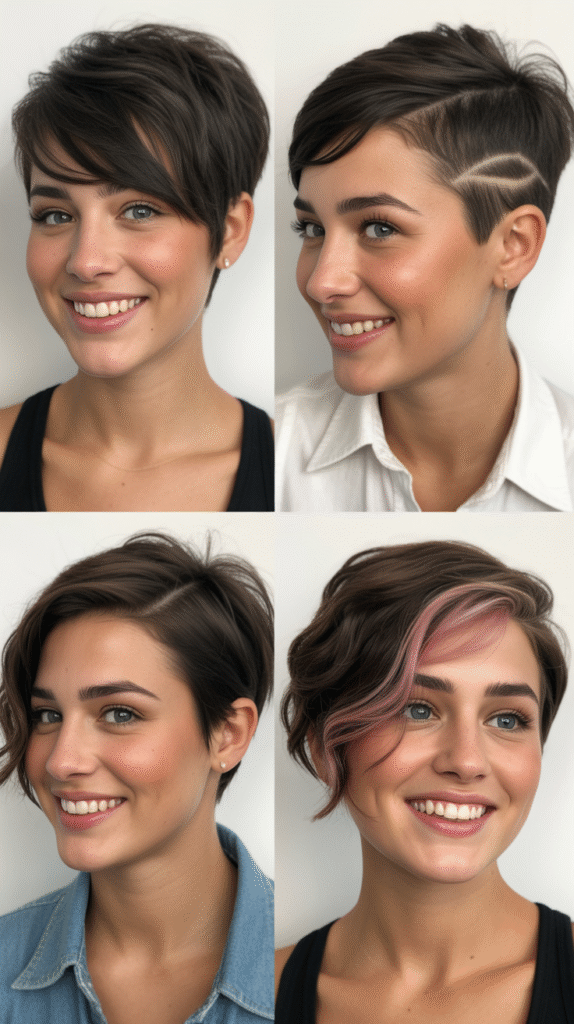
Soft undercuts provide the practical benefits of shaved sections while maintaining femininity through gentle transitions and strategic placement. These subtle undercuts reduce bulk and offer styling versatility without dramatic edge.
Creating Soft Transitions
- Rather than harsh lines of demarcation, soft undercuts blend gradually into longer sections above.
- The undercut section is kept slightly longer than dramatic undercuts (often #4 or #5 guard) for a softer appearance.
- Blending techniques ensure the transition from buzzed to longer hair is smooth and nearly invisible when styled down.
- The width and height of soft undercuts can be customized to remove just enough bulk without creating obvious shaved sections.
- This approach offers benefits of undercuts (less weight, faster drying) while maintaining conservative, feminine aesthetics.
Strategic Placement for Femininity
- Behind-the-ear undercuts remove bulk from the sides while remaining completely hidden when hair is down.
- Nape-only undercuts provide comfort and manageability without visible undercut when viewed from the front or sides.
- Very narrow undercuts create subtle relief from weight without the dramatic appearance of wider undercuts.
- Placement can be customized to address specific concerns like hair sticking out, excess bulk, or styling difficulties.
- The goal is functional improvement and comfort without the bold statement of traditional, visible undercuts.
Growing Out Soft Undercuts
- The gentle transitions of soft undercuts make grow-out significantly less awkward than harsh undercuts.
- As they grow, the slightly longer length blends more easily with the rest of the cut.
- Many people maintain soft undercuts long-term because they offer benefits without the high-impact look they may eventually tire of.
- The grow-out period is shorter and less noticeable, making soft undercuts ideal for those unsure about long-term commitment.
- Styling can conceal growing undercuts completely, unlike dramatic undercuts that remain visible during the grow-out phase.
39. Pixie Bob for Heart-Shaped Faces
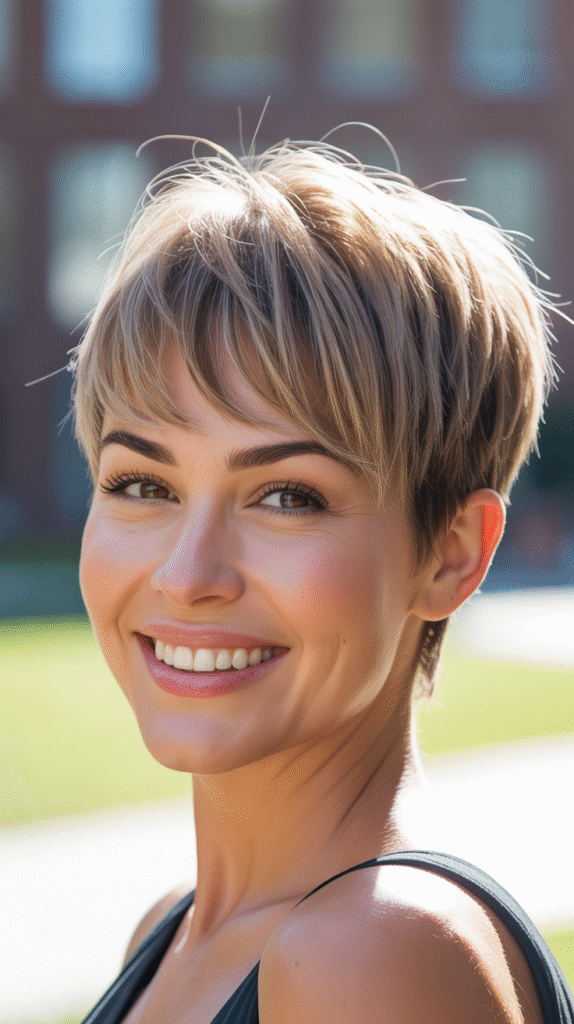
Heart-shaped faces (wide foreheads, narrow chins) benefit from specific pixie bob variations that balance proportions and highlight beautiful features. Strategic cutting creates harmony and femininity perfectly suited to this face shape.
Ideal Pixie Bob Characteristics for Heart Shapes
- Longer side-swept bangs or curtain bangs minimize wider foreheads while adding weight to narrow chins.
- Volume at the jawline creates balance with the wider forehead through horizontal visual weight.
- Avoid volume at the temples or crown, which emphasizes the already-wider upper portion of the face.
- Chin-length or slightly longer front pieces balance the face shape by adding width where needed most.
- Soft, curved lines rather than harsh, angular cuts complement the natural curves of heart-shaped faces.
Strategic Styling for Heart Shapes
- Direct volume toward the jawline and away from the temples using round brushes during blow-drying.
- Curl ends outward at the jaw to create width and balance, using a small curling iron or round brush.
- Keep the top relatively smooth and close to the head to avoid adding volume where it emphasizes width.
- Side parts work beautifully, creating asymmetry that breaks up the width of the forehead visually.
- Face-framing pieces should angle toward the jaw to create the illusion of width at the narrower portion of the face.
Avoiding Common Mistakes
- Short, wispy bangs or micro bangs expose the forehead and emphasize its width, working against balanced proportions.
- Volume at the crown elongates the face and emphasizes the pointed chin characteristic of heart shapes.
- Very short sides expose the widest part of the face without balancing elements lower on the face.
- Symmetrical styles without movement or interest can emphasize the V-shape rather than balancing it.
- All-over texture without strategic volume placement misses the opportunity to create flattering balance.
40. Pixie Bob for Round Faces
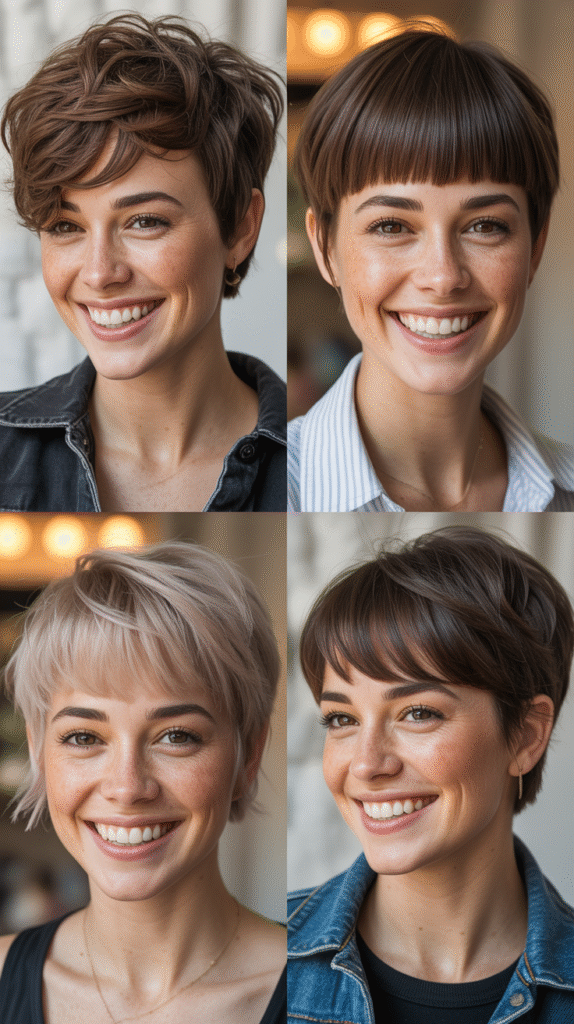
Round faces benefit from pixie bobs that create the illusion of length and angles, balancing circular features with strategic cutting and styling. The goal is elongation and definition while maintaining feminine softness.
Creating Length and Angles
- Height at the crown elongates round faces visually, making them appear longer and less circular.
- Diagonal lines through cutting and styling create angles that round faces naturally lack.
- Asymmetry breaks up the circular shape through intentional imbalance and visual interest.
- Longer front pieces that extend past the chin create vertical lines that elongate the face shape.
- Avoid blunt, straight-across elements that emphasize the horizontal nature of round faces.
Strategic Volume Placement
- Volume focused at the crown lifts and lengthens rather than widening the appearance of round faces.
- Keep sides sleek and close to the head to minimize width and avoid emphasizing roundness.
- The nape can have volume since it doesn’t affect the face-widening aspects of round face shapes.
- Top volume creates the illusion of an oval face shape, which is considered the ideal balanced proportion.
- Avoid volume at the sides or temples, which makes round faces appear even wider and more circular.
Best Pixie Bob Variations for Round Faces
| Style Element | Why It Flatters | Styling Tip |
|---|---|---|
| Deep side part | Creates diagonal angles | Part at eyebrow arch |
| Crown height | Elongates visually | Use volumizing products at roots |
| Longer front pieces | Adds vertical lines | Keep length past jawline |
| Asymmetrical cuts | Breaks up roundness | Style one side behind ear |
| Tapered sides | Minimizes width | Keep sides close to head |
41. Pixie Bob for Square Faces
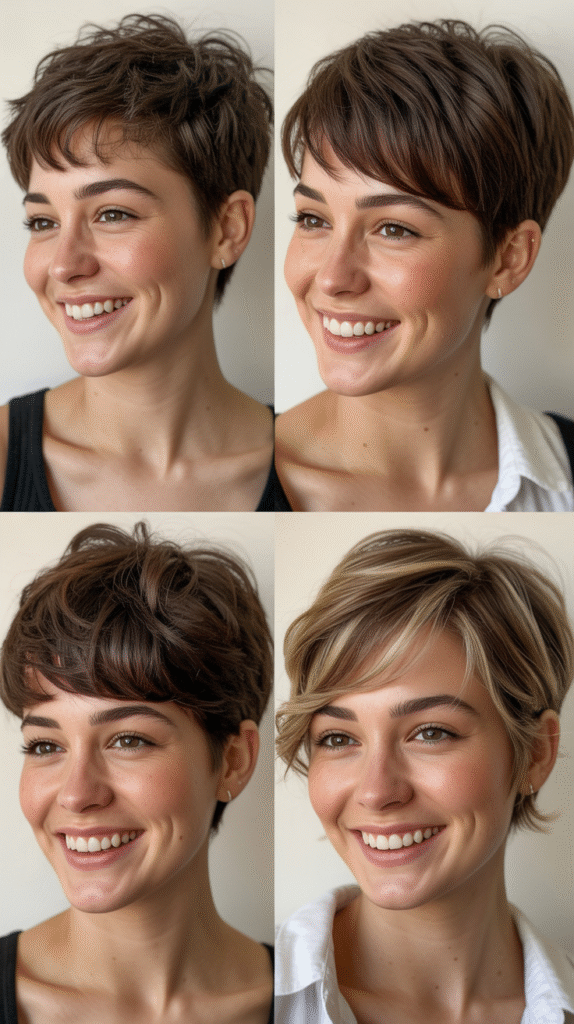
Square faces with strong jawlines and angular features are beautifully softened by pixie bobs that incorporate curves, softness, and strategic length placement. The goal is balancing angles with feminine roundness.
Softening Angular Features
- Soft, curved layers around the face soften strong jawlines and angular cheekbones naturally associated with square faces.
- Avoid blunt, straight cuts that echo and emphasize the already-angular nature of square faces.
- Rounded silhouettes create contrast against angular facial structure, bringing balance through opposition.
- Face-framing pieces should curl toward or away from the face rather than hanging straight, introducing curves.
- Wispy, feathered ends create softness that contrasts with the hard edges of a square jaw.
Ideal Length and Proportions
- Chin-length or slightly longer front pieces draw the eye vertically past the strong jawline.
- Very short crops can emphasize jaw width, while strategic length adds needed softness.
- Avoid jaw-length blunt cuts that end exactly at the widest part of the face, emphasizing squareness.
- Layers that fall above or below the jaw work better than those ending precisely at the jawline.
- Volume at the crown balances the width of the jaw by adding proportional width to the upper face.
Styling Techniques for Square Faces
- Add soft waves or curls to introduce curves that the face shape naturally lacks.
- Direct hair forward around the jaw with blow-drying or styling to visually soften and narrow this area.
- Side-swept styles create diagonal lines that break up the horizontal and vertical lines of square faces.
- Gentle volume throughout creates overall softness that balances angular features beautifully.
- Avoid slicked-back or severe styles that expose and emphasize the angular bone structure.
42. Pixie Bob for Oval Faces
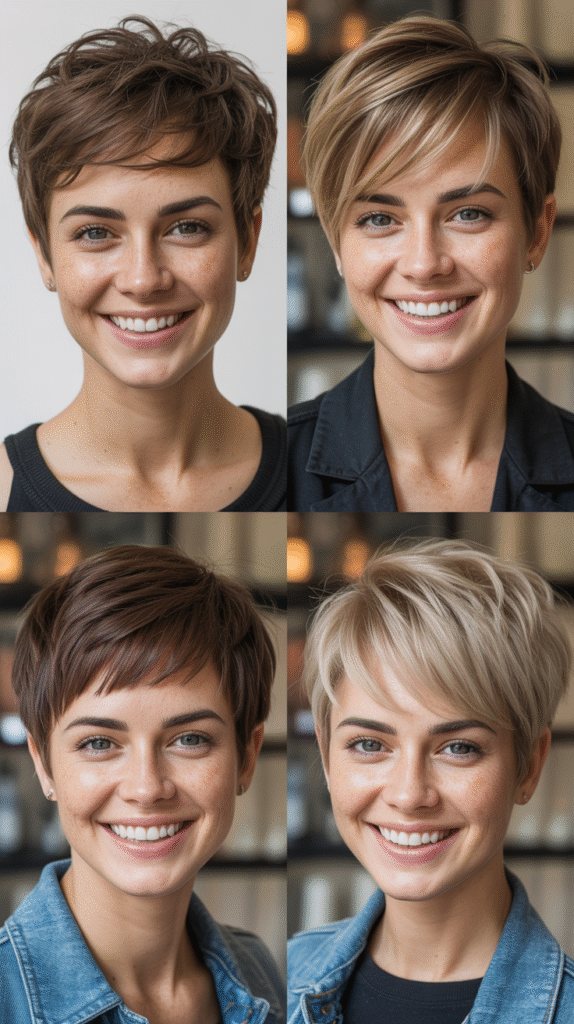
Oval faces are considered the ideal proportions and can carry virtually any pixie bob variation successfully. This face shape allows for maximum creativity and personalization since balance isn’t a primary concern.
The Versatility Advantage
- Oval faces balance width and length naturally, allowing any pixie bob style without proportion concerns.
- Both symmetric and asymmetric cuts work beautifully on oval faces without throwing proportions off balance.
- Volume placement is unrestricted—crown, sides, or even distribution all flatter oval faces equally.
- All bang types (side-swept, blunt, micro, curtain, or no bangs) work successfully on oval proportions.
- Length variations from very short pixies to longer bobs all suit the balanced oval shape.
Exploring Creative Options
- Use the freedom of an oval face to experiment with trendy, avant-garde cuts that other face shapes can’t pull off.
- Try bold color placements, dramatic undercuts, or unusual textures without worrying about unflattering proportions.
- Change styles frequently if desired—oval faces transition between different pixie bob variations seamlessly.
- Focus on personal style preference rather than face-shape rules when choosing your ideal pixie bob.
- Consider other factors like hair texture, lifestyle, and maintenance preferences since face shape isn’t limiting.
Maximizing Your Oval Advantage
- Highlight your best features specifically rather than correcting proportions (which aren’t needed).
- If you have beautiful eyes, choose cuts that draw attention upward with height or interesting bangs.
- Show off great cheekbones with shorter sides that expose this feature prominently.
- Emphasize a graceful neck with pixie bob variations that showcase this area beautifully.
- Use your versatility to find what makes you feel most confident and beautiful rather than following rigid rules.
43. Pixie Bob with Headband Styling
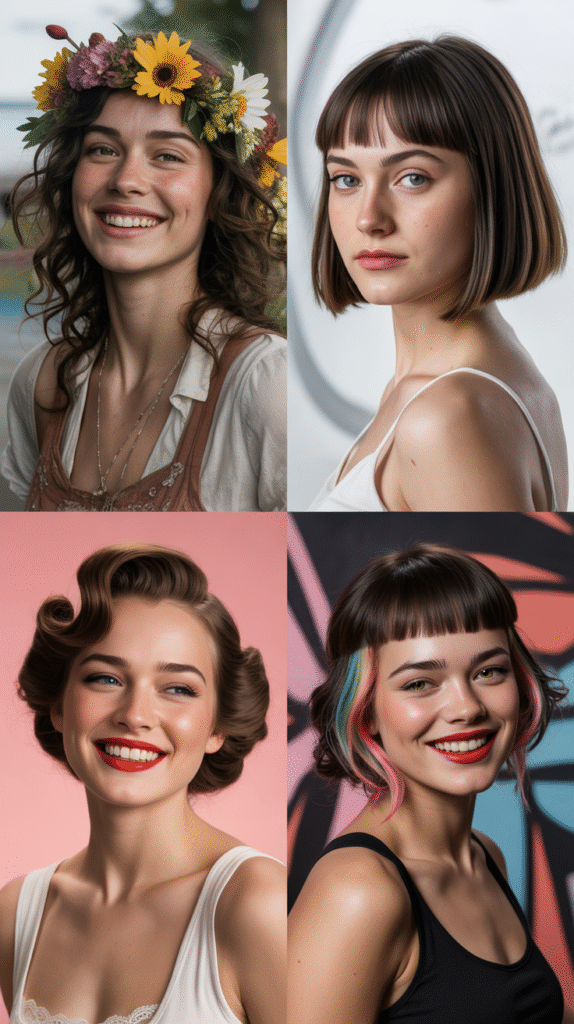
Headbands transform pixie bobs from casual to polished instantly, offering quick styling solutions and adding feminine charm through accessories. This simple addition creates endless variation with minimal effort.
Choosing Flattering Headbands
- Thin, delicate headbands add subtle interest without overwhelming short hair or small facial features.
- Wide headbands make bold statements and can be styled to push hair back or sit further back as decorative elements.
- Embellished headbands with pearls, crystals, or flowers elevate pixie bobs for special occasions and formal events.
- Simple ribbon or fabric headbands create casual, everyday feminine charm without fuss or excessive sparkle.
- Metal or hard headbands provide structure and can double as styling tools to train hair in specific directions.
Styling Techniques with Headbands
- Place headbands where they hold hair back effectively without slipping—typically behind the hairline or at the crown.
- Tuck shorter sections behind ears before adding headbands for a polished, put-together appearance.
- Leave some face-framing pieces out in front of the headband for soft, romantic effect rather than pulling everything back.
- Layer headbands over styled hair (waves, sleek, textured) to complement rather than replace your hairstyling efforts.
- Experiment with placement—closer to the hairline for retro looks, farther back for bohemian vibes.
Headbands for Different Occasions
- Casual outings: Simple fabric or ribbon headbands in coordinating colors for effortless polish.
- Professional settings: Sleek, minimalist headbands in neutral tones that add interest without distraction.
- Evening events: Embellished headbands with sparkle, pearls, or metallic finishes for glamorous impact.
- Athletic activities: Sport headbands that keep hair secure and absorb moisture while remaining stylish.
- Special occasions: Decorative headbands with flowers, bows, or unique designs that make statements.
44. Pixie Bob with Bobby Pin Details
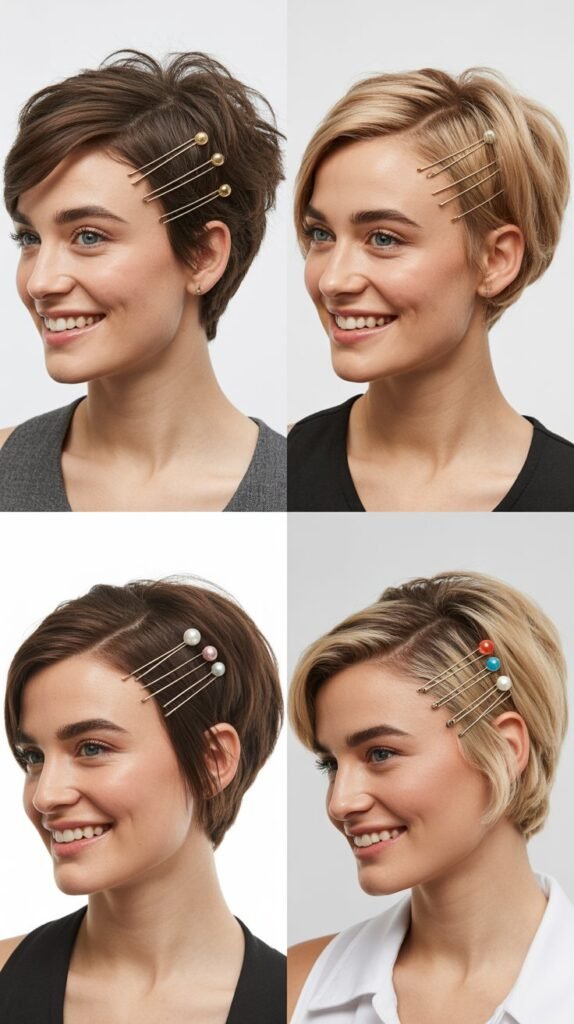
Strategic bobby pin placement transforms pixie bobs through functional styling that doubles as decorative detail. These small accessories create big impact while keeping hair beautifully controlled.
Functional Bobby Pin Styling
- Use bobby pins to secure one side behind the ear while leaving the other side down for asymmetric styling.
- Create pin-curl-like shapes by twisting small sections and securing them with pins for vintage-inspired detail.
- Control unruly pieces or cowlicks by pinning them strategically in the direction you want them to lay.
- Add pins to secure side-swept bangs or face-framing pieces that might otherwise fall into eyes or face.
- Utilize pins to create faux undercuts by pinning up sections to reveal the skin beneath temporarily.
Decorative Pin Arrangements
- Create patterns with multiple pins—crisscross, parallel lines, geometric shapes—for artistic interest.
- Mix metals (gold and silver) or colors for playful, eclectic pin arrangements that show personality.
- Pearl-topped or jeweled pins add elegance and femininity for special occasions and formal events.
- Color-coordinate pins with outfit or hair color for cohesive, intentional styling that looks planned.
- Cluster pins together on one side for dramatic impact rather than scattering them throughout randomly.
Pin Selection and Placement
- Choose pins that match or contrast with hair color depending on whether you want them to blend or stand out.
- Decorative pins with embellishments should be visible, placed on the sides or top of the head.
- Functional pins can be hidden beneath upper layers, securing hair without being seen.
- The thickness and texture of your hair determines how many pins you’ll need for secure hold.
- Test pin security before leaving home—short hair sometimes requires multiple pins to hold sections successfully.
45. Pixie Bob with Ear Tuck Styling
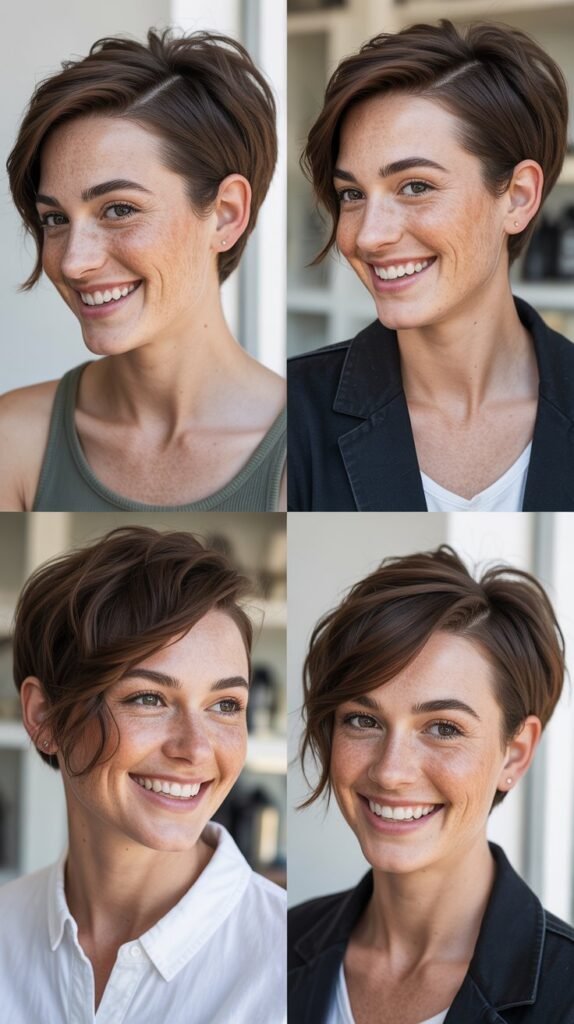
The simple act of tucking one side behind the ear creates instant asymmetry and reveals beautiful facial features in pixie bobs. This effortless styling trick transforms your look in seconds.
Creating the Perfect Tuck
- Choose which side to tuck based on your part, facial features, or simply which side feels natural and comfortable.
- Apply a small amount of product behind the ear to help hair stay tucked without constantly falling forward.
- Use a small bobby pin or clip hidden behind the ear if hair is too short or slippery to stay tucked naturally.
- The tucked side should be smooth and close to the head while the loose side maintains volume and interest.
- Re-tuck throughout the day as needed—this is meant to be casual and effortless, not rigidly perfect.
Showcasing Jewelry and Features
- The ear tuck prominently displays statement earrings, making this styling ideal when wearing special pieces.
- Reveal beautiful ear piercings and curated ear designs that might otherwise be hidden by hair.
- Draw attention to cheekbones and jawline on the tucked side through the exposure this styling creates.
- The asymmetry created by tucking highlights facial features in an artful, flattering way.
- Balance the tucked side with interesting styling on the loose side to prevent the look from appearing lopsided.
Variations on the Tuck
- Tuck both sides for a completely different look that exposes the entire face and ears symmetrically.
- Tuck only the very front section while leaving back sections loose for subtle asymmetry.
- Combine tucking with other styling elements like waves, braids, or pins for layered interest.
- Alternate which side you tuck daily for variety and to prevent hair from developing a permanent tuck pattern.
- Use the tuck temporarily during activities (eating, working) then release it for different aesthetic later.
46. Pixie Bob with Barrette Accents
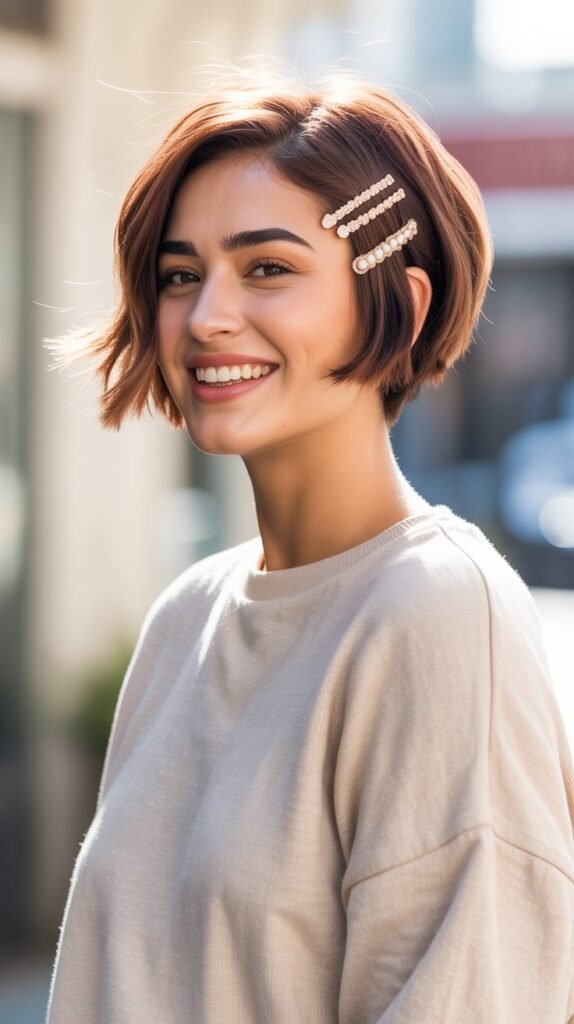
Barrettes add vintage charm and modern sophistication to pixie bobs simultaneously, offering countless styling possibilities through various sizes, styles, and placements of these classic accessories.
Barrette Styles and Choices
- Minimalist metal barrettes create modern, sleek accents that feel current and fashion-forward.
- Pearl or crystal-embellished barrettes add romantic, feminine elegance perfect for special occasions.
- Vintage-inspired barrettes with intricate details bring nostalgic charm to contemporary short cuts.
- Geometric or artistic barrettes make bold statements and showcase personal style through unique designs.
- Tortoiseshell or acetate barrettes offer classic sophistication in various colors and patterns.
Strategic Barrette Placement
- Side placement above or behind the ear secures face-framing pieces while adding decorative interest.
- Crown placement showcases statement barrettes and can create half-up styling in longer pixie bobs.
- Multiple small barrettes create visual interest through repetition and can form patterns or designs.
- Asymmetric placement (one large barrette on one side) creates intentional imbalance that feels modern.
- Back-of-head placement works for practical securing while remaining visible from side and back views.
Coordinating Barrettes with Outfits
- Match barrette materials (gold, silver) to jewelry for cohesive, intentional styling.
- Choose barrette colors that complement or contrast with hair color depending on desired impact.
- Coordinate embellishments with outfit details—pearls with pearls, crystals with sparkle, etc.
- Consider the occasion—understated barrettes for professional settings, dramatic ones for evening events.
- Build a collection of barrettes in various styles to create different looks with the same haircut.
47. Pixie Bob with Root Stretch
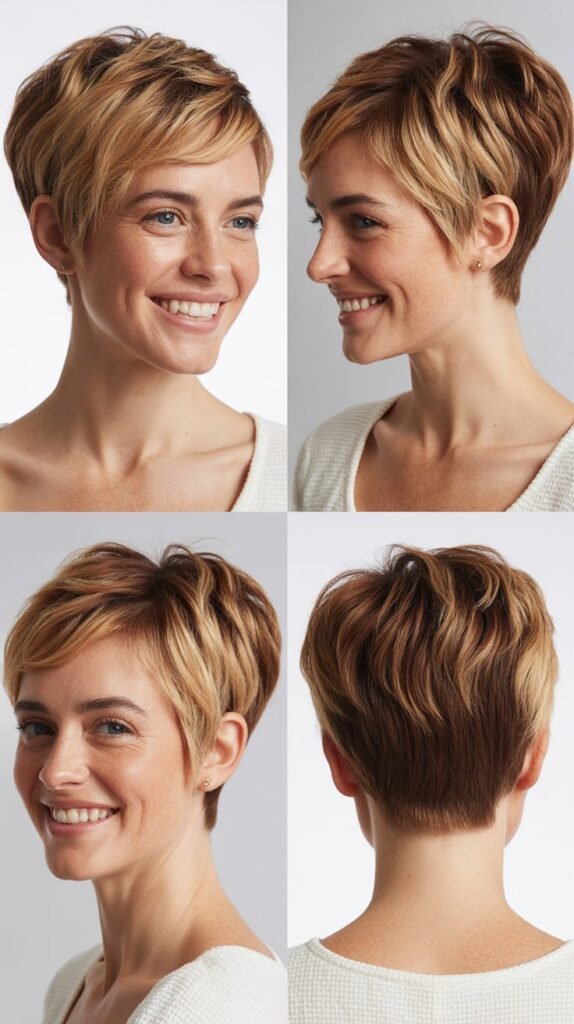
Root stretching allows natural roots to grow several inches before highlighting or coloring, creating low-maintenance color while adding dimension and depth.
This technique is especially beneficial for busy lifestyles.
Understanding Root Stretch Benefits
- Extended time between color appointments reduces maintenance demands and expense significantly.
- Natural roots add depth and dimension that all-over color sometimes lacks, creating visual interest.
- Less frequent coloring means reduced chemical damage and better overall hair health and condition.
- The gradual transition from dark roots to lighter ends appears intentional rather than like neglected regrowth.
- Root stretch works beautifully with the frequent trims pixie bobs require, removing old color naturally.
Ideal Color Combinations
- Dark brown roots melting into caramel or honey ends create warm, natural-looking dimension.
- Black roots transitioning to dark brown or burgundy maintain richness while adding subtle lightness.
- Blonde roots extending to platinum or brighter blonde ends creates tonal variation without drastic contrast.
- Gray roots blended into silver or white ends make transitioning to natural gray more seamless and intentional.
- The key is choosing colors within 2-3 shades of each other for believable, natural-looking results.
Maintenance and Touch-Up Schedule
| Color Type | Root Stretch Length | Touch-Up Frequency | Maintenance Level |
|---|---|---|---|
| Subtle highlights | 2-3 inches | 12-16 weeks | Very low |
| Balayage | 2-4 inches | 12-20 weeks | Very low |
| All-over color | 1-2 inches | 8-12 weeks | Low |
| Fashion colors | 1 inch | 6-8 weeks | Moderate |
| Platinum blonde | 0.5-1 inch | 4-6 weeks | High |
48. Pixie Bob with Fringe Benefits
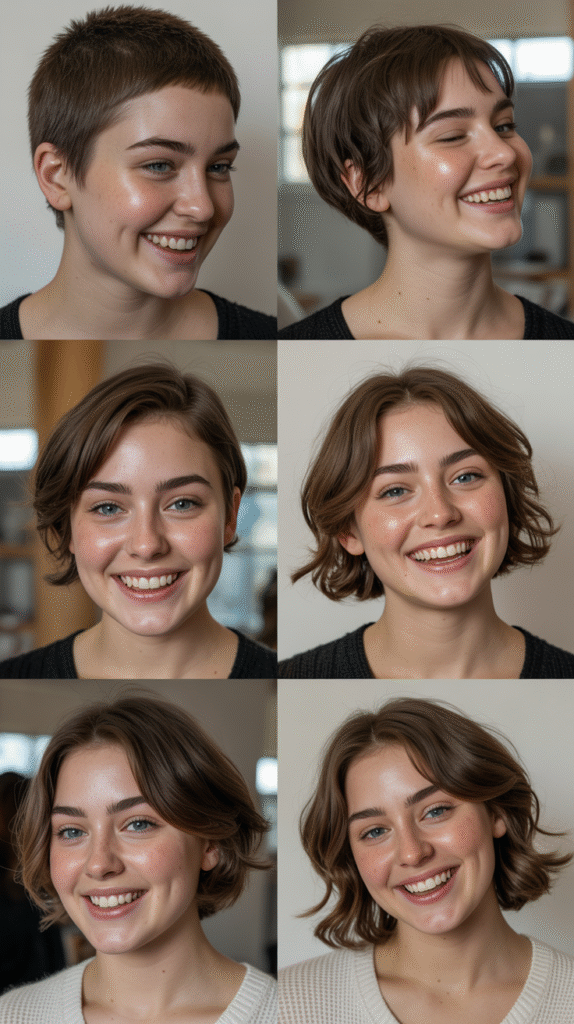
Various fringe styles transform pixie bobs dramatically, offering versatility and the ability to customize the cut to perfectly frame your individual features. From blunt to wispy, fringe options are endless.
Exploring Fringe Options
- Blunt, straight-across fringe creates bold, fashion-forward statements with graphic lines and structure.
- Wispy, textured fringe offers soft, romantic appeal that feels delicate and feminine.
- Side-swept fringe adds elegance and sophistication while remaining versatile for styling changes.
- Baby bangs (micro fringe) make daring, trendy statements for the fashion-adventurous.
- Curtain fringe frames the face symmetrically with a center part for vintage-inspired beauty.
Customizing Fringe for Your Face
- Consider forehead height—higher foreheads can handle more fringe coverage while lower foreheads need lighter, airier bangs.
- Eye emphasis changes with fringe placement—draw attention upward with shorter fringe, downward with longer.
- Fringe thickness impacts overall look—thicker fringe makes bolder statements while thin fringe stays subtle.
- Texture within fringe (choppy vs. smooth) should complement the texture throughout the rest of your pixie bob.
- The transition from fringe to sides determines how seamlessly fringe integrates with the overall cut.
Living with Fringe Daily
- Fringe requires more frequent trims than the rest of the cut—plan for bang trims every 2-3 weeks.
- Styling fringe becomes part of daily routine—allow extra time for blow-drying or flat-ironing bangs.
- Oil from skin can transfer to fringe throughout the day, potentially requiring mid-day refreshing or blotting.
- Workout and weather considerations matter—sweat and humidity affect fringe significantly.
- Growing out fringe takes patience and strategy—pins, headbands, and side-sweeping help through awkward phases.
49. Pixie Bob for Active Lifestyles
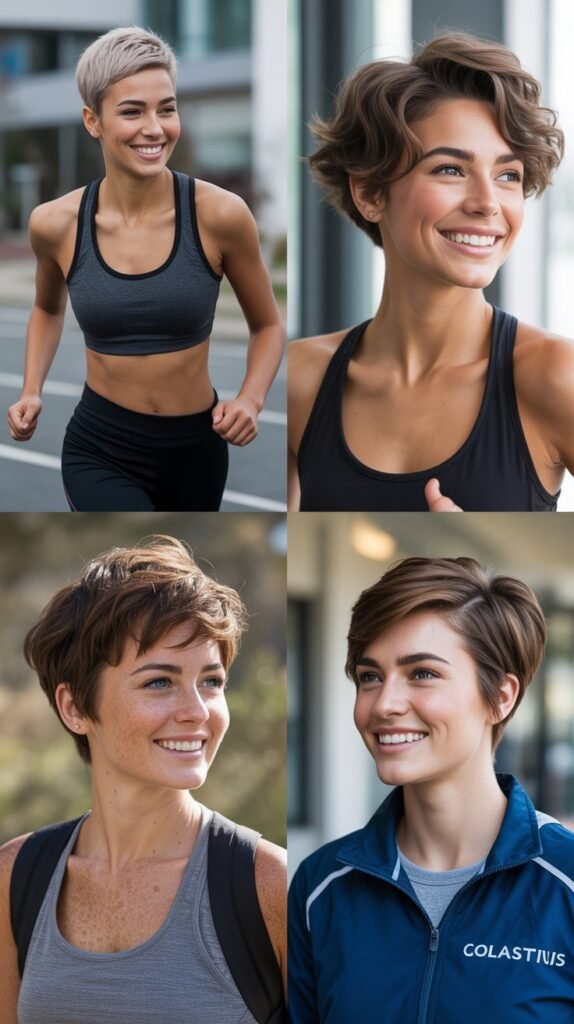
Active individuals need pixie bobs that stay put during movement, dry quickly, and require minimal maintenance while still looking feminine and polished. Specific cuts and styling approaches meet these unique needs.
Cut Characteristics for Activity
- Tapered sides and nape stay close to the head, preventing hair from sticking to sweaty skin during exercise.
- Minimal length overall reduces drying time after showers following workouts or water activities.
- Fewer layers mean less styling required to make hair look intentional and put-together.
- Slightly longer top sections allow for securing hair with headbands or clips during intense activity.
- The cut should look good with minimal product, as heavy products can feel uncomfortable during physical activity.
Low-Maintenance Styling Solutions
- Air-drying works well for cuts designed for active lifestyles, eliminating heat styling requirements.
- Texturizing spray adds just enough interest without requiring blow-drying or extensive manipulation.
- Sport headbands keep hair secure and absorb sweat while adding a stylish element.
- Quick refresh options like dry shampoo extend time between washes without sacrificing appearance.
- The goal is looking polished in under 5 minutes for busy mornings or post-workout refreshing.
Products for Active Hair
- Water-resistant styling products maintain hold and appearance even through sweat and humidity.
- Dry shampoo designed for active lifestyles absorbs oil and sweat while adding texture and volume.
- Leave-in conditioners provide moisture without weighing hair down or requiring rinsing.
- UV-protectant sprays shield hair from sun damage during outdoor activities and sports.
- Minimal, lightweight products prevent buildup and the heavy feeling that discourages washing after every workout.
50. Pixie Bob with Graduated Color
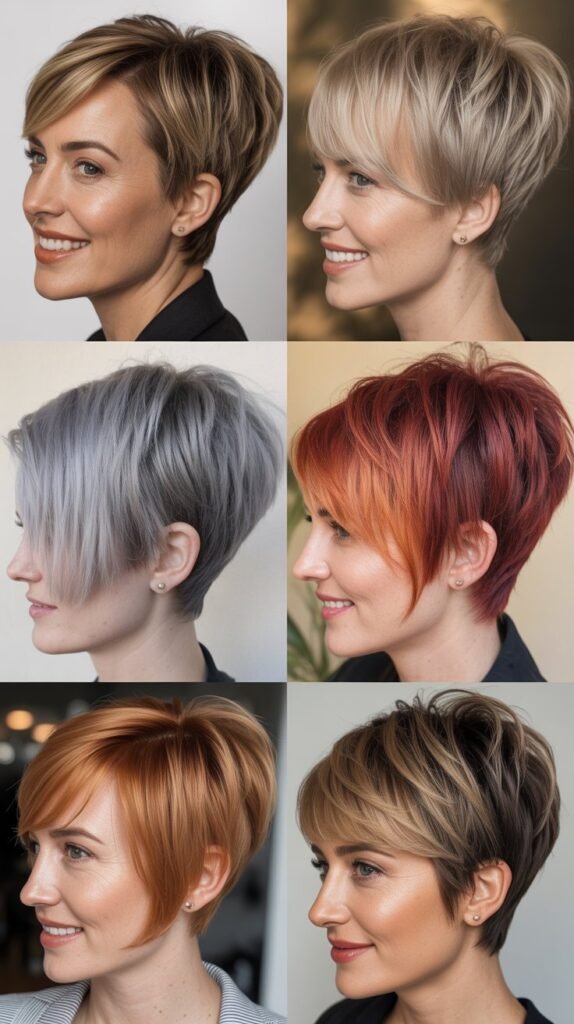
Graduated color techniques create seamless transitions from dark to light throughout the pixie bob, adding dimension and movement through color that enhances the cut’s shape and layers beautifully.
Creating Seamless Color Transitions
- Color gradually shifts from darker at the roots to progressively lighter through mid-lengths and ends.
- The transition should be imperceptible—no harsh lines demarcating where one color ends and another begins.
- Multiple tones bridge the gap between darkest and lightest shades for smooth, natural-looking graduation.
- Placement follows the cut’s natural layers, with color enhancing rather than fighting the structural shape.
- The graduated effect creates depth and dimension that makes the cut appear more complex and interesting.
Color Selection for Graduation
- Stay within the same color family (cool browns, warm blondes) for natural, believable graduation.
- The darkest shade typically sits 2-4 levels darker than the lightest for visible but not stark contrast.
- Warm color progressions (espresso to caramel to honey) create sun-kissed, natural dimension.
- Cool progressions (black to ash brown to silver) deliver modern, edgy graduation that still feels soft.
- Consider skin tone when selecting color families—warm tones for warm skin, cool tones for cool skin.
Maintaining Graduated Color
- The beauty of graduation is graceful grow-out that looks intentional rather than like neglected roots.
- Toning appointments every 6-8 weeks adjust the lighter ends without requiring full recoloring.
- Regular trims remove the lightest, most damaged ends while maintaining the graduated effect.
- Color-depositing treatments refresh vibrancy between salon visits without damaging hair further.
- Plan for full color refresh every 3-4 months to maintain the seamless graduation as hair grows.
51. Pixie Bob with Natural Texture Enhancement
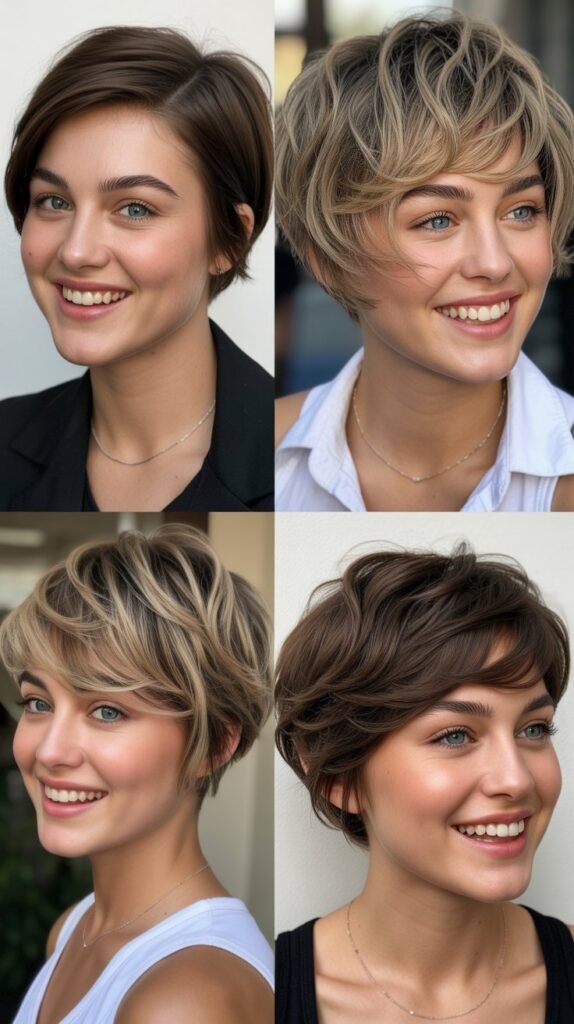
Embracing and enhancing natural texture rather than fighting it creates easy-maintenance pixie bobs that work with your hair’s inherent patterns.
This approach celebrates individuality while minimizing daily styling time.
Working with Natural Wave
- Cuts for naturally wavy hair should enhance S-pattern waves through strategic layering that removes weight.
- Curl-enhancing products define waves without creating stiffness or crunch that looks unnatural.
- Scrunching while air-drying or diffusing encourages natural wave formation and reduces frizz.
- Longer lengths allow waves to form more completely, while very short sections may appear straight.
- Embrace the natural movement and imperfection of waves rather than trying to create uniform curls.
Enhancing Natural Curls
- Curly pixie bobs require moisture-rich products to maintain curl health and definition.
- The DevaCurl cutting method (cutting curls individually when dry) creates custom shapes for curly pixie bobs.
- Diffusing on low heat with minimal manipulation creates defined curls without disturbing their natural pattern.
- Sleep protection (silk pillowcase or bonnet) maintains curl definition overnight, reducing morning styling time.
- Refresh curls between washes with water and leave-in conditioner rather than restyling from scratch.
Celebrating Straight Texture
- Naturally straight hair in pixie bobs creates sleek, polished looks with minimal effort.
- Enhance natural shine with smoothing products rather than adding artificial texture.
- Straight pixie bobs showcase clean lines and precision cuts beautifully without textured distraction.
- A slight bend at the ends adds softness without fighting the hair’s inherent straightness.
- Embrace the ease of straight hair that air-dries smooth and requires little daily manipulation.
52. Pixie Bob with Seasonal Adjustments
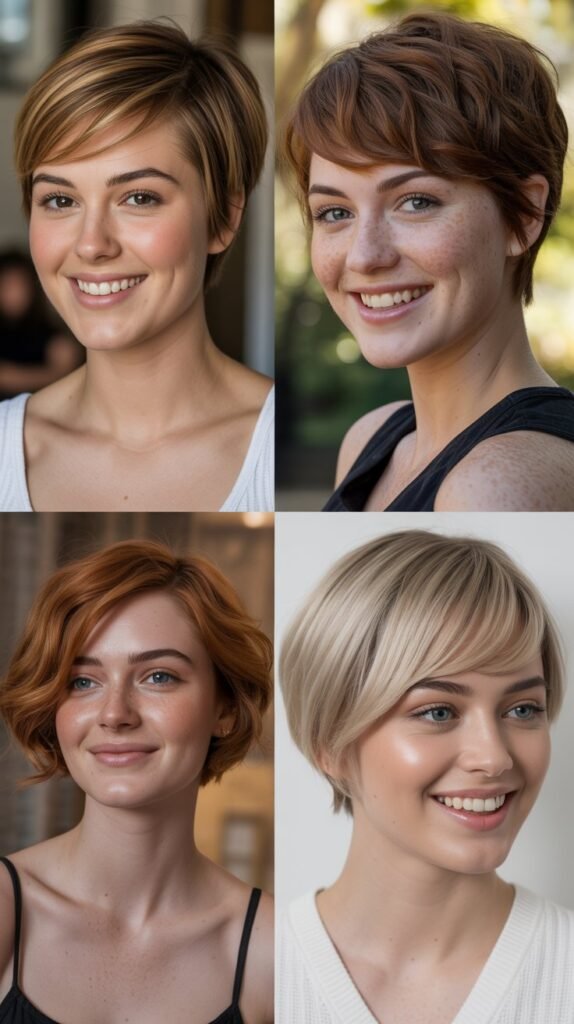
Adapting your pixie bob to seasonal changes keeps you comfortable and stylish year-round while accommodating weather challenges that affect short hair differently than long hair.
Summer Pixie Bob Strategies
- Shorter lengths and tapered sides provide relief from heat and reduce neck sweating significantly.
- Lighter colors reflect heat and feel cooler than dark colors that absorb sunlight.
- Minimal product use prevents melting, greasiness, and the heavy feeling that summer heat exacerbates.
- UV-protectant products shield hair from sun damage that intensifies during long summer days outdoors.
- Embrace air-drying and natural texture to avoid adding heat from styling tools to already-hot days.
Winter Pixie Bob Adjustments
- Slightly longer lengths provide warmth at the ears and neck during cold weather months.
- Rich, deep colors feel appropriate for winter and require less sun protection than lighter summer shades.
- Moisture treatments combat dryness from indoor heating and cold outdoor air that strips hair.
- Static control products prevent flyaways and frizz that winter’s dry air aggravates.
- Hat-friendly styles maintain shape after wearing winter accessories like beanies and ear warmers.
Transitional Season Styling
| Season | Key Adjustment | Styling Focus | Product Priority |
|---|---|---|---|
| Spring | Lighten color slightly | Add movement and bounce | Frizz control for humidity |
| Summer | Maximum brevity | Minimal styling, natural texture | UV protection, light hold |
| Fall | Deepen color tones | Add richness and gloss | Moisture restoration |
| Winter | Slight length addition | Smooth, polished finishes | Hydration, static control |
53. Pixie Bob with Professional Polish
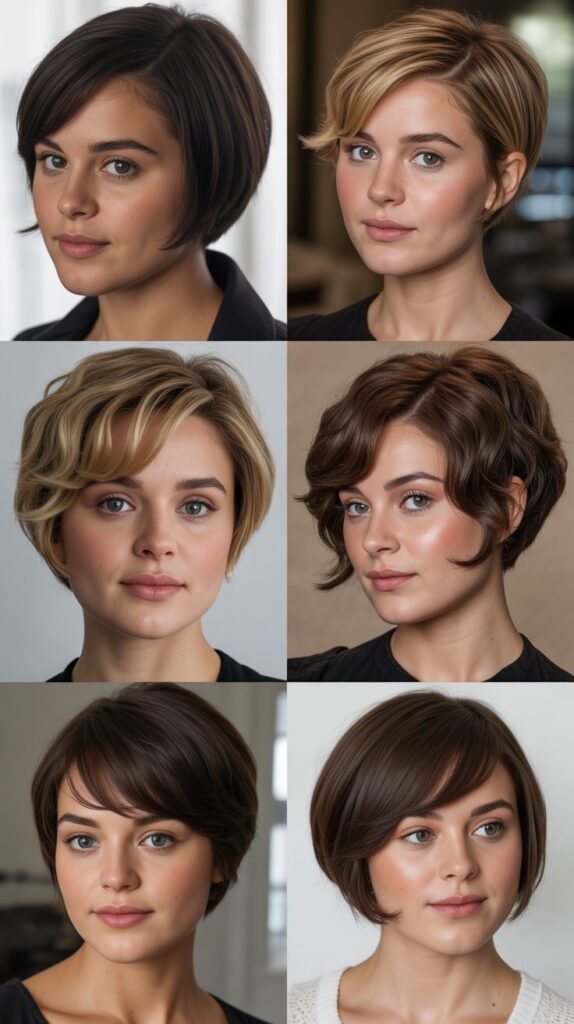
Professional settings require pixie bobs that appear polished, intentional, and appropriately styled without reading as too trendy or casual.
Specific cuts and styling approaches achieve workplace-appropriate femininity.
Conservative Cut Elements
- Clean lines and defined shapes appear more professional than heavily textured, messy styles.
- Conservative colors (natural browns, blondes, subtle highlights) read as more workplace-appropriate than fashion colors.
- Length that covers ears and doesn’t expose undercuts maintains traditional professional aesthetics.
- Smooth, controlled styling rather than tousled, undone looks conveys professionalism and attention to detail.
- Avoid extreme asymmetry or avant-garde elements that might distract in conservative professional environments.
Professional Styling Techniques
- Blow-dry smooth with round brushes for polished finish that appears intentionally styled.
- Use shine-enhancing products that create glossy, healthy appearance without greasiness.
- Secure flyaways and frizz with appropriate products and tools for controlled, neat presentation.
- Style hair away from the face to appear open, approachable, and engaged in professional interactions.
- Minimal accessories in neutral tones (if any) maintain focus on your work rather than your hairstyle.
Industry-Specific Considerations
- Creative industries allow more styling freedom, texture, and fashion-forward color choices.
- Corporate environments typically require more conservative cuts, colors, and styling approaches.
- Client-facing roles benefit from polished, approachable styles that build trust and professionalism.
- Medical and scientific fields often prefer practical, out-of-the-way styles that don’t interfere with work.
- Consider your specific workplace culture when deciding how to cut and style your professional pixie bob.
54. Pixie Bob with Evening Elegance
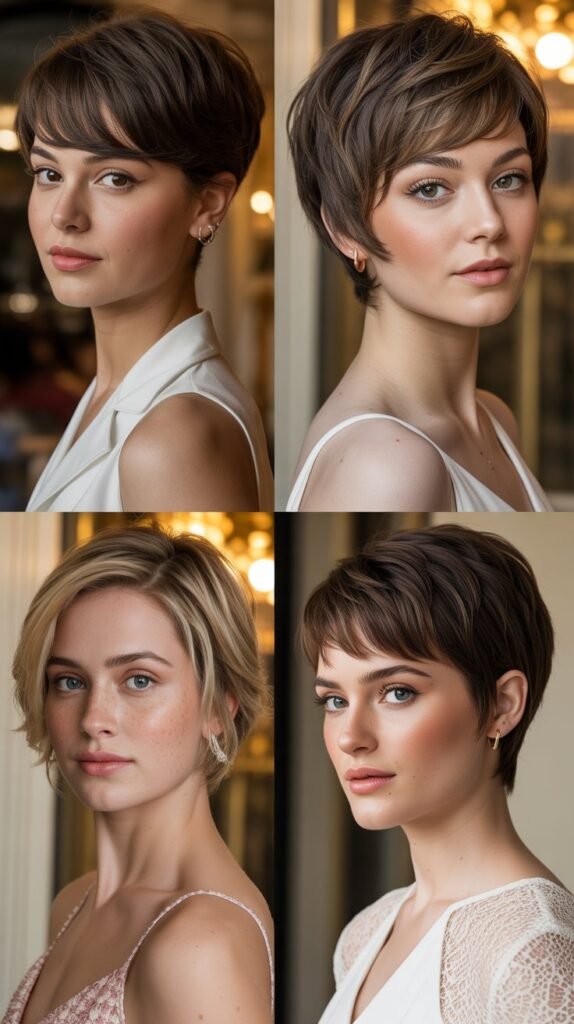
Transforming daytime pixie bobs into evening glamour requires specific styling techniques and product choices that elevate the look for special occasions, formal events, and night-out sophistication.
Elevating with Product Choices
- High-shine serums and glosses create luminous, polished finishes that catch light beautifully in evening settings.
- Stronger-hold products maintain styled shapes throughout long events without requiring touch-ups.
- Glitter or metallic sprays add sparkle appropriate for celebratory occasions and evening glamour.
- Smoothing balms create sleek, refined finishes that feel more elevated than textured, casual styling.
- Fragrant styling products add an extra luxurious sensory element to your evening hair.
Glamorous Styling Techniques
- Sleek, smooth styling with deep side parts creates classic Hollywood elegance perfect for formal events.
- Vintage-inspired waves or curls add romance and femininity appropriate for weddings and dressy occasions.
- Strategic volume at the crown creates drama and elegance that elevates the entire look.
- Pin one side back with decorative accessories for asymmetric sophistication that shows off jewelry.
- Extra shine through blow-drying techniques and products makes hair appear healthier and more luxurious.
Accessorizing for Evening Impact
- Statement earrings become focal points when hair is styled away from ears in sleek pixie bobs.
- Decorative hairpins with crystals, pearls, or metallic finishes add elegance without overwhelming short hair.
- Delicate headbands in metallics or embellished designs elevate evening styling significantly.
- Hair jewelry (chains, decorative combs) creates unique, memorable evening looks for special occasions.
- Consider your overall outfit when choosing hair accessories to create cohesive, intentional styling.
55. Pixie Bob with Confidence-Building Elements
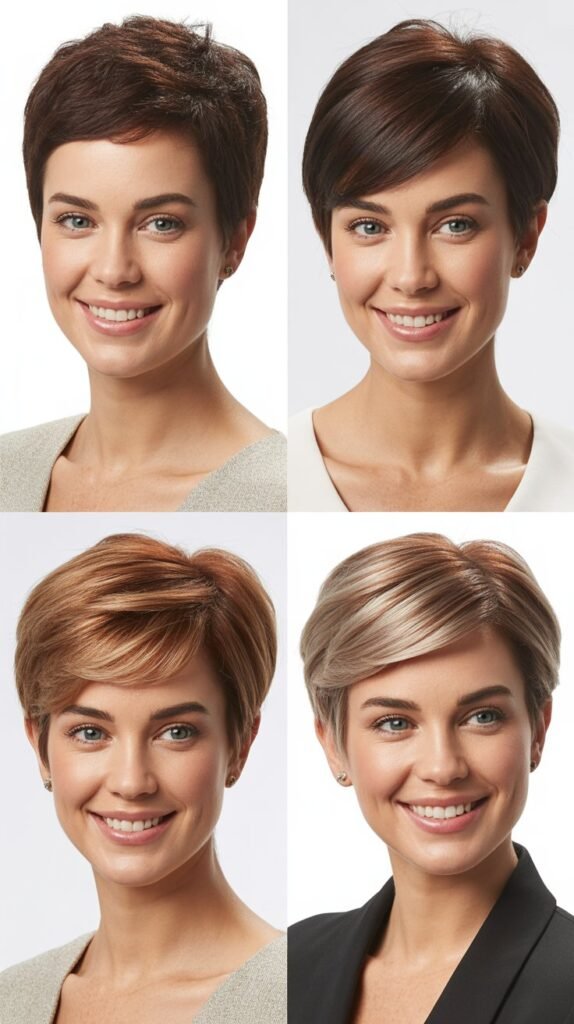
Certain pixie bob characteristics build confidence through flattering features, easy maintenance, and styling that makes you feel beautiful and empowered. Identifying these elements helps create your ideal cut.
Face-Framing for Feature Enhancement
- Strategic layers highlight your best features—eyes, cheekbones, jawline—through thoughtful framing.
- The right fringe draws attention to beautiful eyes and creates balance in facial proportions.
- Volume placement can create the illusion of desired face shape rather than emphasizing less-preferred features.
- Color placement brightens complexion and creates the appearance of healthy, glowing skin.
- The overall shape should make you feel like your best self when you look in the mirror.
Ease and Manageability
- Cuts that work with your natural texture reduce daily frustration and styling time significantly.
- Low-maintenance color choices eliminate the stress of constant appointments and upkeep concerns.
- Styles that hold up throughout the day without constant checking or adjusting build confidence in appearance.
- Versatility in styling options provides security that you can adapt your look to different situations.
- The knowledge that your hair looks good with minimal effort creates freedom and confidence throughout your day.
Personal Style Expression
- Your pixie bob should reflect your personality and aesthetic preferences rather than following trends blindly.
- Elements that make you feel like “yourself” (texture, color, length) are more important than what’s currently popular.
- The confidence that comes from authentic self-expression through your hairstyle radiates outward.
- Choosing a cut you love rather than one that’s “safe” often leads to the most confidence.
- Remember that the best hairstyle is one that makes you feel beautiful, powerful, and authentically you.
56. Pixie Bob Transition Strategies
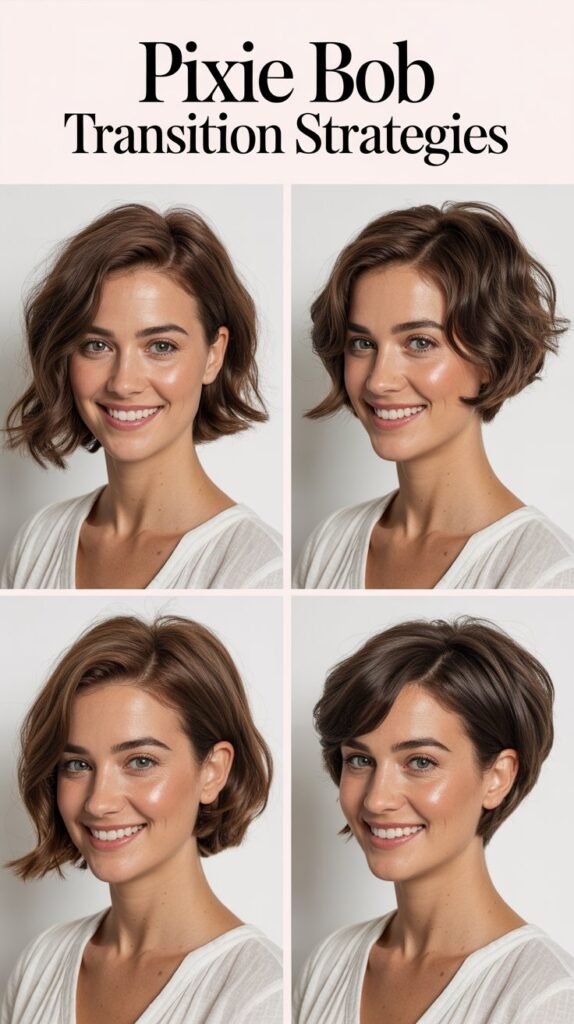
Transitioning to or from a pixie bob requires strategy to minimize awkward phases and maintain style throughout the process.
Understanding transition techniques makes these changes smoother and more manageable.
Growing Out a Pixie Bob
- Allow all sections to grow evenly initially rather than trying to maintain any particular shape too early.
- Regular trims of the back and sides while leaving the top and front longer gradually creates bob shape.
- Strategic layering as hair grows prevents the mullet effect that sometimes occurs during pixie grow-out.
- Patience is essential—plan for 6-12 months of transition depending on desired final length and growth rate.
- Use accessories, styling techniques, and creative cuts to make transition phases look intentional rather than accidental.
Cutting Longer Hair into Pixie Bob
- The psychological adjustment to short hair is often more challenging than the physical cut itself.
- Consider donating long hair to charity to make the cut feel meaningful and positive.
- Start with a longer pixie bob rather than going very short immediately if you’re nervous about the change.
- Bring multiple reference photos to consultations to ensure your stylist understands your vision clearly.
- Remember that hair grows—this isn’t a permanent, unchangeable decision if you ultimately decide short hair isn’t for you.
Maintaining Style During Transition
- Creative cuts during transition periods make each phase look intentional and stylish rather than grown-out.
- Products and styling techniques help manage awkward lengths that don’t want to cooperate.
- Regular salon visits every 4-6 weeks maintain shape even during transition, preventing completely unmanageable growth.
- Extensions or pieces can be added if you’re growing out and want length sooner than natural growth provides.
- Attitude matters—confidence in your transition style makes others perceive it as intentional and fashionable.
57. Pixie Bob for Mature Women
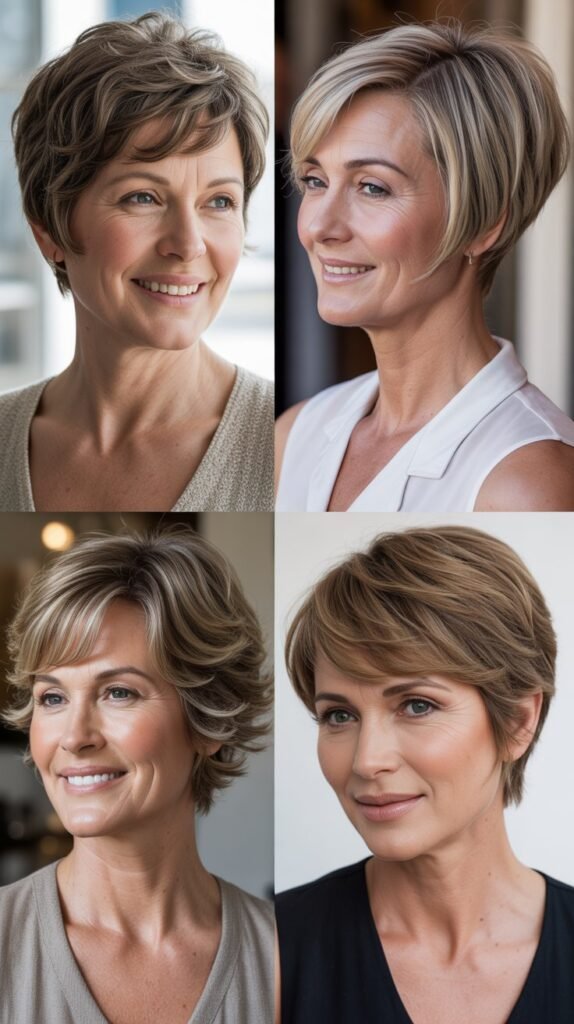
Age should never limit hairstyle choices, and pixie bobs offer sophisticated, youthful femininity for mature women that celebrates beauty at every life stage.
Specific considerations help older women rock short cuts confidently.
Age-Appropriate Doesn’t Mean Boring
- Mature women can absolutely wear trendy, modern pixie bobs without looking like they’re trying too young.
- The key is polish and refinement rather than overly textured, messy styles that can appear unkempt.
- Sophisticated color choices (dimensional grays, rich browns, subtle highlights) feel elegant at any age.
- Well-maintained cuts with regular trims appear polished and intentional, which reads as age-appropriate sophistication.
- Confidence in your choice matters more than arbitrary age-related “rules” about hair length.
Addressing Changing Hair Texture
- Hair often becomes finer and thinner with age, making pixie bobs ideal for creating the illusion of fullness.
- Perimenopausal and postmenopausal hormonal changes can alter texture, requiring different cutting approaches.
- Volumizing products become increasingly important as natural volume decreases with age.
- Regular deep conditioning treatments maintain hair health as hair becomes drier and more prone to damage.
- Working with rather than against age-related hair changes creates more successful, manageable styles.
Celebrating Gray Beautifully
- Natural gray and silver hair is stunning in pixie bobs, showcasing the color’s unique beauty prominently.
- Proper toning keeps gray hair from yellowing, maintaining that gorgeous silver or white appearance.
- Gray pixie bobs make a powerful statement about embracing natural aging with confidence and grace.
- The short length means transitioning to gray happens quickly without years of awkward grow-out.
- Many mature women find that going gray with a pixie bob feels liberating and authentically beautiful.
58. Pixie Bob Consultation Essentials
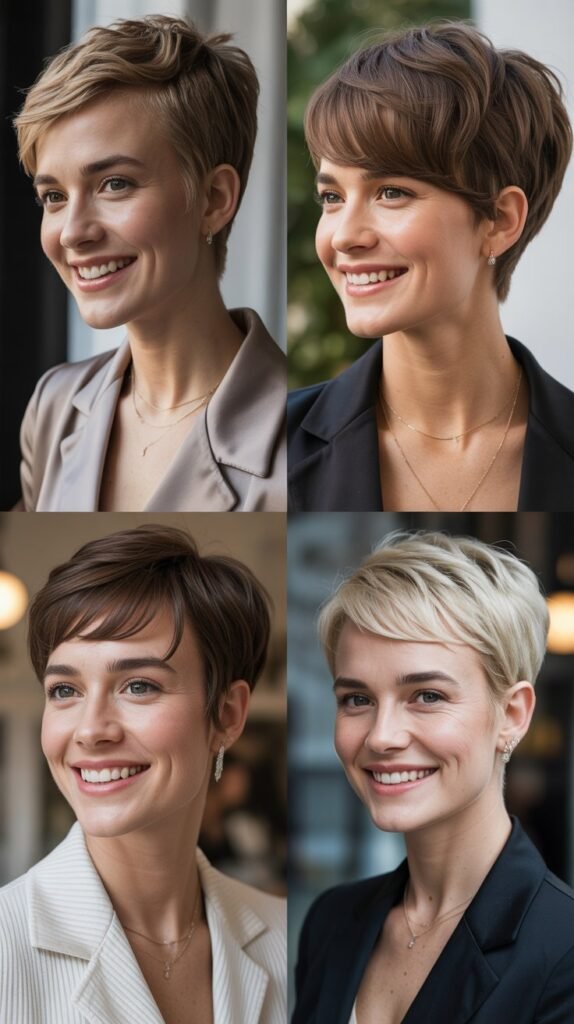
Effective consultation with your stylist ensures you get the pixie bob you envision rather than a disappointing interpretation. Knowing what to communicate and how to prepare makes all the difference.
Preparing for Your Consultation
- Gather multiple reference photos showing various angles of pixie bobs you love from different sources.
- Include photos of styles you dislike to clarify what you want to avoid in your cut.
- Come with clean, naturally styled hair so your stylist can assess your natural texture and growth patterns.
- List your daily routine, styling skills, and time availability to ensure the cut matches your lifestyle.
- Be honest about your maintenance commitment—how often you’ll return for trims and how much time you’ll spend styling daily.
Essential Questions to Ask
- “How will this cut work with my natural texture?” ensures compatibility between vision and reality.
- “What’s the maintenance schedule for this cut?” clarifies the commitment you’re making.
- “Can you show me how to style this?” ensures you can recreate the look at home successfully.
- “What products will I need?” helps you budget and prepare for proper maintenance.
- “What will growing this out look like?” provides information for future decisions about keeping or changing the cut.
Communication During the Cut
- Speak up if something doesn’t look right as cutting progresses—it’s easier to address concerns early.
- Ask questions about why certain choices are being made to understand the technique and vision.
- Request mirror checks throughout the process to ensure you’re comfortable with the direction.
- Be specific about length concerns—use measurements or comparisons rather than vague descriptors.
- Remember that you and your stylist are collaborating to create your ideal look together.
59. Pixie Bob Troubleshooting Common Issues
Even the best pixie bobs encounter occasional challenges. Understanding common problems and their solutions helps you manage and maintain your cut successfully between salon visits.
Solving Flatness and Lost Volume
- Roots lose lift as hair gets oily—dry shampoo restores volume and extends time between washes.
- Sleeping positions can flatten pixie bobs—refresh by dampening and re-styling problem areas in the morning.
- Volumizing products applied at roots before styling create foundational lift that lasts throughout the day.
- Blow-drying in the opposite direction of natural fall creates volume that holds longer than styling with natural direction.
- Sometimes volume loss means you need a trim to restore the cut’s original shape and intention.
Managing Awkward Growing Sections
- Hair doesn’t grow evenly—some sections will seem too long before others, creating temporary awkwardness.
- Strategic pinning, tucking, or accessorizing manages sections that are in awkward in-between phases.
- Small trims of problem areas without cutting everything can address specific awkwardness while maintaining growth.
- Styling products with hold tame sections that want to stick out or behave unpredictably.
- Sometimes embracing the awkward phase and styling it intentionally creates unexpected new looks you might love.
Addressing Styling Difficulties
| Problem | Cause | Solution |
|---|---|---|
| Won’t hold curl | Hair too healthy/slippery | Use texture spray before styling |
| Sticks up at crown | Cowlick or growth pattern | Blow-dry in opposite direction |
| Falls flat quickly | Fine texture, heavy products | Switch to lightweight mousses |
| Frizzes immediately | Humidity, damaged hair | Anti-frizz serum, regular treatments |
| Color fades fast | Porous hair, frequent washing | Color-safe products, less washing |
60. Pixie Bob Inspiration and Resources
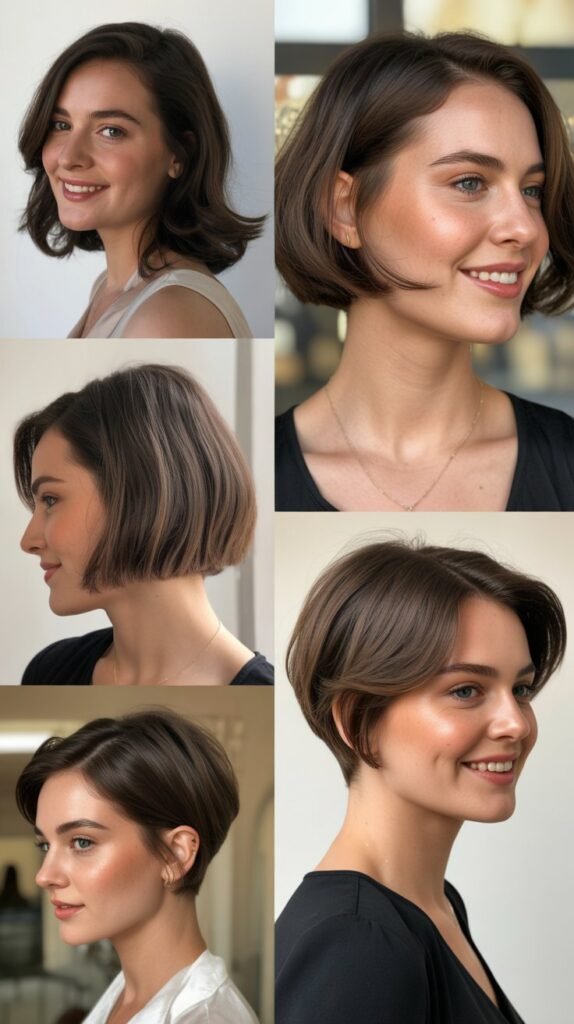
Finding ongoing inspiration and reliable resources helps you evolve your pixie bob style and maintain enthusiasm for your short hair journey. Various sources provide fresh ideas and practical guidance.
Social Media and Online Communities
- Instagram hashtags like #pixiebob, #shorthairdontcare, and #pixiecut showcase thousands of real-life styles for inspiration.
- Pinterest boards dedicated to short hair provide curated collections of styles, colors, and styling tutorials.
- YouTube tutorials teach styling techniques specific to pixie bobs from beauty professionals and enthusiasts.
- Online communities and forums connect you with others who understand the pixie bob lifestyle and can offer advice.
- Following hairstylists specializing in short hair provides access to expert knowledge and trending styles.
Professional Resources
- Regular consultations with your stylist build relationship and ensure your cut evolves with your changing preferences.
- Hairstyling apps allow you to virtually try different pixie bob styles before committing to cutting your hair.
- Professional hair magazines feature editorial content about short hair trends, techniques, and inspiration.
- Salon websites and blogs often provide styling tutorials and product recommendations specific to short cuts.
- Continuing education about hair care, styling techniques, and trends keeps your knowledge current and your style fresh.
Celebrity and Fashion Inspiration
- Red carpet events showcase how celebrities style pixie bobs for glamorous occasions and special events.
- Fashion week runways feature avant-garde pixie bob styling that pushes creative boundaries.
- Celebrity hairstylists’ social media accounts reveal behind-the-scenes looks at creating stunning short styles.
- Entertainment news provides constant stream of celebrity pixie bob transformations and styling variations.
- Remember that professional styling teams create celebrity looks—adjust expectations for at-home recreation realistically.
Conclusion
The journey through 60 Soft Chic Pixie Bob Hairstyles That Feel Feminine reveals the incredible versatility, beauty, and empowerment that short hair offers to women who dare to embrace it.
From understanding how different cuts flatter various face shapes to exploring color techniques that enhance femininity, managing different hair textures, and discovering styling approaches for every occasion,
this comprehensive guide proves that pixie bobs transcend the limiting stereotypes often associated with short hair.
The soft, feminine aesthetic achievable through strategic layering, thoughtful color choices, delicate texturing, and confident styling demonstrates that length has nothing to do with femininity—it’s all about how you wear it.
Whether you’re drawn to sleek and polished sophistication, tousled and textured playfulness, dramatically asymmetric statements, or classically rounded shapes, there’s a pixie bob variation waiting to make you feel absolutely beautiful.
The freedom from lengthy styling routines, the confidence that comes from a bold hair choice, the versatility of switching between casual and elegant looks effortlessly, and the pure joy of running your fingers through short hair that feels fresh and light are experiences that can only be understood by taking the plunge.
Remember that hair grows, styles evolve, and the most important element of any hairstyle is how it makes you feel when you look in the mirror—if a pixie bob calls to you,
trust that instinct and discover firsthand why so many women find that short hair becomes not just a hairstyle choice, but a lifestyle they never want to give up.

