
When it comes to styling children’s natural hair, cornrows remain one of the most versatile, protective, and beautiful options available to parents and caregivers.
Best 32 Cornrow Hairstyles for Kids with Natural Hair showcases a comprehensive collection of creative, practical, and age-appropriate braiding styles that celebrate the beauty and texture of natural hair while keeping it healthy and manageable.
Natural hair in children requires special care and attention, and cornrows offer the perfect solution by reducing daily manipulation, protecting delicate strands from breakage, and allowing young ones to play, learn, and grow without constant hair maintenance.
From simple straight-back cornrows perfect for toddlers to intricate geometric patterns that make older children feel confident and stylish, this guide covers every style you need to know.
Whether you’re a parent learning to braid for the first time, a professional stylist seeking fresh inspiration, or simply someone who wants to explore the rich tradition of African braiding techniques adapted for young children, this article provides detailed information about each style, including difficulty levels, maintenance tips, and styling variations.
The beauty of cornrows lies not only in their aesthetic appeal but also in their cultural significance, connecting children to a heritage of hair artistry that spans generations and continents.
Each of the 32 styles featured here has been carefully selected to ensure they are gentle on young scalps, easy to maintain, and suitable for various hair lengths, textures, and densities.
You’ll discover classic styles that never go out of fashion, trendy contemporary patterns that reflect current styling preferences, and creative designs that allow children to express their unique personalities through their hair.
1. Classic Straight-Back Cornrows
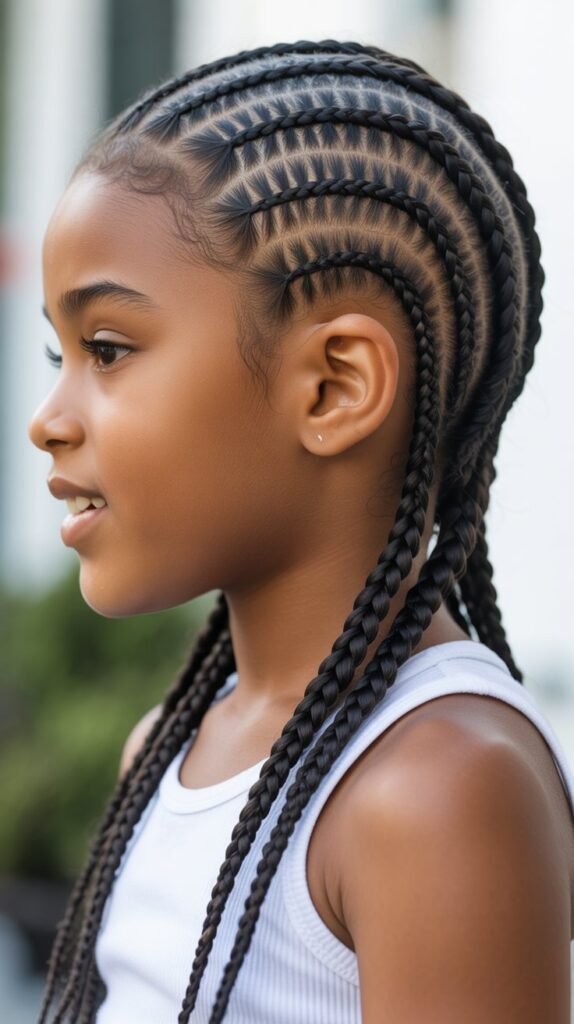
Classic straight-back cornrows represent the foundation of all cornrow styling and serve as the perfect introduction to protective styling for children with natural hair.
This timeless style features neat, parallel rows that run from the front hairline directly to the nape of the neck, creating a clean and organized appearance that works beautifully for school, sports, and everyday activities.
The simplicity of this design makes it ideal for younger children and toddlers whose hair may be finer or shorter, while also serving as an excellent practice style for parents learning to cornrow for the first time.
Key Features:
- The straight-back pattern typically includes anywhere from 4 to 10 cornrows, depending on the child’s hair density and desired thickness of each braid.
- This style can last between 1 to 3 weeks with proper nighttime maintenance using a satin or silk bonnet or pillowcase.
- The uniform direction of the braids makes this style particularly comfortable for children who need to lie down for naps or bedtime.
- Straight-back cornrows work exceptionally well for active children participating in sports, dance, or swimming activities.
- The style can be customized by varying the size of each cornrow, creating either chunky bold braids or thinner, more numerous rows.
Maintenance Tips:
- Apply a light oil or moisturizing spray to the scalp every 2-3 days to prevent dryness and itching.
- Gently cleanse the scalp with a diluted shampoo or cleansing spray weekly to remove buildup without disturbing the braids.
- Tie hair with a satin scarf or bonnet every night to minimize frizz and extend the style’s lifespan.
- Avoid excessive tension during the braiding process to protect young, sensitive scalps from traction alopecia.
2. Side-Swept Cornrows
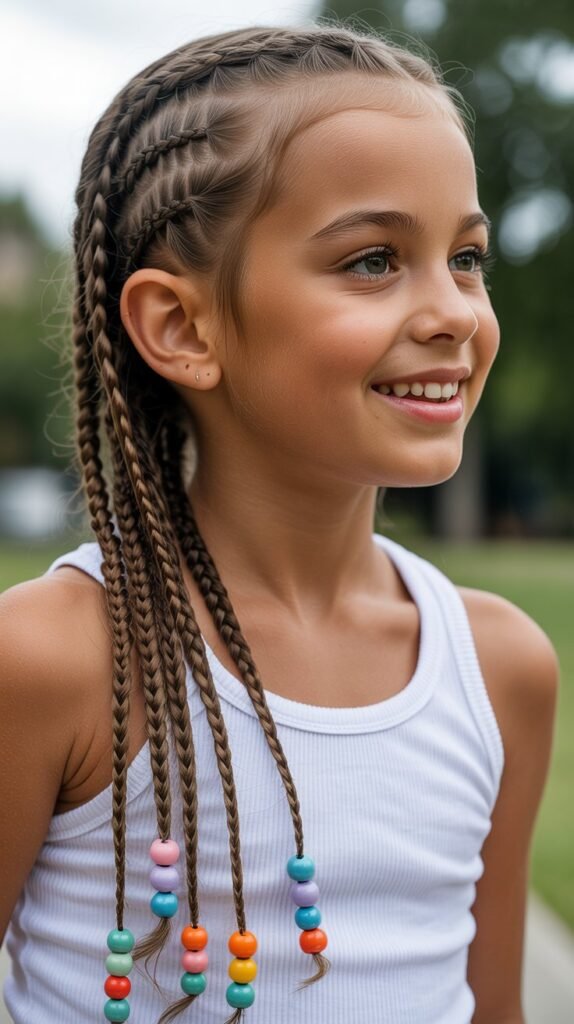
Side-swept cornrows introduce an elegant asymmetrical element to traditional cornrow styling by directing all braids to flow toward one side of the head.
This sophisticated style adds visual interest and movement while maintaining all the protective benefits that make cornrows ideal for children’s natural hair.
The side-swept design creates a beautiful cascading effect that frames the face beautifully and allows for creative styling options at the ends.
Design Elements:
- The braids begin at the opposite side of the head and curve gracefully toward the chosen side, creating a sweeping motion across the scalp.
- This style typically features 6-12 cornrows depending on hair thickness and the desired fullness of the side sweep.
- The ends of the braids can be left loose, gathered into a ponytail, or styled into a bun for additional versatility.
- Side-swept cornrows work particularly well for special occasions, photo sessions, or when you want your child’s hairstyle to stand out.
- The asymmetrical design helps distribute tension more evenly across the scalp compared to pulling all hair straight back.
Styling Variations:
- Add colorful beads or hair accessories to the ends of the braids for extra flair and personality.
- Create a deep side part on the opposite side to enhance the dramatic sweep of the style.
- Combine with loose natural curls at the ends for a textured, dimensional finish.
- Incorporate thin metallic threads or yarn during the braiding process for a unique artistic touch.
3. Zigzag Part Cornrows
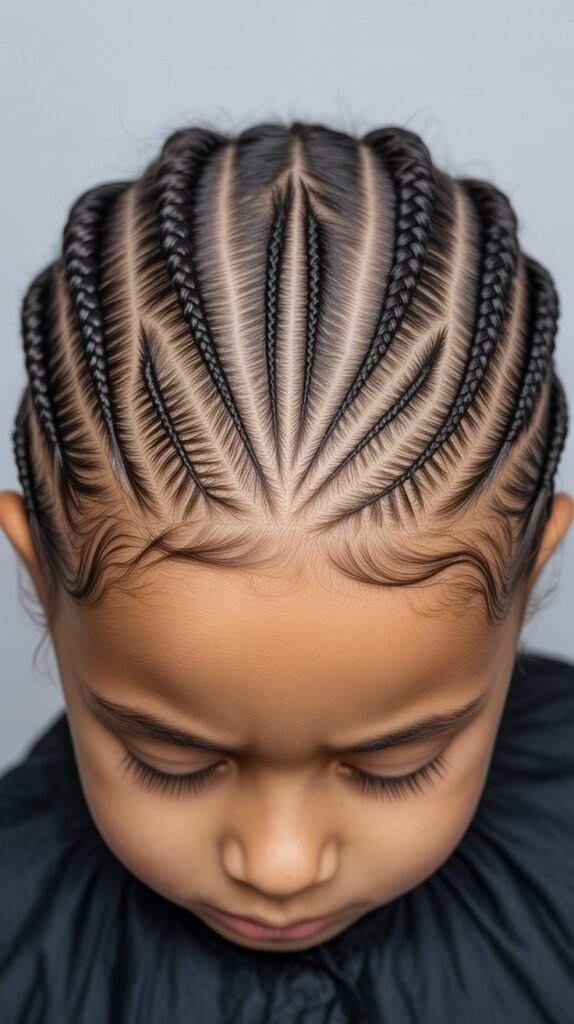
Zigzag part cornrows elevate traditional cornrow styling by incorporating geometric patterns into the hair partings themselves, creating visual intrigue before the braiding even begins.
This creative approach transforms a simple protective style into a work of art that showcases both technical skill and artistic vision.
Children love this style because it makes them feel unique and special, while parents appreciate the way it maintains the protective and low-maintenance benefits of classic cornrows.
Technical Aspects:
- The zigzag parts are created using the tail of a rat-tail comb, carefully forming sharp angles or gentle waves between each cornrow section.
- This style requires more time and precision during the initial parting phase but results in a stunning visual effect.
- The actual cornrows can be straight, curved, or follow the pattern of the zigzag parts for additional complexity.
- Zigzag patterns work best on hair that is at least 3-4 inches long to ensure clean sections and neat braids.
- The contrast between the natural scalp and the braided hair makes the zigzag pattern particularly striking and visible.
Creative Options:
- Experiment with different zigzag widths, from tight sharp angles to wide gentle waves, to create varied visual effects.
- Combine zigzag parts with straight parts in alternating patterns for a mixed-technique approach.
- Use the zigzag technique only on the top or front section of the head while keeping the back sections straight for a balanced look.
- Add small gems or rhinestones along the zigzag parts for special occasions or celebrations.
4. Heart-Shaped Cornrow Design
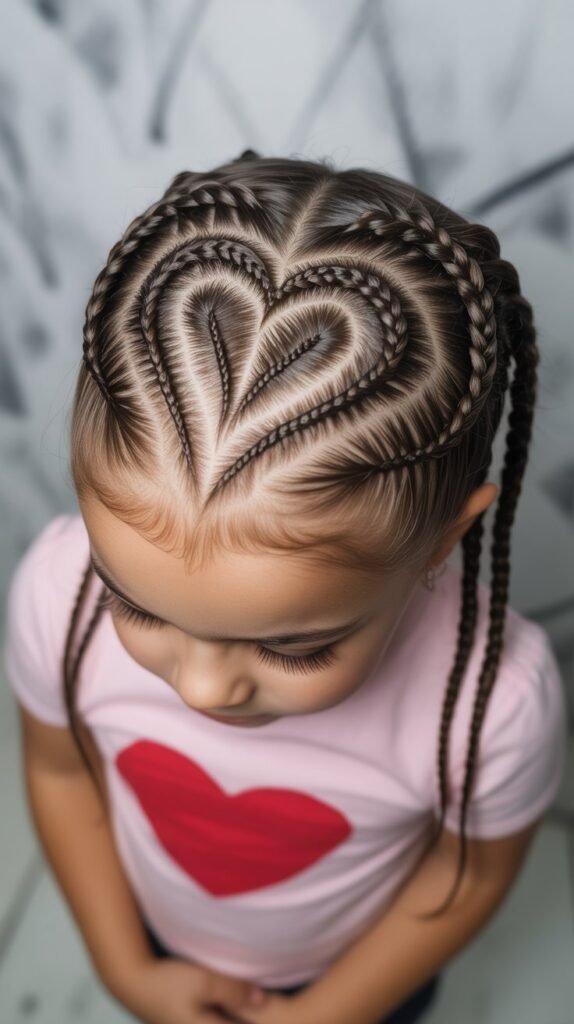
Heart-shaped cornrow designs bring romance and sweetness to children’s hairstyling by incorporating one or more heart patterns into the cornrow arrangement.
This charming style is particularly popular for Valentine’s Day, birthdays, family photos, or any occasion where you want to showcase love and creativity through hair art.
The heart design can be created as a single large centerpiece or multiple smaller hearts scattered throughout the style.
Design Specifications:
- The heart shape is formed by carefully parting the hair and braiding cornrows that follow the curved outline of a heart.
- A single large heart typically sits at the crown or back of the head, with additional cornrows filling the surrounding areas.
- Multiple small hearts can be arranged in patterns across the scalp for a more playful, whimsical effect.
- This style works best on children with medium to thick hair density to ensure the heart shape remains clearly visible and defined.
- The interior of the heart can be filled with smaller cornrows, left with loose natural hair, or styled with a different braiding technique for contrast.
Execution Tips:
- Draw the heart outline lightly on the scalp with a washable marker or use a stencil to ensure symmetrical shape before parting.
- Begin braiding from the outer edge of the heart and work inward to maintain the shape’s integrity.
- Keep the cornrows within the heart slightly smaller and tighter than the surrounding braids to enhance definition.
- Photograph the completed style from above to fully capture the heart design for memories.
5. Tribal Cornrow Patterns
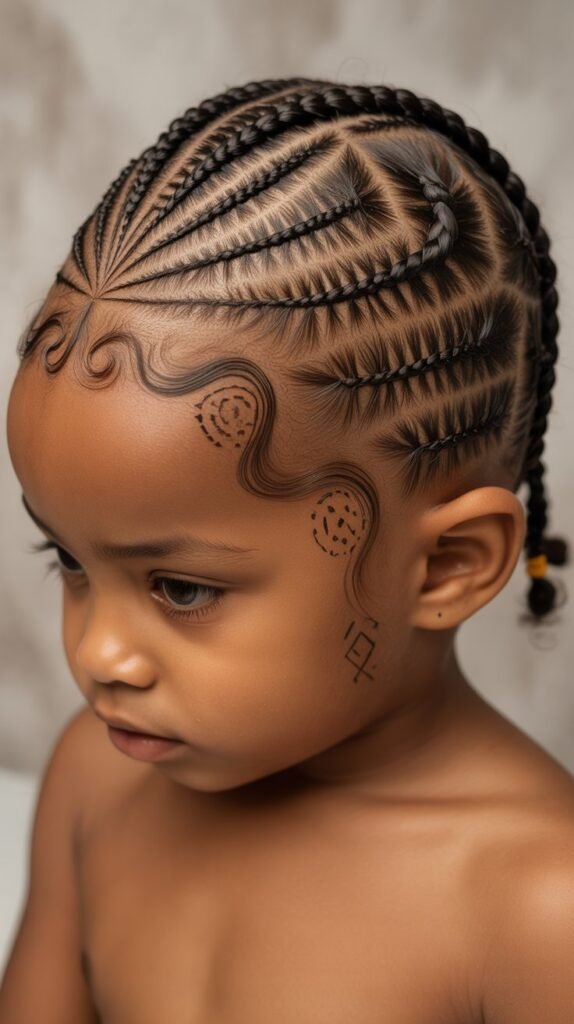
Tribal cornrow patterns honor the rich African heritage of braiding traditions by incorporating authentic geometric designs, symbols, and arrangements that have cultural and historical significance.
These styles connect children to ancestral hair artistry while providing a protective style that celebrates natural hair texture and beauty.
Tribal patterns often feature bold lines, angular shapes, and intricate details that create striking visual statements.
Cultural Elements:
- Traditional tribal patterns may include symbols representing strength, unity, fertility, protection, or family connections.
- Common geometric elements include triangles, diamonds, circles, and parallel lines arranged in meaningful configurations.
- Different African cultures and tribes have distinctive braiding patterns that can be researched and adapted respectfully for children’s styles.
- These patterns often incorporate both thick and thin cornrows to create contrast and emphasize the geometric designs.
- Tribal styles typically cover the entire head with an interconnected pattern that flows seamlessly from section to section.
Pattern Characteristics:
- Bold, thick cornrows form the primary structural lines of the pattern, creating clear borders and shapes.
- Thinner cornrows fill interior spaces and add intricate detail to the overall design.
- The patterns often feature symmetry on both sides of the head or intentional asymmetry for artistic effect.
- Curved and straight lines are combined strategically to create dynamic, eye-catching compositions.
- The style duration typically ranges from 2-4 weeks depending on hair growth rate and maintenance quality.
6. Cornrow Ponytail
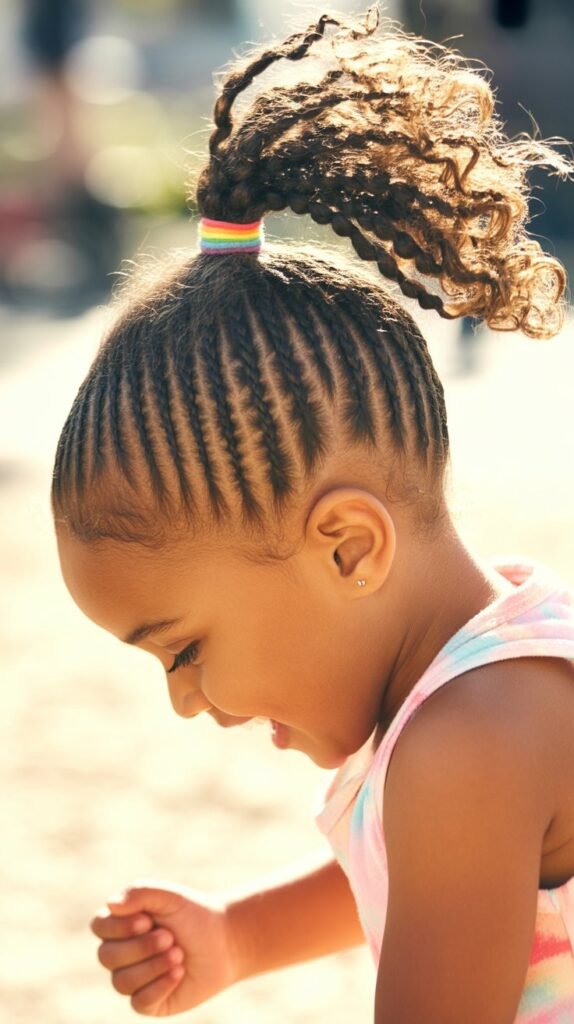
The cornrow ponytail combines the sleek, polished look of cornrows with the versatility and playfulness of a gathered ponytail, creating a style that works beautifully for school, sports, and social activities.
This practical yet stylish option keeps hair secure and manageable while allowing the ponytail portion to showcase natural texture and movement.
The style is particularly popular among active children who need their hair completely off their face and neck.
Construction Method:
- Cornrows are braided from the front and sides of the head, directing all braids toward a central gathering point on the crown or back of the head.
- The convergence point can be positioned high for a classic high ponytail, mid-level for a versatile look, or low at the nape for a sophisticated style.
- Once all cornrows meet at the gathering point, they are secured with a covered elastic band that won’t snag or damage the hair.
- The loose ends beyond the elastic can be left in their natural braided state, unraveled for texture, or styled with additional braiding or twisting.
- This style typically includes 6-10 cornrows feeding into the ponytail, though the number can be adjusted based on preference and hair density.
Styling Options:
- Wrap a small section of hair or a decorative band around the elastic to conceal it and create a polished finish.
- Add beads, ribbons, or accessories to both the cornrow sections and the ponytail for personalized embellishment.
- Create zigzag or curved cornrow patterns leading to the ponytail for additional visual interest.
- Allow the ponytail to remain in tight braids for a sleek look or gently unravel the ends for a fuller, textured ponytail.
7. Cornrow Bun
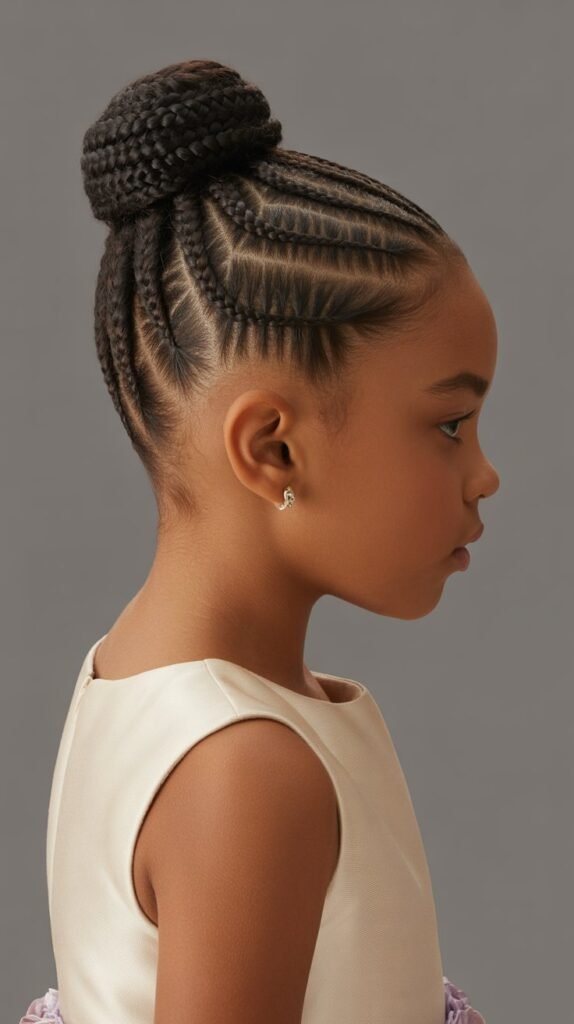
The cornrow bun represents an elegant and sophisticated protective style that combines the security of cornrows with the classic refinement of an updo.
This versatile style works equally well for formal events, school activities, dance performances, and everyday wear, making it a favorite among parents seeking a polished yet practical hairstyle for their children.
The bun can be positioned at various locations on the head and styled in multiple ways to suit different occasions and preferences.
Styling Technique:
- Cornrows are braided from all directions toward a central point where the bun will be created, typically at the crown, back, or side of the head.
- The cornrows can be straight, curved, or patterned depending on the desired aesthetic and complexity level.
- Once the braids converge, they are gathered and twisted, coiled, or wrapped to form a bun shape.
- The bun is secured with bobby pins, hair pins, or elastic bands, ensuring it remains stable throughout the day.
- For thinner or shorter hair, a bun form or hair donut can be incorporated to add volume and create a fuller appearance.
Bun Variations:
- A high top knot creates a ballet-inspired look that’s perfect for dancers and performers.
- A low side bun offers an elegant, asymmetrical style ideal for special occasions and photographs.
- Multiple small buns scattered across the head provide a playful, youthful alternative to a single large bun.
- A braided or twisted bun adds additional texture and dimension to the finished style.
8. Feed-In Cornrows
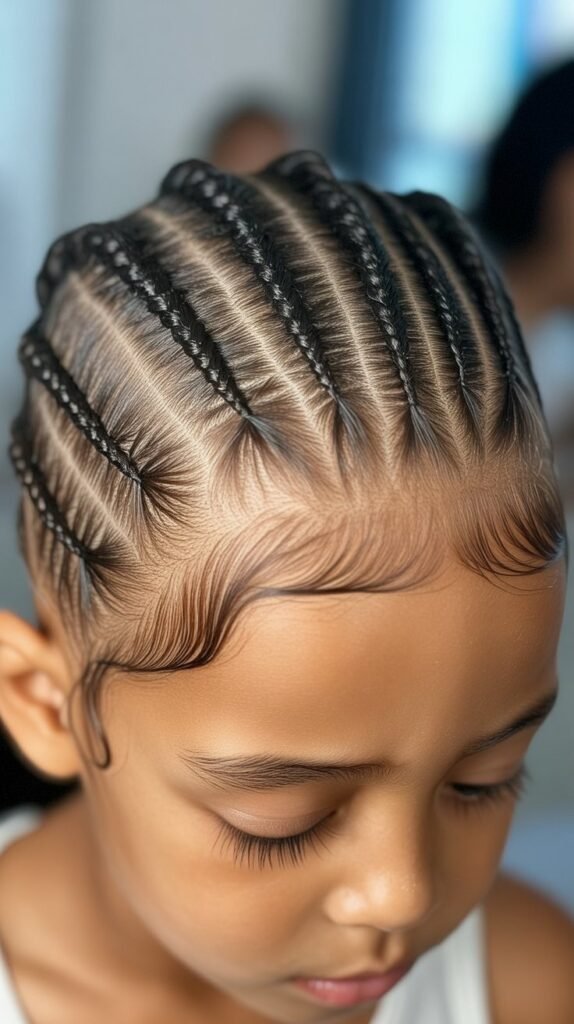
Feed-in cornrows utilize a specialized braiding technique that creates a more natural-looking style with less tension on the hairline and scalp, making them particularly suitable for children’s sensitive scalps.
This method involves gradually adding small amounts of extension hair as the cornrow progresses, creating braids that start thin at the hairline and gradually increase in size.
The result is a protective style that appears more natural and puts less stress on developing hair follicles.
Technical Process:
- The style begins with the child’s natural hair only, creating a very small, thin start to each cornrow at the hairline.
- As the braid progresses backward, small amounts of extension hair are methodically added at regular intervals.
- This gradual feeding process creates a tapered effect where the cornrow naturally thickens from front to back.
- The technique requires more skill and time than traditional cornrows but results in a more polished, professional appearance.
- Feed-in cornrows typically last 2-4 weeks and are gentler on the hairline than styles that start with full tension.
Benefits for Children:
- Significantly reduces tension and pulling on the delicate edges and hairline area.
- Creates a more natural appearance that looks like the child’s own hair rather than obviously added extensions.
- Allows for longer-lasting styles without the discomfort of tight braids at the scalp.
- Helps prevent traction alopecia and hairline damage that can result from excessive tension during braiding.
- Provides flexibility to create both simple and complex patterns with a refined, seamless finish.
9. Curved Cornrow Design
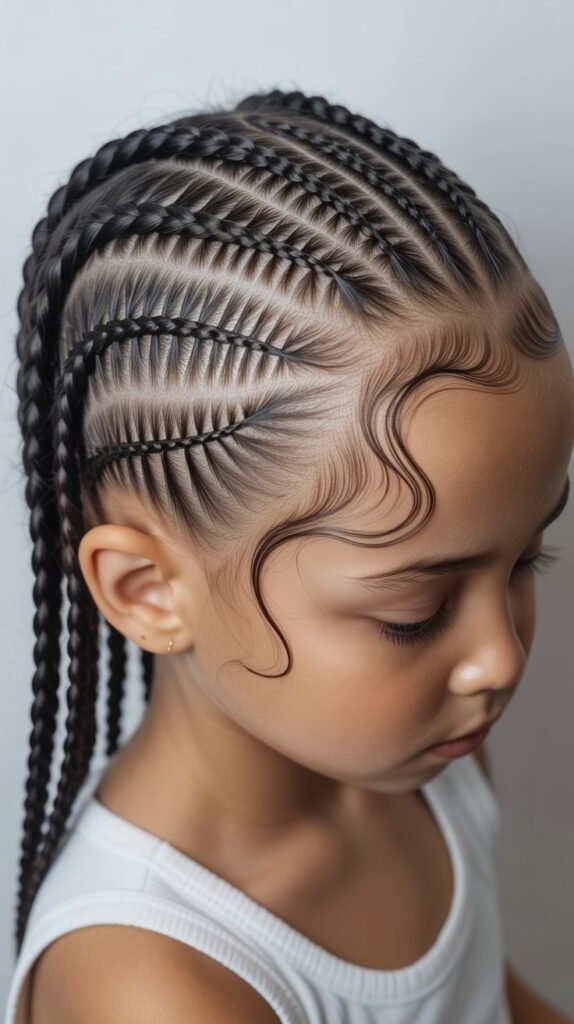
Curved cornrow designs move away from traditional straight lines to create flowing, organic patterns that add artistic movement and visual softness to protective styling.
These gracefully arcing braids can follow the natural contours of the head, create wave-like patterns, or form deliberate artistic shapes that showcase the braider’s creativity and technical skill.
Children often prefer curved designs because they feel less rigid and more playful than straight geometric patterns.
Design Principles:
- Curved cornrows follow gentle arcs rather than straight lines, creating a sense of movement and fluidity across the scalp.
- The curves can be symmetrical on both sides of the head or intentionally asymmetrical for a more contemporary artistic effect.
- Common curve patterns include S-curves, C-curves, waves, and spirals that can be combined in various configurations.
- The braiding direction can change within a single style, with some sections curving forward while others curve backward or to the sides.
- Curved patterns often work best with medium-thickness cornrows that can clearly define the arc without appearing too chunky or too thin.
Pattern Ideas:
- Create ocean wave patterns with parallel curves flowing from front to back, mimicking the movement of water.
- Design a sunrise or rainbow pattern with curves radiating from a central point toward the edges.
- Form interlocking C-curves that create a chain-like visual effect across the scalp.
- Combine large sweeping curves with smaller accent curves for a layered, dimensional appearance.
10. Cornrows with Beads
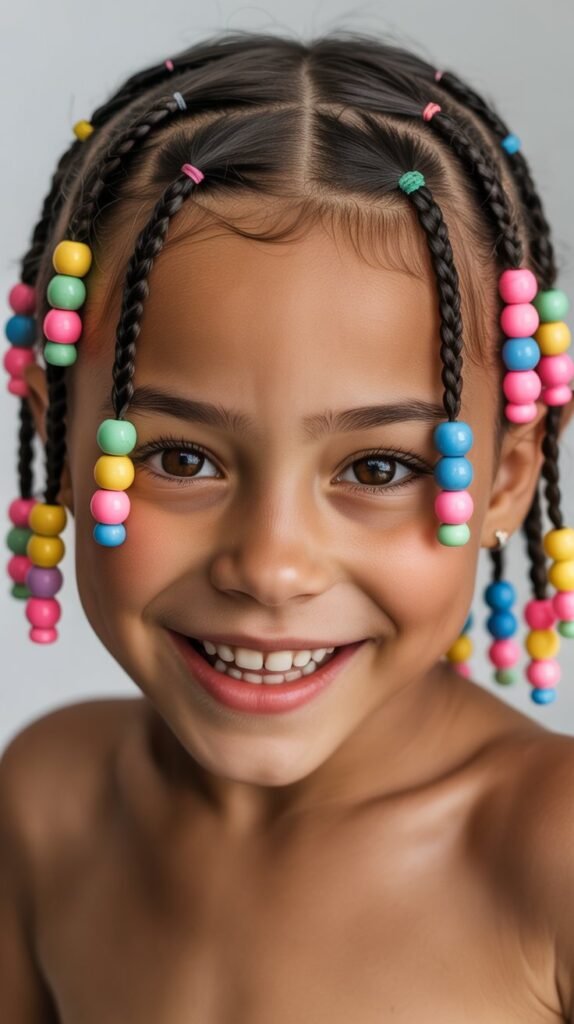
Cornrows with beads represent one of the most beloved and personalized protective styles for children, combining the practical benefits of cornrows with the fun, decorative element of colorful beads and accessories.
This style allows children to express their personality, favorite colors, and individual style preferences while maintaining healthy, protected natural hair.
The rhythmic clicking sound of beads has delighted children for generations and remains a cherished aspect of African and African-American hair culture.
Bead Selection and Placement:
- Beads come in countless varieties including plastic pony beads, wooden beads, metal charms, cowrie shells, and decorative hair jewelry.
- Color choices can coordinate with school colors, favorite outfits, seasonal themes, or simply the child’s color preferences.
- Beads can be placed at the ends of each cornrow, spaced along the length of the braids, or concentrated at specific areas for varied effects.
- The number of beads per braid can range from a single statement bead to multiple beads creating a full, decorated look.
- Different sized beads can be combined on a single braid to create patterns and visual interest.
Application Methods:
- Beads are typically threaded onto the braids before securing the ends, ensuring they stay in place throughout the style’s duration.
- Some beads require a small elastic band after them to prevent sliding, while others grip the braid naturally.
- Alternating bead colors in patterns creates rainbow effects, color blocking, or coordinated color schemes.
- Special occasion beads can include bells, ribbons attached to bead tops, or themed charms that match holidays or celebrations.
11. Lemonade Braids
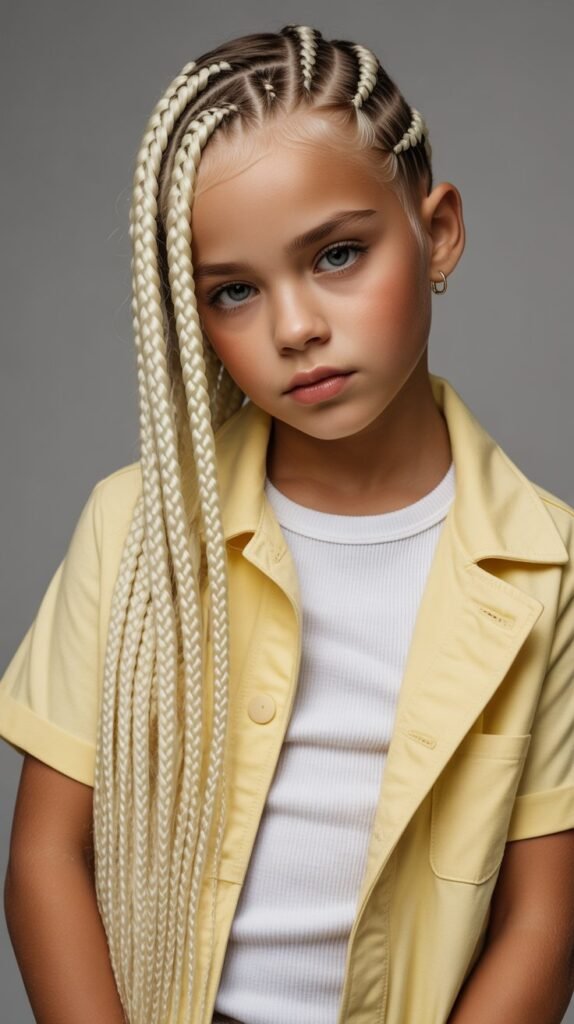
Lemonade braids gained widespread popularity as a contemporary cornrow style characterized by side-swept cornrows that cascade over one shoulder, creating an elegant and trendy look.
This style, which became a cultural phenomenon after being showcased by major entertainment figures, represents a modern evolution of traditional cornrow techniques that children and parents both love for its fashion-forward appeal and practical benefits.
Style Characteristics:
- All cornrows are directed to sweep dramatically toward one side of the head, typically the left or right shoulder area.
- The braids often vary in thickness, with some styles featuring uniform-sized cornrows while others mix thick and thin braids for dimension.
- The parts between braids can be straight or slightly curved to follow the natural flow toward the chosen side.
- This style typically includes 6-12 cornrows depending on hair density, desired braid thickness, and the overall fullness of the look.
- Lemonade braids work best on medium to long hair lengths, typically 6 inches or longer for optimal draping effect.
Styling Features:
- The asymmetrical nature of this style creates a bold, confident statement that children love for its fashionable appearance.
- The style can be worn with the braids flowing freely over the shoulder or gathered into a side ponytail for variation.
- Beads, cuffs, or rings can be added to individual braids or concentrated at the ends for embellishment.
- The opposite side of the head (where braids originate) can feature creative parts, designs, or even shaved patterns for additional edge.
12. Mohawk Cornrows

Mohawk cornrows create an edgy, bold protective style that combines the rebellious aesthetic of a mohawk with the cultural tradition and practical benefits of cornrow braiding.
This eye-catching style features cornrows in the center section of the head while the sides are either braided flat against the scalp or styled differently, creating a dramatic contrast that children love for its unique, confident appearance.
Construction Approach:
- The center section of hair, typically 2-4 inches wide, is left longer or styled to stand upward, forming the mohawk element.
- The center can consist of several cornrows running front to back, a single wide braid, or loose natural hair styled upward.
- Side sections are typically braided with cornrows running horizontally toward the back or in patterns that lie flat against the scalp.
- The contrast between the raised center and flat sides creates the distinctive mohawk silhouette.
- This style works on various hair lengths, with longer hair creating more dramatic height and shorter hair producing a subtler effect.
Mohawk Variations:
- A braided mohawk features cornrows in the center section that are left loose beyond a certain point, allowing them to stand up or curve over.
- A twisted mohawk uses two-strand twists instead of braids in the center section for a different texture.
- A curly mohawk leaves the center section loose and natural, styled with curling products to maximize volume and height.
- A faux hawk creates the illusion of a mohawk without actually shaving or dramatically altering the hair, using strategic parting and styling instead.
13. Criss-Cross Cornrows
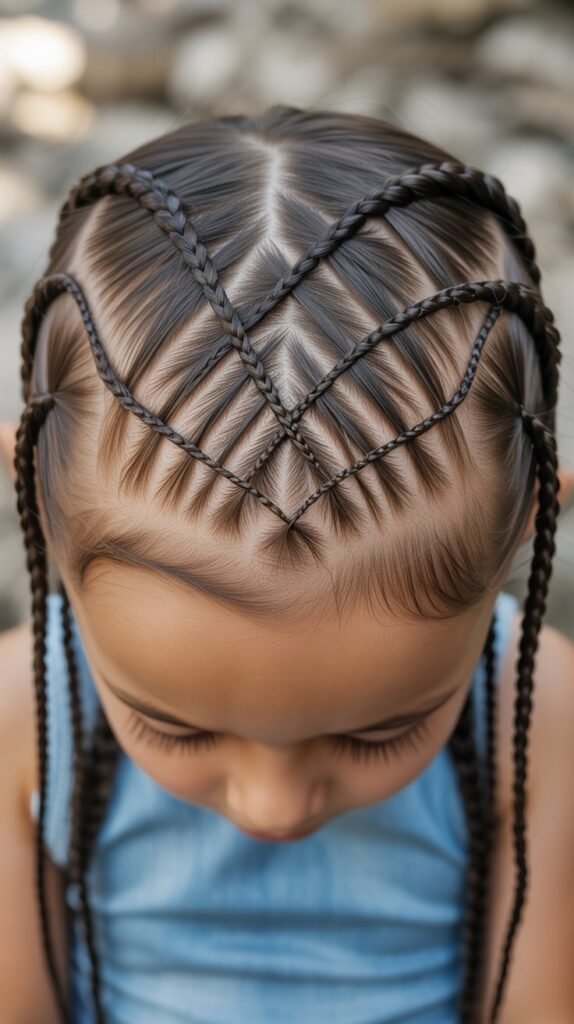
Criss-cross cornrows introduce an intricate woven appearance by creating intersecting braids that pass over and under each other, forming an elaborate basket-weave or lattice pattern across the scalp.
This technically challenging style showcases advanced braiding skills and creates a stunning visual effect that transforms the head into a canvas of geometric artistry.
Children appreciate this style for its unique appearance that sets them apart from more common cornrow patterns.
Technical Execution:
- The style requires careful planning and mapping of the braid paths before beginning to ensure braids intersect at the correct points.
- Cornrows are braided in alternating directions, with some running horizontally and others vertically or diagonally.
- At intersection points, one braid is carefully lifted and the crossing braid is woven underneath, creating the criss-cross effect.
- The pattern typically requires sectioning the hair into multiple zones, completing one set of braids before adding the crossing braids.
- This style demands more time than standard cornrows, often taking 2-4 hours depending on complexity and the child’s hair length and density.
Pattern Possibilities:
- A simple criss-cross features horizontal braids intersected by vertical braids, creating a classic grid pattern.
- Diagonal criss-crosses create X patterns across the scalp with braids running at opposing 45-degree angles.
- Multiple layers of criss-crossing can build depth, with some braids passing over multiple others before being woven under.
- The criss-cross technique can be isolated to one section of the head, such as the top or side, while other areas feature standard cornrows.
14. Stitch Braids
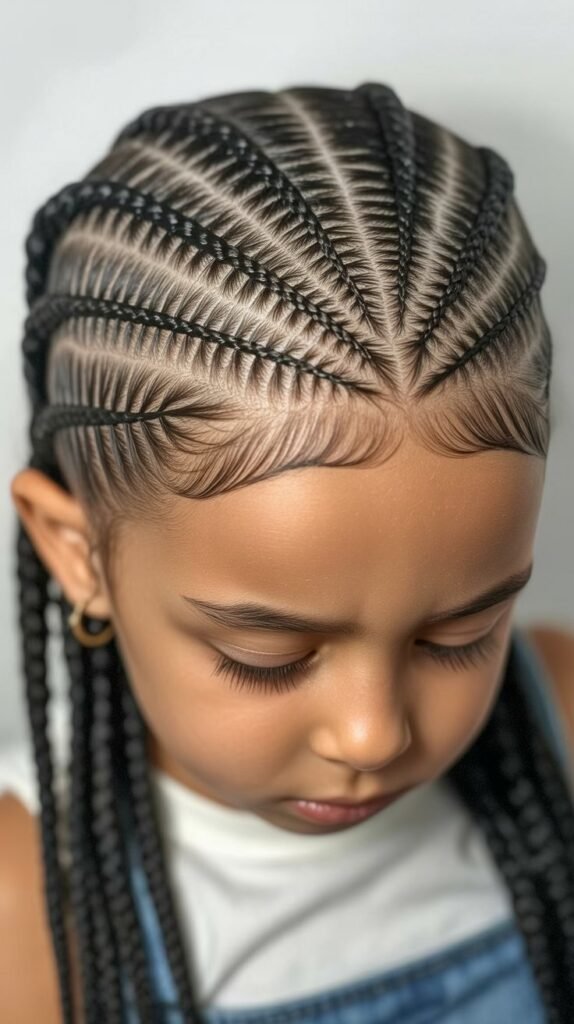
Stitch braids represent a refined cornrow technique characterized by a distinctive horizontal “stitched” appearance created by strategic hair feeding during the braiding process.
This style produces extremely neat, uniform cornrows with visible horizontal lines that resemble hand-stitching, hence the name.
The technique results in sleek, polished braids that lie exceptionally flat against the scalp, making them ideal for children who want a crisp, clean look.
Technique Details:
- As each cornrow is braided, hair is added in small, precise increments at regular intervals rather than continuously.
- This deliberate feeding creates visible horizontal indentations or lines across each braid, producing the characteristic stitched appearance.
- The tension must be consistent throughout to maintain uniformity in the stitch pattern and overall braid appearance.
- Stitch braids typically use extension hair to create longer, fuller braids with more pronounced stitching effects.
- The style requires an experienced braider with excellent technical skills to achieve the clean, precise lines that define proper stitch braids.
Aesthetic Qualities:
- Stitch braids have an exceptionally polished, professional appearance that works well for special occasions and formal events.
- The uniform stitching creates a sense of order and precision that appeals to those who prefer neat, structured styles.
- The technique works particularly well when creating patterns, as the clean lines enhance the visibility of geometric designs.
- Braids lie very flat against the scalp, making this an excellent choice for wearing under wigs, helmets, or sports equipment.
15. Cornrow Updo with Twists
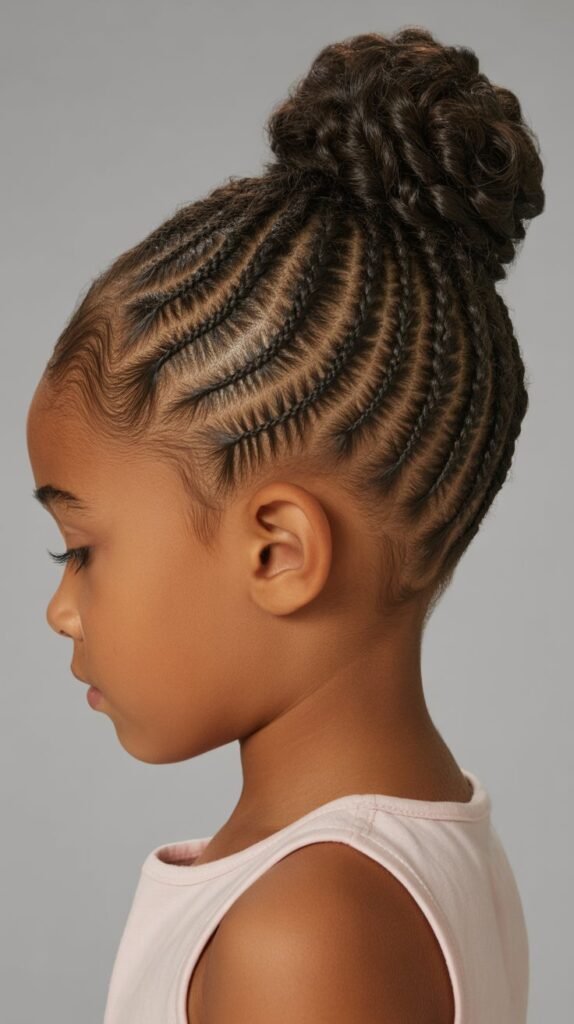
The cornrow updo with twists combines two classic natural hair techniques into one elegant protective style that offers both sophistication and versatility.
This hybrid approach features cornrows along the sides and back of the head that feed into loose two-strand twists gathered into an updo formation, creating a style that balances structured braiding with soft, textured twists.
The combination provides visual interest and works beautifully for both casual and formal occasions.
Construction Method:
- Cornrows are installed starting from the hairline and edges, braiding toward the crown or back of the head where they will transition to twists.
- Once cornrows reach the predetermined transition point, the braiding stops and the remaining loose hair is sectioned for two-strand twisting.
- The twists can be created using the child’s natural hair alone or with added extension hair for length and fullness.
- All twists are then gathered and pinned into an updo arrangement, which can take the form of a bun, pinned coils, or an artistic arrangement.
- The style effectively protects the hairline and edges with cornrows while allowing the crown area to showcase the texture and beauty of twist styling.
Updo Styling Options:
- Create a high bun with the twists wrapped in a circular pattern and pinned securely at the crown.
- Fashion a low gathered updo at the nape of the neck for a more understated, elegant appearance.
- Pin twists in various directions to create an artistic, asymmetrical updo with dimension and movement.
- Leave some twists loose around the face for a softer, more romantic framing effect.
16. Triangle Part Cornrows
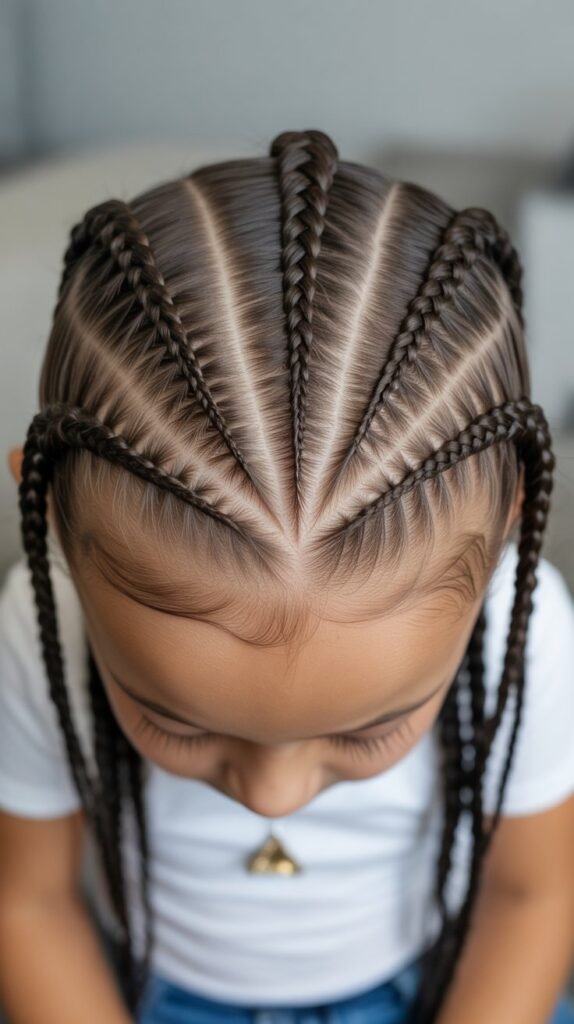
Triangle part cornrows transform the typically straight or curved parts between braids into precise triangular sections, creating a bold geometric pattern that adds architectural interest to the style.
This technique requires careful sectioning and precision but results in a striking visual effect that makes even simple cornrows look intricate and intentional.
The triangular sections create a distinctive pattern that’s visible even from a distance, making this a popular choice for children who want a style that stands out.
Parting Technique:
- Hair is sectioned into triangular shapes rather than traditional straight lines, with the point of each triangle facing either forward or backward.
- The triangles can be uniform in size for a consistent pattern or varied for a more eclectic, artistic appearance.
- Common arrangements include triangles with points facing the back, alternating forward and backward, or arranged in specific patterns.
- Each triangular section becomes one cornrow, with the braid following the natural direction established by the point of the triangle.
- Precision in creating sharp, clean triangular parts is essential for the pattern to remain visible and impactful.
Design Variations:
- All triangles pointing backward creates a sense of movement and direction across the entire head.
- Alternating triangle directions produces a zigzag or chevron-like pattern when viewed from above.
- Larger triangles can be used on top of the head with smaller triangles along the sides for variation in scale.
- The triangular pattern can be isolated to specific sections while other areas feature traditional straight parts.
17. Cornrow Crown
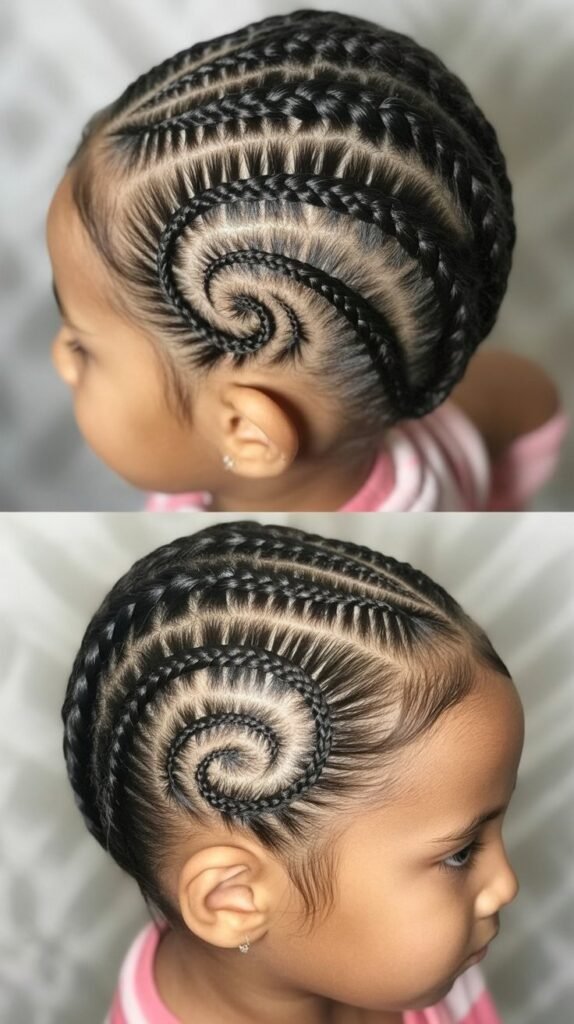
The cornrow crown creates a regal, circular pattern of braids that wrap around the head like a crown or halo, symbolizing royalty and elegance while providing excellent protection for natural hair.
This beautiful style can be created with cornrows forming a complete circle around the head or multiple concentric circles for a more elaborate effect.
The crown pattern has cultural significance in many African traditions and offers a timeless, sophisticated look appropriate for children of all ages.
Crown Formation:
- The style begins with a circular part around the crown area, isolating the center section from the perimeter hair.
- Cornrows are braided in a circular pattern, starting from the outer edge and working inward, or vice versa.
- Each subsequent row follows the circular path, gradually building the crown effect with multiple rings of braids.
- The very center can be finished with a small bun, a decorative bead cluster, or left with natural hair styled outward.
- The remaining hair outside the crown can be styled with additional cornrows, left loose, or incorporated into the crown design itself.
Styling Considerations:
- A full crown utilizes all the hair on the head, creating a complete circular braided pattern from hairline to center.
- A partial crown creates the circular pattern on top while leaving the sides and back with different styling options.
- Multiple concentric circles increase the intricacy and create a more elaborate, formal appearance.
- The crown can sit high on the head like a traditional crown or lower for a halo effect closer to the hairline.
18. Side Part Cornrows

Side part cornrows feature a deep, dramatic side part that creates asymmetry and visual interest while maintaining the clean, protective nature of traditional cornrow styling.
This versatile style offers a more contemporary, fashion-forward take on classic cornrows by incorporating the trendy side part that complements many face shapes and personal style preferences.
The deep part creates two distinct sections that can be styled identically or differently for varied effects.
Parting and Braiding:
- A deep side part is created, typically positioned 1-3 inches from the center of the head toward one side.
- The part can be perfectly straight for a clean, sharp look or slightly curved to follow the head’s natural contours.
- Cornrows on the smaller side are usually braided straight back or swept toward the larger side for a flowing effect.
- The larger side typically features more cornrows due to the increased hair volume, creating a fuller appearance.
- Both sections can be styled with identical cornrow patterns or different techniques for contrast and variety.
Style Advantages:
- The asymmetrical nature of the side part creates a modern, stylish appearance that feels current and trendy.
- This style works exceptionally well for children with cowlicks or strong natural growth patterns, as the part can be positioned strategically.
- The larger side draws attention and can showcase more intricate braiding patterns or decorative elements.
- Side part cornrows frame the face beautifully, highlighting facial features and creating a flattering silhouette.
19. Cornrows with Natural Hair Out
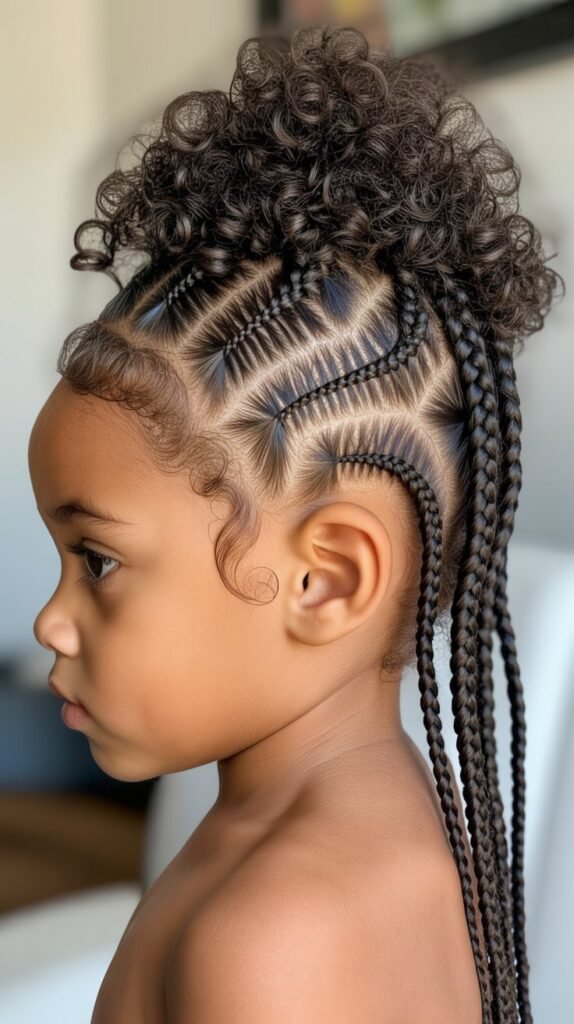
Cornrows with natural hair out combines the security and structure of cornrows with the freedom and texture of loose natural hair, creating a hybrid style that offers the best of both approaches.
This versatile technique typically features cornrows along the sides, back, or specific sections while leaving the top or crown area free to showcase natural curls, coils, or afro texture.
The result is a style that’s both practical and expressive, allowing children to enjoy their natural texture while keeping hair manageable.
Combination Approach:
- Cornrows are strategically placed in areas where hair control is most needed, such as along the hairline, temples, and nape.
- The top section is left loose and can be styled with wash-and-go techniques, twist-outs, braid-outs, or simply left in its natural state.
- The amount of hair left loose versus braided can be adjusted based on hair density, length, and the desired final appearance.
- This style works particularly well for transitioning children from looser styles to full protective styling, as it feels less restrictive.
- The loose section can be gathered into ponytails, puffs, or buns for additional styling versatility throughout the week.
Styling Benefits:
- Provides protection for fragile edges and hairline areas while allowing the healthiest hair to be displayed naturally.
- Offers daily styling flexibility, as the loose hair can be restyled multiple times without disturbing the cornrow foundation.
- Creates visual contrast between the sleek braided sections and the voluminous natural texture.
- Allows children to touch and play with their hair to some extent while still maintaining a protective base style.
20. Box Braids with Cornrow Base

Box braids with cornrow base represents a hybrid protective style that combines the foundation structure of cornrows with the versatility and movement of individual box braids.
This technique features cornrows installed along the perimeter of the head, particularly around the hairline and nape, while the center and majority of the hair is styled with traditional box braids that hang freely.
The cornrow base provides extra security and longevity while the box braids offer styling flexibility and the characteristic swing and movement that children love.
Construction Method:
- Cornrows are installed around the entire hairline, creating a protective border that secures the edges and prevents tension on delicate baby hairs.
- Additional cornrows may be placed along the nape, sides, and even in a circular pattern around the crown area for added structure.
- Once the cornrow base is complete, the remaining hair is sectioned into squares and braided into individual box braids using extension hair.
- The box braids can begin where the cornrows end, creating a seamless transition from flat braids to hanging braids.
- This style typically lasts 4-8 weeks, with the cornrow base providing stability that extends the overall lifespan of the style.
Design Benefits:
- The cornrow perimeter acts as a protective frame that safeguards the most vulnerable areas of a child’s hair from breakage and thinning.
- Eliminates the common issue of loose box braids creating tension on the hairline by distributing weight more evenly.
- Creates an aesthetically pleasing border effect that adds visual interest to what would otherwise be standard box braids.
- Allows for easier maintenance of the hairline and edges, as the cornrow sections can be moisturized and cared for separately.
- Provides the best of both worlds: the security of cornrows and the styling versatility of box braids.
Styling Versatility:
- The box braids can be styled in high ponytails, low ponytails, buns, or half-up styles without disturbing the cornrow base.
- The hanging braids can be curled with hot water setting techniques for special occasions and events.
- Different colors of extension hair can be used in the box braid section while keeping the cornrow base natural.
- The length of box braids can be customized based on the child’s preference and activity level.
21. Cornrow Bob Style

The cornrow bob style adapts the classic bob haircut silhouette into a protective braided format, creating cornrows that are cut or styled to end at a uniform length around chin or shoulder level.
This sophisticated style offers the chic, polished appearance of a bob while maintaining all the protective benefits of cornrow braiding.
The bob length is particularly practical for younger children and creates a neat, manageable style that frames the face beautifully without excessive length.
Style Construction:
- Cornrows are installed in the desired pattern, typically straight back or with a side sweep, using extension hair to achieve the target bob length.
- All braids are cut or naturally end at approximately the same point, creating a blunt or slightly layered perimeter line.
- The bob can fall at various lengths: chin-length for a short bob, just below the chin for a classic bob, or at shoulder length for a longer bob variation.
- The ends can be left as traditional braid tips, sealed with hot water for a blunt cut appearance, or curled for a softer finish.
- Face-framing pieces can be slightly shorter or left longer intentionally to create dimension and movement.
Bob Variations:
- An asymmetrical cornrow bob features one side longer than the other, creating a trendy, edgy appearance that children love.
- A stacked cornrow bob is shorter in the back and gradually longer toward the front, mimicking the popular stacked bob haircut.
- A blunt cornrow bob maintains one uniform length all around for a sharp, geometric silhouette.
- An angled cornrow bob slopes from shorter in back to longer in front, creating a classic A-line shape.
Practical Benefits:
- The shorter length reduces weight on the scalp and neck, making this style comfortable for extended wear.
- Bob-length braids are easier for children to manage independently as they learn to care for their own hair.
- The uniform length creates a polished, put-together appearance that works well for school and formal occasions.
- Reduced length means less time in the styling chair, making the installation process more bearable for younger children.
22. Fulani Braids
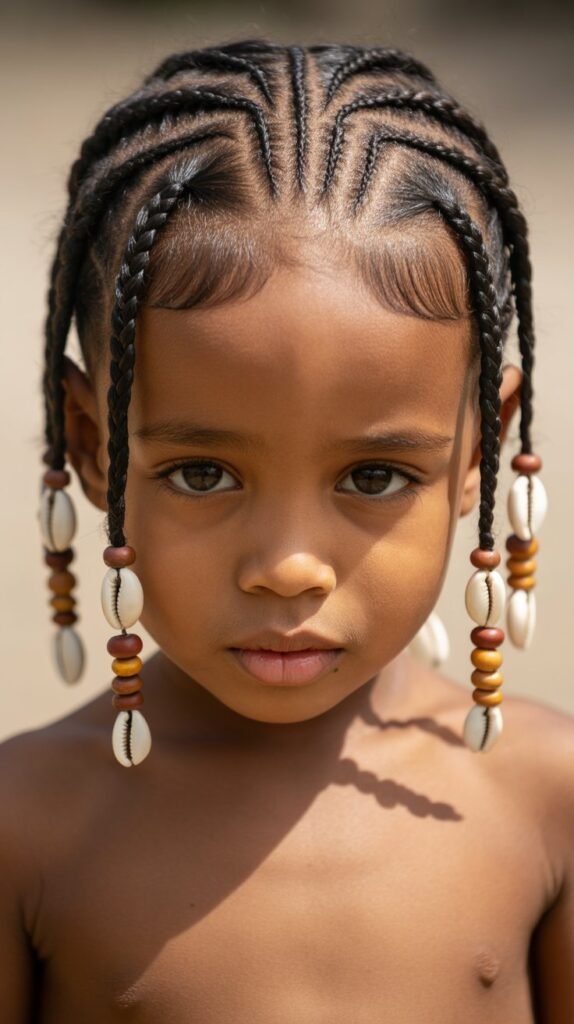
Fulani braids represent a distinctive West African braiding tradition characterized by specific patterns and styling elements that honor the Fulani people’s cultural heritage.
This style typically features a central cornrow or braids running front to back down the middle of the head, with additional cornrows on the sides, and decorative elements such as beads, cowrie shells, and hair jewelry.
The authentic Fulani style carries deep cultural significance and has gained widespread popularity for its unique aesthetic and beautiful adornments.
Traditional Elements:
- A signature center braid runs from the front hairline straight back to the nape, often starting with a small loop or curl at the front.
- Side cornrows typically run horizontally from the temples toward the back or curve gracefully following the head’s shape.
- Fine braids or twists frame the face on both sides, hanging loosely to create soft, feminine framing.
- Traditional adornments include cowrie shells, gold or silver beads, coins, and hair jewelry that carries cultural meaning.
- The style often incorporates both cornrows lying flat and hanging braids for textural contrast.
Cultural Significance:
- Fulani braids historically indicated tribal affiliation, age, social status, and marital status within Fulani communities.
- The braiding patterns and adornments were used to communicate identity and belonging.
- Creating this style connects children to African heritage and the rich traditions of hair artistry that span centuries.
- Respect for the cultural origins should be maintained when choosing to wear this traditional style.
Styling Characteristics:
- The central braid or braids create a striking vertical element that draws the eye and organizes the overall design.
- Side braids can wrap around the head like a halo or curve toward the back, creating movement and flow.
- Hanging braids are often medium to long in length, providing swing and versatility for different styling options.
- The decorative elements are essential to authentic Fulani braiding and should be thoughtfully selected and placed.
23. Cornrows into Space Buns

Cornrows into space buns creates a playful, youthful style that combines the security of cornrow braiding with the fun, trendy appearance of space buns positioned on either side of the head.
This energetic style has become increasingly popular among children and teenagers, offering a look that’s both protective and fashionable.
The combination of sleek cornrows leading into voluminous buns creates excellent textural contrast and a balanced, symmetrical aesthetic.
Construction Process:
- The head is parted down the center, dividing hair into two equal sections for symmetrical space buns.
- Cornrows are braided from the front hairline and sides of each section, directing all braids toward the intended bun placement point.
- The bun positions are typically on the upper sides of the head, above and behind the ears, though placement can be adjusted.
- Once cornrows converge at each bun location, the remaining loose ends are gathered, twisted, and wrapped into bun formations.
- Buns are secured with elastic bands and bobby pins, ensuring they remain stable during active play and daily activities.
Styling Variations:
- High space buns sit near the top of the head for a dramatic, statement-making appearance.
- Low space buns are positioned closer to ear level for a more subtle, understated interpretation.
- The size of buns can range from small, tight knots to large, voluminous puffs depending on hair density and extension use.
- Cornrow patterns leading to the buns can be straight, curved, zigzagged, or designed with creative patterns.
- Buns can be left smooth and neat or deliberately textured and messy for different aesthetic effects.
Personality Expression:
- This style allows children to express their playful, fun-loving personality through their hair.
- The symmetry of space buns creates a balanced, harmonious appearance that’s visually appealing.
- The style works well with colorful accessories, ribbons, or even LED hair accessories for special events.
- Perfect for children who love trendy, Instagram-worthy hairstyles that photograph beautifully.
24. Cornrow Pigtails
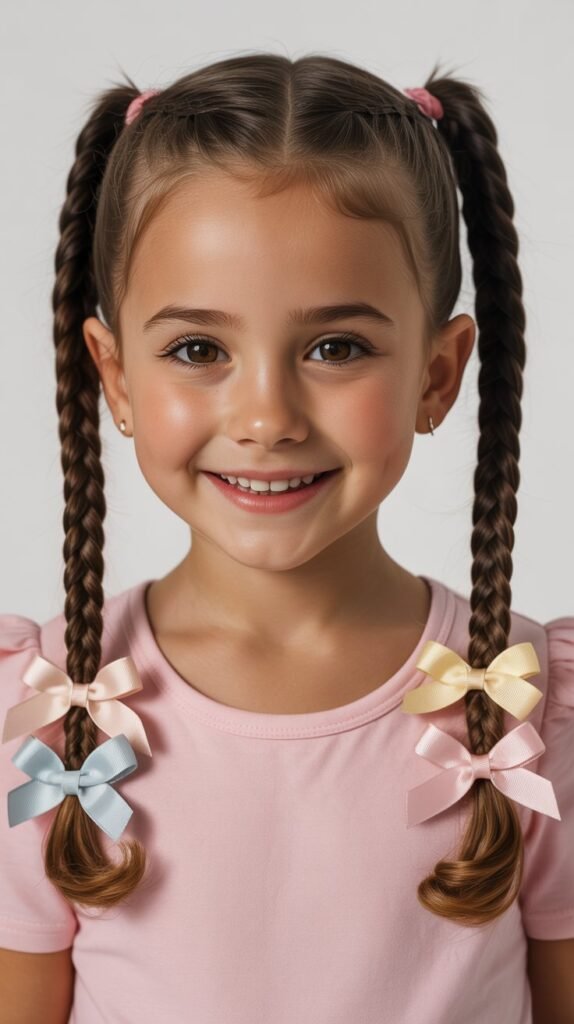
Cornrow pigtails transform the classic childhood pigtail style into a protective braided version that maintains the sweet, youthful charm while offering the benefits of cornrow styling.
This style features cornrows that converge into two gathered sections on either side of the head, creating pigtails that can hang freely, be styled with additional braiding, or adorned with accessories.
The symmetrical nature of pigtails creates a balanced, harmonious look that remains timeless and universally appealing.
Style Construction:
- The head is sectioned down the center, creating two equal halves for symmetrical pigtail placement.
- Cornrows are installed on each side, all directing toward the intended pigtail gathering point.
- Pigtails can be positioned at various heights: high near the crown, mid-level behind the ears, or low near the nape.
- The cornrows can follow straight paths, curved patterns, or creative designs before converging at the pigtail point.
- Once gathered, the loose ends can remain in braided form, be unraveled for texture, or styled with additional braiding or twisting.
Pigtail Placement Options:
- High pigtails create an energetic, youthful appearance perfect for younger children and active play.
- Mid-level pigtails offer a balanced, classic look that works well for school and everyday activities.
- Low pigtails provide a more sophisticated, understated version suitable for slightly older children.
- Asymmetrical pigtails at different heights create a trendy, contemporary twist on the traditional style.
Styling Enhancements:
- Wrap a small section of hair around each elastic band to conceal it and create a polished finish.
- Add coordinating bows, ribbons, or scrunchies to each pigtail for classic childhood charm.
- Thread beads onto individual braids within each pigtail for color and personality.
- Curl the ends of the pigtails for special occasions or leave them straight for everyday wear.
25. Cornrow Half-Up Half-Down
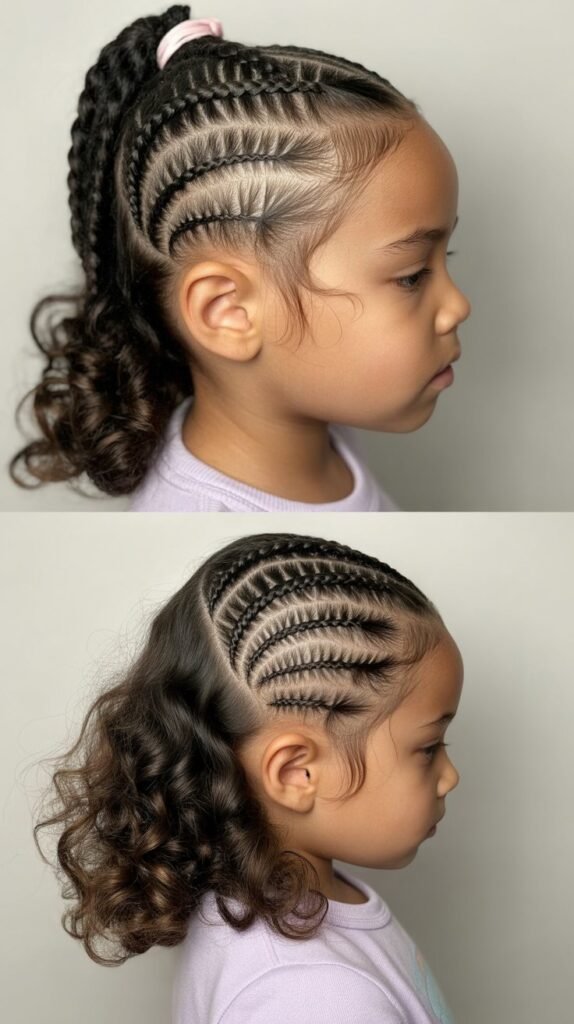
The cornrow half-up half-down style offers the perfect compromise between secured, controlled hair and loose, flowing texture, making it ideal for children who want styling versatility.
This approach features cornrows installed on the top portion of the head while leaving the bottom section loose to showcase natural texture, curls, or additional styling options.
The combination creates dimension, interest, and the flexibility to change the loose section’s appearance throughout the style’s lifespan.
Section Division:
- The head is horizontally divided, typically from ear to ear across the crown, creating distinct top and bottom sections.
- The top section is styled with cornrows that can follow various patterns: straight back, side-swept, or creative designs.
- The bottom section remains unbraided, allowing natural hair to be worn loose, twisted, or styled as desired.
- The division point can be adjusted higher or lower depending on how much hair should remain loose.
- This style works particularly well on children with medium to long hair lengths that provide substantial volume when worn loose.
Styling the Loose Section:
- Natural curls can be defined with curl cream or gel and left to air dry or diffused for volume.
- Two-strand twists can be installed in the loose section for added texture and a cohesive braided aesthetic.
- The loose hair can be gathered into a ponytail, leaving the cornrow top visible while controlling the bottom.
- Twist-outs or braid-outs can be performed on the loose section for stretched, defined curl patterns.
Practical Benefits:
- Provides the protective benefits of cornrows where they’re needed most while allowing natural hair to be visible and enjoyed.
- Offers daily versatility, as the loose section can be restyled multiple times without touching the cornrow base.
- Reduces overall styling time compared to full-head cornrow installations.
- Allows children to transition gradually to full protective styling by maintaining some loose hair.
26. Goddess Cornrows
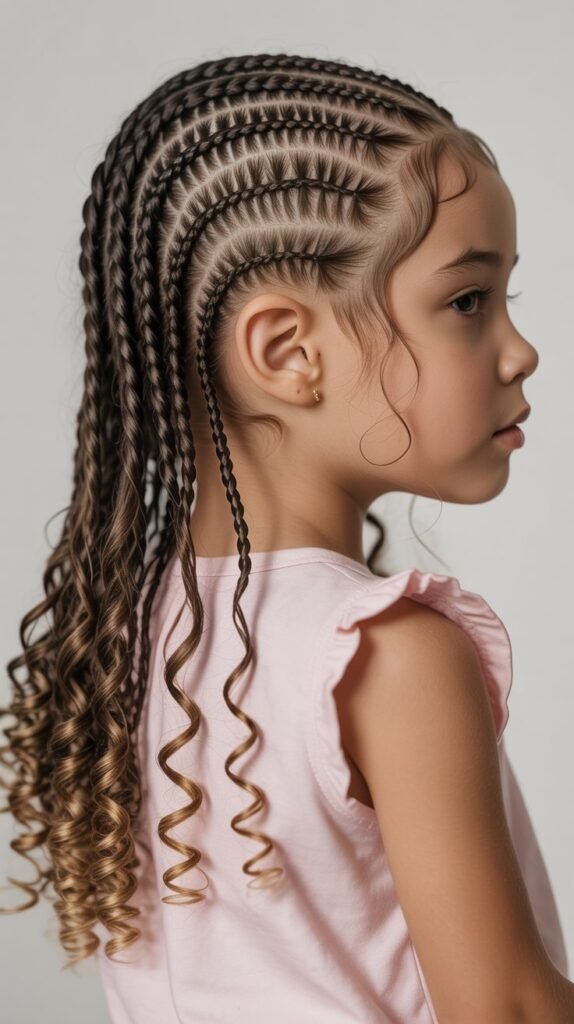
Goddess cornrows represent an elevated, romantic version of traditional cornrows that incorporates loose, curly hair left out at intervals along each braid, creating a soft, textured, and feminine appearance.
This style combines the structure and protection of cornrows with the flowing beauty of loose curls, resulting in a look that’s both bohemian and elegant.
The technique has gained tremendous popularity for its unique aesthetic that softens the typically sleek appearance of standard cornrows.
Construction Technique:
- Cornrows are braided normally but at strategic intervals, sections of hair are intentionally left out of the braid instead of being incorporated.
- These left-out sections naturally curl and spiral outward from the cornrow base, creating a curly halo effect along each braid.
- The frequency of leaving hair out can be adjusted: more frequent releases create a fuller, curlier appearance while less frequent releases produce a subtler effect.
- Extension hair with pre-curled ends is often used to enhance the goddess effect and add length and fullness.
- The style works best on naturally curly or coily hair textures that will spiral beautifully when released from the braid.
Styling Characteristics:
- The juxtaposition of sleek, flat cornrows with soft, flowing curls creates beautiful textural contrast.
- Goddess cornrows have a romantic, dreamy quality that works wonderfully for special occasions and photo sessions.
- The loose curls add significant volume and dimension to the overall style, making it appear fuller and more elaborate.
- This style offers movement and bounce that traditional tight cornrows don’t provide.
Maintenance Considerations:
- The loose curls require regular moisturizing to prevent dryness and maintain their defined, springy appearance.
- Nighttime care involves both protecting the cornrow base and preserving the curl pattern with a silk or satin covering.
- The loose sections may require occasional refreshing with water and curl cream to revive the curl definition.
- This style typically lasts 2-3 weeks, slightly less than traditional cornrows due to the loose curl component.
27. Cornrows with Colored Extensions

Cornrows with colored extensions add vibrant personality and creative expression to traditional cornrow styling by incorporating extension hair in various colors, creating a style that’s both protective and visually striking.
This approach allows children to experiment with temporary color without any chemical processing or potential damage to their natural hair.
The color options are virtually limitless, ranging from subtle highlights to bold rainbow effects that showcase individuality and creativity.
Color Selection Options:
- Single color extensions create a uniform, coordinated look that can match favorite colors, school colors, or seasonal themes.
- Ombre effects blend natural hair color at the roots into vibrant color at the ends, creating a gradual transition.
- Two-tone combinations use alternating colors in different braids, creating a striped or patterned effect across the head.
- Rainbow or multi-colored approaches incorporate three or more colors for a bold, playful, festival-inspired appearance.
- Pastel shades offer a softer, more subdued approach to colored extensions that still provides visual interest.
Application Methods:
- Colored extension hair is added during the cornrow braiding process, blended with natural hair from the start.
- The color can begin at the roots for full-color braids or be introduced partway down for a color-blocked effect.
- Different colors can be used in different sections of the head, creating intentional color zones or patterns.
- Metallic or neon extensions create especially eye-catching effects for special occasions and performances.
Creative Possibilities:
- Holiday-themed colors such as red and green for Christmas, orange and black for Halloween, or pastels for Easter.
- Sports team colors showing school spirit or supporting favorite professional teams.
- Birthstone colors or colors that hold personal significance to the child.
- Coordinating colors that match specific outfits for special events or photo sessions.
28. Micro Cornrows
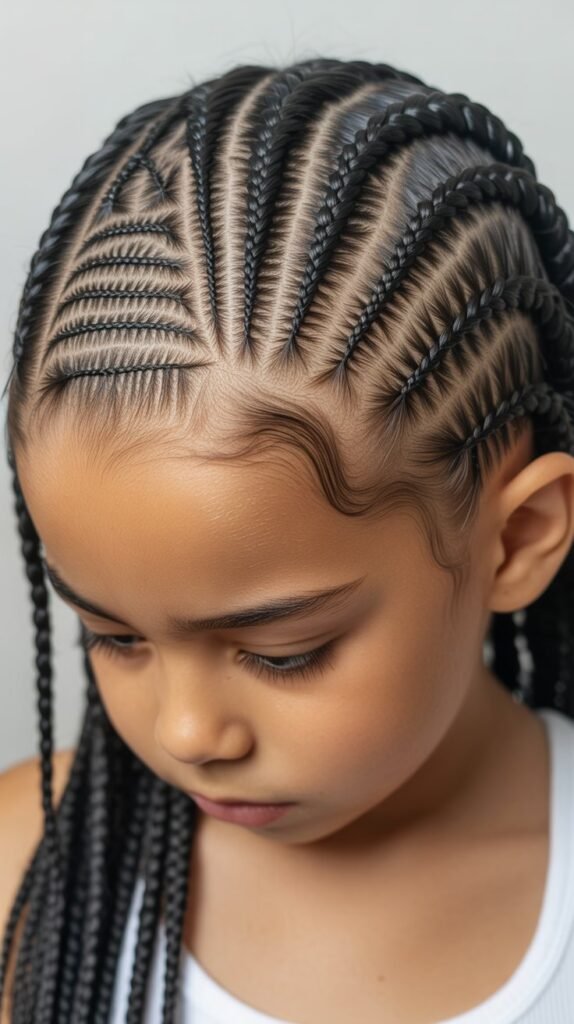
Micro cornrows represent the delicate, precision-focused end of the cornrow spectrum, featuring extremely thin braids that create intricate, detailed patterns with remarkable longevity.
These tiny braids require significant time, patience, and technical skill to install but reward the investment with a sleek, refined appearance and extended wearability.
Micro cornrows work particularly well for children with fine to medium hair textures and those who need a long-lasting protective style.
Technical Specifications:
- Micro cornrows are typically pencil-thin or smaller, with some styles featuring braids as thin as a few millimeters in width.
- The increased number of braids results in installation times of 4-8 hours depending on head size and desired style complexity.
- These tiny braids distribute tension more evenly across the scalp due to the increased number of anchor points.
- Micro cornrows can last 4-8 weeks with proper maintenance, significantly longer than standard-sized cornrows.
- The small size allows for extremely intricate patterns and designs that would be impossible with larger braids.
Styling Advantages:
- The abundance of thin braids creates exceptional coverage and a very neat, polished appearance from all angles.
- Micro cornrows provide more styling versatility, as the thin braids can be gathered, twisted, and arranged in numerous ways.
- The lightweight nature of individual micro braids reduces overall tension despite the style’s longevity.
- These small braids create beautiful, detailed patterns that showcase the braider’s technical expertise and artistry.
Considerations:
- The extended installation time requires children to sit patiently for several hours, which may be challenging for younger ages.
- Micro cornrows work best on children who can commit to proper nighttime care and avoid excessive manipulation.
- The thin size means each braid is more delicate and may be more prone to frizzing than thicker braids.
- Professional installation is highly recommended for micro cornrows to ensure proper tension and technique.
29. Cornrow Faux Hawk with Curls
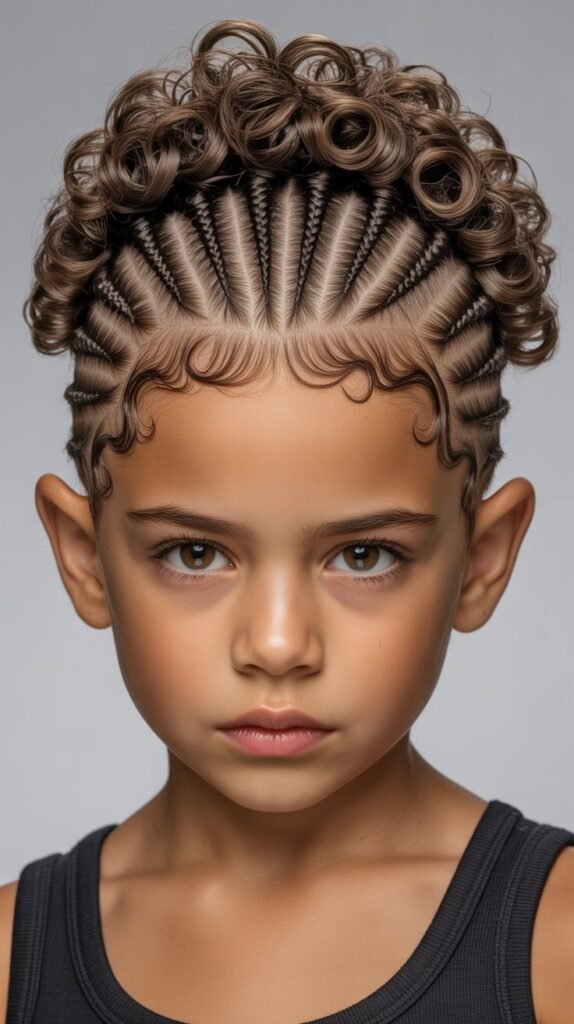
The cornrow faux hawk with curls combines edgy structure with soft, romantic texture by featuring tight cornrows along the sides that create a faux hawk silhouette while leaving the center strip styled with loose curls or naturally textured hair.
This creative hybrid style offers the bold visual impact of a mohawk without the commitment of shaving or dramatically altering the hair, making it perfect for children who want an adventurous look that can be easily modified or transitioned to other styles.
Style Architecture:
- Both side sections of the head are braided with tight cornrows that run horizontally toward the back, lying flat against the scalp.
- The center strip, typically 2-4 inches wide, is left unbraided and styled to emphasize height, volume, and curl definition.
- The width of the center section can be adjusted based on hair density and the desired prominence of the faux hawk effect.
- The cornrow sections effectively create the illusion of shaved sides, making the center section appear more dramatic by contrast.
- The curly center can be styled upward, allowed to fall naturally to one side, or arranged in various directions for different effects.
Center Section Styling:
- Natural curls can be enhanced with curl-defining products and diffused for maximum volume and definition.
- Two-strand twists can be installed in the center section and unraveled for a twisted-out curl pattern.
- Bantu knots or roller sets can create uniform, springy curls throughout the center mohawk strip.
- The curls can be left loose and free or pinned up into an updo for a different aesthetic within the same base style.
Personality and Expression:
- This style allows children to embrace a bold, confident aesthetic that stands out in any crowd.
- The combination of structured sides and free-flowing curls represents a perfect balance of control and creativity.
- Works exceptionally well for performances, dance recitals, or special events where making an impression is desired.
- The style can be easily modified by changing how the center section is arranged without redoing the cornrow base.
30. Jumbo Cornrows
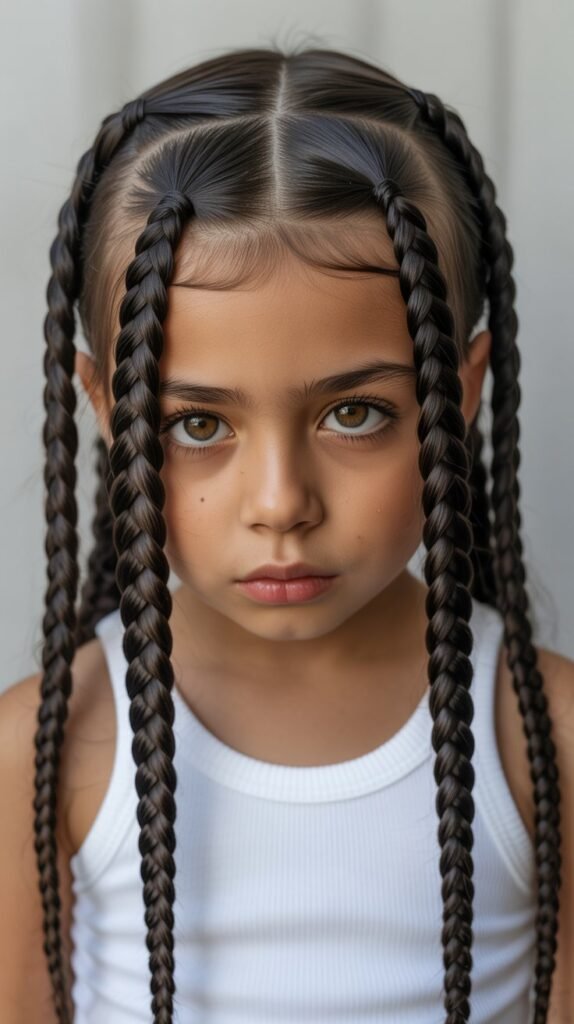
Jumbo cornrows embrace a bold, statement-making approach to cornrow styling by featuring thick, chunky braids that create a dramatic visual impact while significantly reducing installation time.
This style works beautifully for children with thick, dense hair and appeals to those who prefer a more relaxed, bohemian aesthetic over the precision of smaller braids.
Jumbo cornrows celebrate the beauty of larger-scale braiding and offer excellent versatility despite their substantial size.
Size and Scale:
- Jumbo cornrows are typically finger-width or larger, with some styles featuring braids as thick as two fingers side by side.
- A complete jumbo cornrow style may include only 4-8 braids total, compared to 10-20+ for standard cornrows.
- The reduced number of braids means installation can be completed in 30 minutes to 2 hours, making it ideal for children with limited patience.
- Despite their size, jumbo cornrows should still maintain proper tension distribution to avoid excessive pulling on any single area.
- The large size creates a bold, graphic quality that makes even simple straight-back patterns appear intentional and stylish.
Styling Characteristics:
- The thickness of jumbo braids creates a strong visual presence that works well for fashion-forward, trendy looks.
- Large braids can be gathered into chunky ponytails or buns that make a substantial statement.
- The substantial size allows for easier bead addition, as larger beads can be accommodated without sliding off.
- Jumbo cornrows have a relaxed, effortless vibe that contrasts with the precision of micro or standard-sized braids.
Practical Aspects:
- The quick installation time makes this style perfect for busy families or last-minute styling needs.
- Jumbo cornrows typically last 1-2 weeks, shorter than smaller braids, but the reduced installation time balances this trade-off.
- The larger size means fewer braids to moisturize and maintain, simplifying the care routine.
- This style works particularly well as an introduction to cornrows for children trying protective styling for the first time.
31. Cornrow Crown with Center Bun
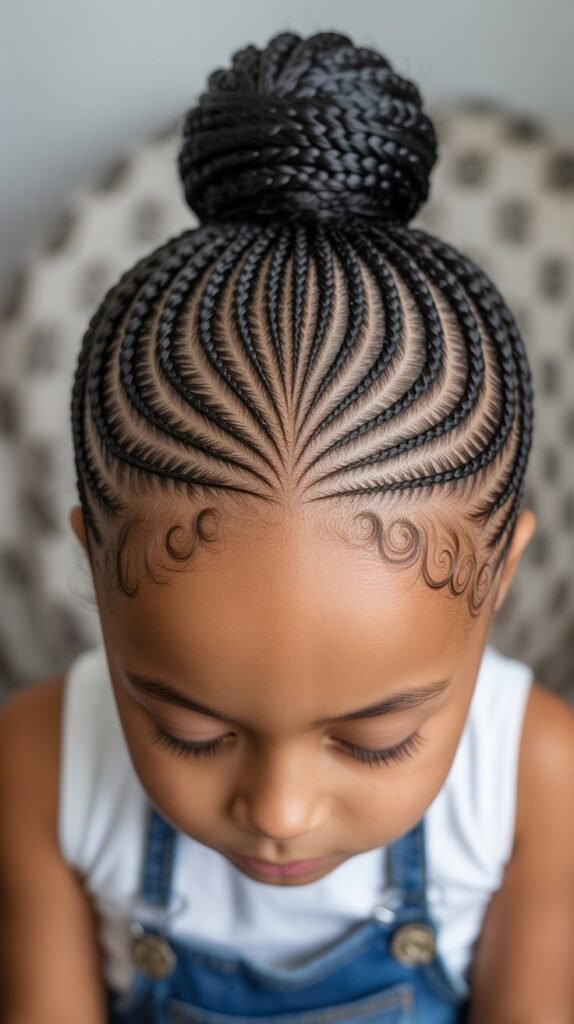
The cornrow crown with center bun creates a regal, sophisticated protective style that combines circular cornrow patterns with a gathered bun at the crown’s center point.
This elegant style draws the eye toward the center of the head where all design elements converge, creating a focal point that can be adorned and embellished for extra impact.
The circular pattern symbolizes unity and completeness while the central bun adds height and dimension to the overall silhouette.
Construction Method:
- A circular section is parted at the crown of the head, establishing the boundaries for the central bun area.
- Cornrows are braided in concentric circles around this central point, or in patterns that radiate from or flow toward the center.
- Each subsequent row of cornrows follows the circular path, gradually building the crown effect.
- Once all cornrows converge at the central point, the remaining loose ends are gathered and styled into a bun.
- The bun can be smooth and sleek or textured and voluminous depending on preference and hair density.
Circular Pattern Variations:
- Perfect concentric circles create a target-like pattern that emphasizes symmetry and precision.
- Spiral patterns begin at the center and swirl outward, creating a hypnotic, dynamic effect.
- Multiple starting points with cornrows flowing toward the center create a starburst or sunburst pattern.
- The circular rows can vary in spacing, with tighter circles near the center and wider circles toward the perimeter.
Center Bun Styling:
- A high, voluminous bun creates a crown-like appearance that enhances the regal quality of the style.
- A flat, spread-out bun emphasizes the circular cornrow pattern by remaining proportional to the design.
- The bun can be wrapped with decorative ribbon, adorned with a large decorative pin, or left simple and natural.
- Small braids from the bun can be left hanging to frame the face or add additional movement.
32. Cornrow Halo Braid
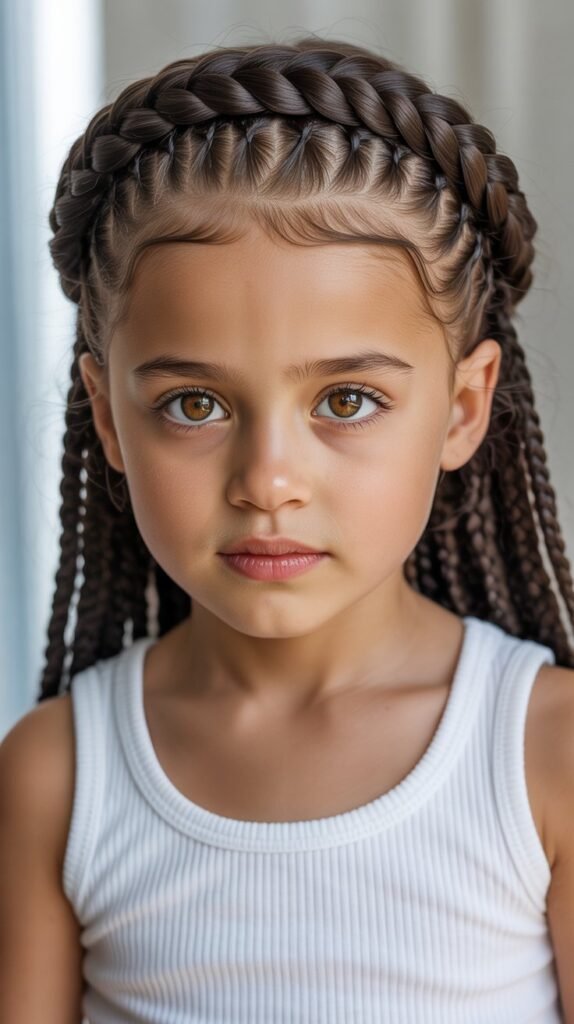
The cornrow halo braid creates an angelic, ethereal protective style featuring a continuous cornrow that wraps around the entire head like a crown or halo, symbolizing innocence, beauty, and grace.
This stunning style can be created with a single continuous braid that circles the head or multiple cornrows arranged to create the halo effect.
The circular nature of the design ensures even tension distribution and creates a timeless, elegant appearance suitable for formal occasions, religious ceremonies, or everyday wear.
Halo Construction:
- The style typically begins at one point near the temple or behind the ear and braids continuously around the head.
- The cornrow follows the hairline’s natural curve, creating a circular path that ends near the starting point.
- The halo can sit directly along the hairline for a tighter, more defined look or slightly away from the edges for a softer effect.
- The braid end is typically tucked under the beginning section and pinned securely to create a seamless, continuous appearance.
- Additional hair in the center of the head can be styled separately or incorporated into the halo pattern.
Single vs. Multiple Halos:
- A single thick halo braid makes a bold, graphic statement and emphasizes the circular crown shape.
- Double halos feature two parallel cornrows circling the head, creating a more elaborate, detailed pattern.
- Triple or multiple halos fill more of the head and create a very intricate, ornate appearance.
- The space between multiple halos can be left with natural hair or filled with additional styling elements.
Styling the Interior:
- The hair inside the halo can be left loose in its natural texture for a soft, romantic contrast.
- Interior hair can be styled into a bun, ponytail, or updo that sits within the protective halo frame.
- Additional small braids or twists can fill the interior space while maintaining the prominent halo border.
- For very full styles, the entire head except the halo path can be braided in a different pattern or direction.
Symbolic and Aesthetic Appeal:
- The halo design carries spiritual and angelic symbolism that makes it particularly meaningful for religious occasions and ceremonies.
- Creates a frame around the face that draws attention to facial features and expressions.
- The continuous circle represents wholeness, protection, and unity in many cultural traditions.
- This style photographs beautifully from all angles, making it ideal for special events and portraits.
Conclusion
The journey through these Best 32 Cornrow Hairstyles for Kids with Natural Hair demonstrates the incredible versatility, beauty, and cultural richness that cornrow styling offers to children and their families.
From the timeless simplicity of classic straight-back cornrows to the intricate artistry of tribal patterns and the contemporary flair of goddess cornrows with colored extensions, each style presents unique opportunities for creative expression while maintaining the essential protective qualities that keep natural hair healthy and thriving.
These styles honor the deep African heritage of braiding traditions while adapting to modern aesthetic preferences and practical considerations that fit children’s active lifestyles, whether they’re attending school, playing sports, performing in recitals, or celebrating special occasions.
The protective nature of cornrows cannot be overstated—these styles significantly reduce daily manipulation, minimize breakage, protect delicate edges, and allow natural hair to grow and flourish while giving children the confidence that comes from wearing beautiful, well-maintained hairstyles.
Parents and caregivers will find options suitable for every skill level, from beginner-friendly styles that can be mastered with practice to advanced techniques that showcase professional-level artistry and precision.
The maintenance requirements for cornrow styles remain relatively simple compared to daily styling routines, requiring only regular moisturizing, gentle cleansing, and proper nighttime protection to extend the life of each style and keep hair healthy underneath.
Beyond the practical benefits, cornrows connect children to a powerful legacy of hair artistry that spans generations and continents, teaching them to appreciate and celebrate their natural hair texture while exploring the limitless creative possibilities that braiding offers.
Whether you choose simple, understated styles for everyday wear or elaborate, decorated designs for memorable occasions, cornrows provide a foundation for healthy hair practices that will serve children well throughout their lives.
The key to success with any cornrow style lies in proper technique, appropriate tension, quality products, consistent maintenance, and most importantly, allowing children to participate in choosing styles that make them feel confident, comfortable, and authentically themselves.
As you explore these 32 styles and begin incorporating cornrow techniques into your hair care routine, remember that practice improves skill, patience yields beautiful results, and every braid represents an opportunity to celebrate the natural beauty and versatility of textured hair while creating lasting memories and strengthening bonds between caregivers and children through the intimate, nurturing act of hair care and styling.
